
The Highest-Rated Horsepower In A Production Six-Cylinder Engine
Six-cylinder engines have quietly powered some of the most compelling machines in automotive history — and they continue to punch above their weight. From mid-range sports cars to luxury sedans like those in Lexus’ famously reliable lineup, the layout has always offered an appealing balance of smoothness, efficiency, and performance. But how far can a six-cylinder actually be pushed in a production car? The answer, it turns out, is further than most people expect.

While many high-performance machines have historically leaned on V8s or V12s for outright power, the rise of forced induction and hybrid drive has steadily changed that calculus. A handful of engineers have wrung genuinely supercar-grade outputs from just six cylinders — and the results are worth examining closely.
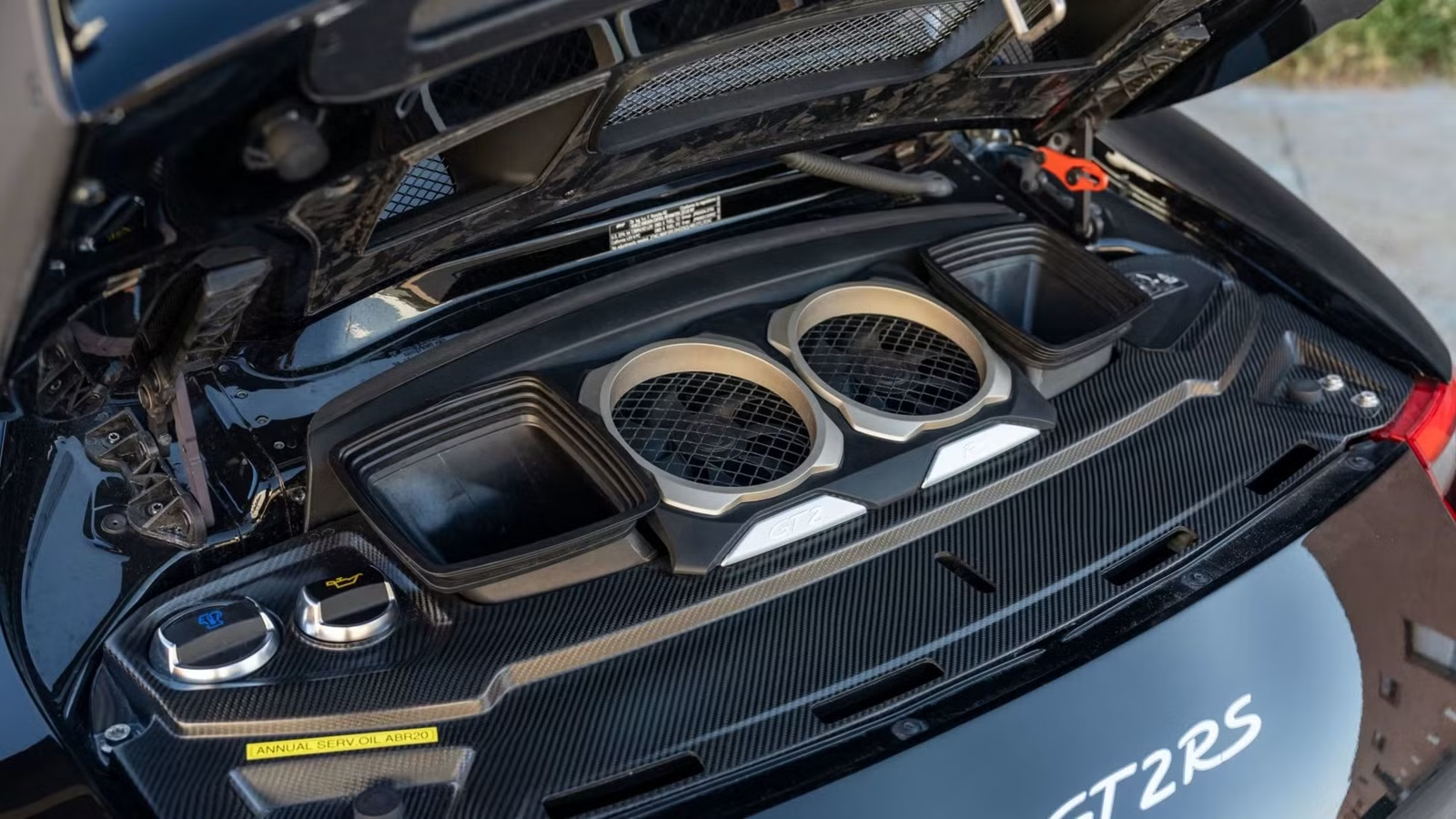
Twin-Turbocharged Flat-Six In 2018 Porsche 911 GT2 RS Leads The Pack
2018 Porsche Flat Six
|
Configuration |
 75 autotech Twin-turbo Flat-Six |
|
Displacement |
3.8-liters (231 ci) |
|
Power |
690 hp |
|
Torque |
553 lb-ft |
(Source: Porsche)
It may be unsurprising to many gearheads that the leader in this regard is German performance powerhouse Porsche. The marque has been using its unique flat-six engine layout, which consists of having three cylinders mounted longitudinally on either side of the crankshaft, since it first introduced its legendary 911 sports car back in 1964.
It didn’t take the brand long to begin searching for ways to extract more power from its little 2.0-liter engine, and it soon found a way to hit a 3.0-liter displacement. Then, in 1974, Porsche introduced the game-changing 911 Turbo. This was its first attempt at adding forced induction to the mix, and it continues to develop the turbocharged model alongside naturally aspirated variants to this day.
It wasn’t finished yet though, as in 1992, nearly 30 years after the 911 first broke cover, Porsche unleashed the GT2. Built essentially as a homologation special for the manufacturer’s exploits in GT racing, the 993 GT2 featured a twin-turbocharged version of its 3.6-liter flat-six, which made a hefty 424 hp.
Proving popular with its customers, the GT2 has remained a mainstay of Porsche’s 911 range ever since. As a result, Porsche continually tweaked the recipe until we finally arrived in 2018. By this point, Porsche was also offering an RS version of the GT2, which was a lighter, more hardcore version of the breed. Pretty much a race car for the road, one of the biggest talking points of the vehicle was its mighty powerplant.
Despite sharing the same twin-turbocharged 3.8-liter flat-six as the Turbo S, which sent 580 hp to the rear wheels, the 2018 GT2 RS had a formidable 690 hp at its disposal. As well as being the most powerful 911 ever at the time of its launch, the GT2 RS’ powerplant also stands as the most powerful six-cylinder engine ever fitted to a production car.
Keen to push the envelope further than ever, Porsche elected to allow some of its very clever engineers from its racing division to work their magic on the 3.8-liter flat-six. A change that had one of the biggest effects was a pair of brand-new turbos, which gave 22.5 psi of boost. A set of bespoke new pistons also helped make it possible to reduce the compression ratio to 9.0:1, down from 9.5:1 in the Turbo S.
This meant Porsche didn’t have to run the engine as hard to achieve high RPMs, allowing its engineers to raise the rev limit to 7,200 rpm. The higher ceiling meant more power hidden within the engine could be unleashed. The marque also managed to develop a new intake manifold to help boost grunt even further.
Porsche made the manifold longer and with a smaller diameter, while the intake was a little shorter than in the Turbo S. The brand’s engineers found that this altered profile changed the way the air oscillated in the combustion chamber, with the result being that the air/fuel mixture remained cooler. This meant it could be ignited more effectively, yielding another meaningful boost in power.
To help keep the flat-six running in optimal shape, Porsche also developed a system that sprays cool water onto its intercoolers. This helps to keep engine temperatures down, which means the engine can continuously produce maximum power even under consistent stress, such as on a racetrack. According to Porsche, the system engages when the air intake temperature hits 122 degrees Fahrenheit, with the throttle at least 90% engaged and the engine above 3,000 RPM.
This drops temperatures by a useful 20 degrees, allowing the engine to run consistently and reliably at its maximum power output. The technology isn’t entirely new — Subaru employed a similar approach in its celebrated Impreza 22B back in the late 1990s — but it remains highly effective. All these advancements resulted in the GT2 RS’ 110 hp power boost over the engine it started with. Its 690 hp figure is therefore enough to make it the most powerful production six-cylinder powerplant ever made.
EcoBoost Engine In Ford GT Not Far Behind

2022 Ford EcoBoost V6
|
Displacement |
3.5-liters (213 ci) |
|
Power |
660 hp |
|
Torque |
550 lb-ft |
(Source: Ford)
Most would be forgiven for associating the ‘EcoBoost’ name with one of Ford’s economy vehicles like an Edge, or perhaps a Focus for European buyers. The American automotive giant, however, deployed its efficiency-focused technology in the latest version of its GT supercar, which launched in 2016.
The car was developed to take the company back to the fabled 24 Hours of Le Mans endurance race, which it won on four consecutive occasions with the GT’s GT40 predecessor between 1966 and ’69. The program delivered success almost immediately, with the GTE version of the vehicle claiming a historic victory in the 2016 running of the race — exactly 50 years after its first win at the classic event.
The 647 hp twin-turbocharged 3.5-liter V6 in the road-going GT made it the most powerful of its kind when it first launched, though the 911 GT2 RS would soon eclipse it a couple of years later. The final version of the powerplant featured a few enhancements, according to Ford, such as gallery-cooled pistons and higher-energy ignition coils, lifting power to 660 hp.
The V6 is a serious piece of engineering. The block and cylinder heads, pistons, and intake manifold were all constructed with weight savings in mind, while the connecting rods were produced from tough forged steel. It featured a dual-overhead-camshaft layout with a compression ratio set to 9.0:1. All these elements combined to make its 660 hp and 550 lb-ft of torque figures possible, allowing it to secure the runner-up spot in this metric behind the mighty Porsche.
With many hypercars now pairing six-cylinder engines with powerful electric powertrains, it seems only a matter of time before the 700 hp combustion-only barrier is breached. With Porsche known to be working on a next-generation GT2, it wouldn’t be a shock to see it push the target even further out of reach.
Sources: Porsche, Ford, Mecum Auctions

Related posts

Latest Post


No Comments