
The Honda Motorcycle Engine That Refuses To Die
Few engines in motorcycle history have achieved the level of trust earned by Honda’s legendary small displacement powerplant. For more than six decades, this compact engine has carried commuters, workers and businesses across countless countries while proving that reliability often matters more than outright performance.

Its story is not built around speed, technology or exclusivity, but around intelligent design and real-world usability. From busy city streets to remote rural roads, this remarkable engine has demonstrated an ability to deliver dependable transportation year after year, establishing Honda as one of the world’s most respected motorcycle manufacturers.
The Tiny Honda Engine That Changed Transportation Forever
When Honda introduced its ground-breaking small motorcycle engine in 1958, it was not chasing speed records or racing success. Instead, the company focused on creating simple, dependable and affordable transportation that could be used by almost anyone. The engineering goal was to build a machine that was easy to operate, economical to run and durable enough to withstand daily use in demanding conditions.

Developed under the leadership of Soichiro Honda and Takeo Fujisawa, the compact four-stroke engine became the foundation for a global transportation revolution. Its combination of practicality, reliability and accessibility helped Honda expand motorcycle ownership far beyond traditional enthusiasts, proving that thoughtful engineering could have a profound social impact.
It Became The Best Selling Motorcycle (and vehicle) In History

The Honda Super Cub’s incredible success is reflected in one remarkable achievement: it is the best-selling motor vehicle ever produced. Honda celebrated production of the 100 millionth Super Cub in 2017, less than six decades after the model first entered production, and the total has since surpassed 110 million units. Built in factories across Japan, Thailand, Vietnam, Indonesia, China, India and other countries, the Super Cub became a truly global product sold in more than 160 markets.
Its success was driven by a combination of affordability, exceptional fuel efficiency, easy operation and proven dependability. Used by commuters, businesses, postal services and delivery operators around the world, it became far more than just a motorcycle. The Super Cub became a symbol of practical mobility, helping millions of people access reliable personal transportation.
Some Super Cubs Have Covered Hundreds Of Thousands Of Miles

The Super Cub’s reputation for longevity is not built on marketing claims but on the experiences of owners who continue to rack up extraordinary mileages. One of the best documented examples is British rider Ed March, who has traveled more than 110,000 miles on a Honda Super Cub he bought for just £150 ($200).
Rather than preserving the motorcycle, March has subjected it to some of the harshest conditions imaginable, riding across Europe, Asia, Africa and the Americas on demanding overland expeditions. Despite its modest 90-cc engine and minimalist design, the Super Cub has repeatedly proven capable of enduring extreme climates, rough terrain and years of continuous use with routine maintenance.
Stories like March’s reinforce why the Super Cub has earned a legendary reputation for durability. While many motorcycles are designed to deliver excitement, Honda’s greatest achievement may be its ability to keep running long after others have reached the end of the road.

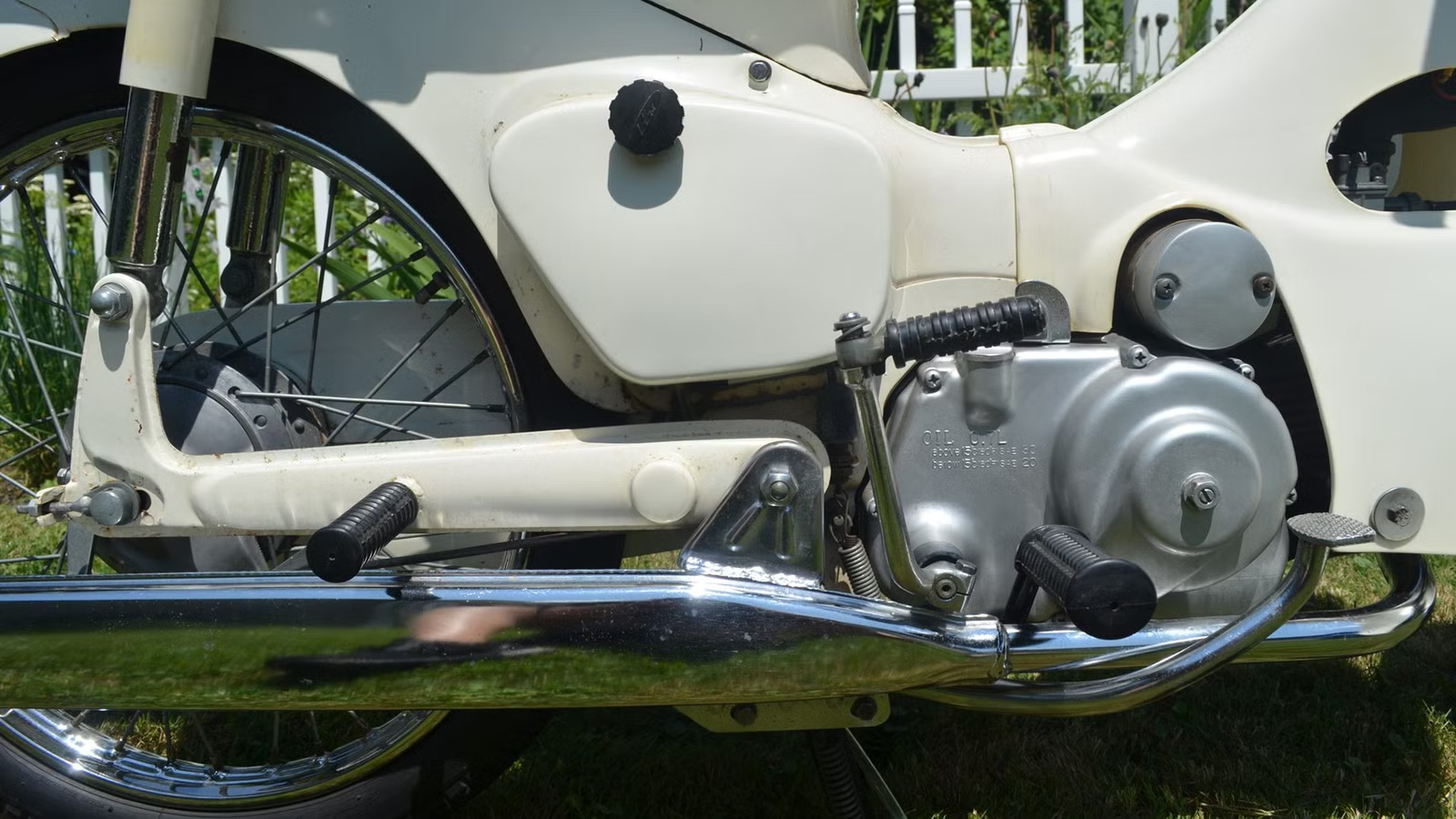
The secret behind the Super Cub’s legendary durability lies in its remarkably simple engineering. From the beginning, Honda equipped the motorcycle with an air-cooled, horizontal single-cylinder four-stroke engine that prioritized reliability over outright performance.
The horizontal layout helped keep the center of gravity low while allowing efficient cooling airflow around the cylinder, reducing thermal stress during prolonged use. Equally important was the Super Cub’s semi-automatic transmission, which used a centrifugal clutch to eliminate the need for a manual clutch lever. This not only made the bike easier for beginners to ride but also reduced the likelihood of clutch abuse, extending the life of the drivetrain.
Rather than extracting maximum power from the small displacement engine, Honda tuned it conservatively, keeping internal stresses low and fuel efficiency high. The result was an engine capable of running reliably for years with little more than routine oil changes, valve adjustments and basic maintenance.
Honda Built An Engine That Almost Anyone Could Maintain

A major reason the Super Cub engine has earned such an enviable reputation is that Honda designed it to be as easy to maintain as it was to ride. Routine servicing requires only basic tools, with straightforward jobs such as changing the oil, adjusting the valves and replacing the spark plug well within the abilities of most owners.
The engine’s uncomplicated air-cooled design also eliminates components such as radiators, coolant hoses and water pumps, reducing both maintenance requirements and potential failure points. Just as importantly, Honda has produced the Super Cub in enormous numbers for more than six decades, ensuring replacement parts remain widely available and relatively inexpensive in many parts of the world.
Even aftermarket suppliers offer a huge selection of affordable components, making repairs economical long after many motorcycles would have become too costly to keep on the road. That combination of simplicity, accessibility and low running costs has helped cement the Super Cub’s legendary status.
Performance Was Never The Priority
The Super Cub’s engine was never designed to impress with headline-grabbing performance figures. The original 49-cc C100 produced only around 4.5 bhp, while later 110-cc and 125-cc versions remained focused on efficiency and reliability rather than outright speed.
However, this modest output was central to Honda’s durability strategy. By avoiding high compression ratios, aggressive camshafts and extreme engine tuning, Honda kept internal stresses remarkably low. The engine did not have to operate near its limits to deliver useful everyday transportation, meaning components such as the crankshaft, bearings and piston experienced less strain over thousands of miles.
This low stress approach allowed the Super Cub to survive constant use in demanding environments, from busy Asian cities to rural communities. Honda’s achievement was not creating the most powerful small motorcycle engine, but one that could reliably deliver practical mobility for generations.
Decades Of Continuous Development Kept The Super Cub Relevant

Although the Super Cub’s basic philosophy has remained unchanged since 1958, Honda has continuously refined the motorcycle to meet modern demands. The original C100 introduced a simple 49-cc air-cooled engine and semi-automatic transmission, but subsequent generations increased displacement, improved reliability and adopted modern technology.
The latest C125, introduced in 2018, retains the Super Cub’s familiar horizontal single cylinder layout while adding fuel injection, electronic ignition, improved combustion efficiency and cleaner emissions. Honda also strengthened the chassis, upgraded suspension and improved rider comfort without abandoning the simplicity that made the original so successful. This careful evolution allowed the Super Cub to comply with increasingly strict emissions regulations while maintaining its reputation for durability and ease of use. Rather than replacing a successful formula, Honda demonstrated that thoughtful engineering improvements could keep a near seven-decade concept relevant in the modern motorcycle market.
More Than Six Decades Later, The Formula Still Works

Decades after its introduction, the Honda Super Cub remains in production because the qualities that made the original successful are still valued today. While modern motorcycles have gained advanced electronics, higher performance and greater complexity, millions of riders still need affordable, economical and dependable transportation.
The Super Cub continues to deliver exactly that combination through its lightweight design, exceptional fuel efficiency, easy operation and proven durability. Its influence can be seen throughout the small displacement motorcycle market, where manufacturers continue to prioritize reliability, accessibility and low running costs.
The Super Cub proved that a motorcycle does not need extreme performance or complicated technology to have a lasting impact. By focusing on practical engineering and everyday usability, Honda created a machine that transcended generations and became a blueprint for reliable personal transportation around the world.
Sources: Global.Honda, Bring a Trailer,

Related posts



Latest Post


No Comments