The Mainstream Hatchback That Feels More Luxurious Than Cars Costing Twice Its Price
11 minutes reading
Monday, 14 Sep 2026 03:15 0 38 autotech
BMW, Cadillac, Audi, Mercedes-Benz, and Porsche: these are the brands we shop for when we want a luxury car within a relatively reasonable budget. They offer some of the best cabins on the market, the best engines, the most fun driving experiences, and a lot of respect on the road. However, today, the mainstream market and the luxury one are crossing over.
Some Hatchbacks Just Feel More Expensive Than They Are
Front action shot of 2026 Volkswagen Golf GTI driving on roadVolkswagen
In a market where mainstream and luxury are getting harder to distinguish between, generally well-priced segments like the hatchback segment are getting rather good at punching above their weight. The 2026 Volkswagen Golf GTI is the obvious example of a performance car that feels more expensive than its circa $36,000 price tag suggests.
It gets a 241-horsepower/273-pound-feet 2.0-liter turbo, a seven-speed DSG, and an electronically controlled limited-slip differential. Inside, it’s fancier than you’d expect from a hot hatch as well; you get a 12.9-inch infotainment screen and an available Harman Kardon audio rig.
Shot of 2026 Kia K4 Hatchback interior showing front cabinTopSpeed | Michael Frank
Then there is the new Kia K4 Hatchback GT-Line Turbo, which takes its circa $30,000 sticker price and raises the game with a 190-horsepower turbo-four, an eight-speed auto, sport-tuned rear suspension, a cabin with 29.6 inches of digital displays, and a power sunroof. For something that costs much less than a BMW or Audi, you still get an awful amount of car.
Premium Materials Can Make An Affordable Car Feel Upscale
Close-up shot of 2026 Honda Civic Hybrid sedan interior showing dashboardHonda
Luxury is not created by leather seats alone. The way a car looks parked, how it responds when you turn the wheel, how quietly it cruises, and even the weight of a door as it shuts can all make it into something upscale. However, the cabin is where the feeling has to hold together.
It is where you spend your time, and a good interior can make you want to buy some models before even driving them. This is why marques are putting so much effort into the cabins of affordable cars today. The new Civic Hatchback can be kitted out with leather-trimmed seats, a nine-inch touchscreen is available, and a 12-speaker Bose system can be added.
Shot of 2025 Volkswagen GLI interior showing front cabinLyndon Conrad Bell | TopSpeed
None of these mainstream examples can be described as luxury cars, but they do show that you can now get a lot in terms of cabin tech and finery without having to pay silly money for it. It is no longer the case that we ask if an affordable car can have expensive-looking features, but whether it can combine them with performance and design to make something that feels far more luxurious than its price suggests.
The 2026 Mazda3 Delivers Luxury Feels For Less
A 2026 Mazda 3 hatchback being driven on a hilly roadMazda
Available in six trims, the 2026 Mazda3 Hatchback is the sporty hatchback to look for if you want finery without having to pay for it. The available trims of this Mazda3 Hatchback are the 2.5 S, the 2.5 S Select Sport, the 2.5 S Preferred, the 2.5 S Carbon Edition, the 2.5 S Premium, and the 2.5 Turbo Premium Plus. Prices range from $25,650 to $38,090.
A Cabin That Scores 4.3 Out Of 5 From Owners — And Costs Less Than A Base Audi A3
Shot of 2026 Mazda3 interior showing front cabinMazda
At the center of every good luxury car is the interior. It wouldn’t be much good without a comfortable cabin, somewhere you want to spend time in, and the new Mazda3 Hatchback nails it. You get a driver-focused cockpit, a quiet ride inside thanks to two-wall construction between the floor carpet and the body panels, and a clean dash design. The entry-level model gets cloth-trimmed sports seats, a leatherette steering wheel, and dual-zone climate control, and even though Mazda saves the proper leather stuff for higher trims, it still looks and feels nice to be in.
Even the cheapest model gets an 8.8-inch display, an eight-speaker audio rig, Apple CarPlay, and Android Auto. The Select Sport brings leatherette seats, while the Preferred gets heated seats, an eight-way power driver’s seat, and a power moonroof. The Carbon Edition looks sportier with some very nice red leather seats.
Front shot of 2026 Mazda3 interior showing front cabinMazda
At the top of the range is the Premium, which is equipped with leather seating and a 12-speaker Bose system, while above that is the Turbo Premium Plus. This trim gets the full-fat treatment with a 10.25-inch display, a 360-degree monitor, wireless smartphone connectivity, wireless charging, a heated steering wheel, and paddle shifters.
According to owner reviews on Kelley Blue Book, people seem very happy with the interior, and have rated it 4.2 out of 5 for comfort, and 4.3 out of 5 for styling. Bear in mind the starting price for the fanciest trim is still below $40,000, while something like the new Audi A3 has a starting price of just over $40,000 for the base trim. It is nice, but expensive in comparison.
Mazda’s Kodo Design Philosophy Gives The Mazda3 A Presence That Turns Heads At Any Trim Level
Rear 3/4 shot of Mazda Mazda3 hatchback driving on roadMazda
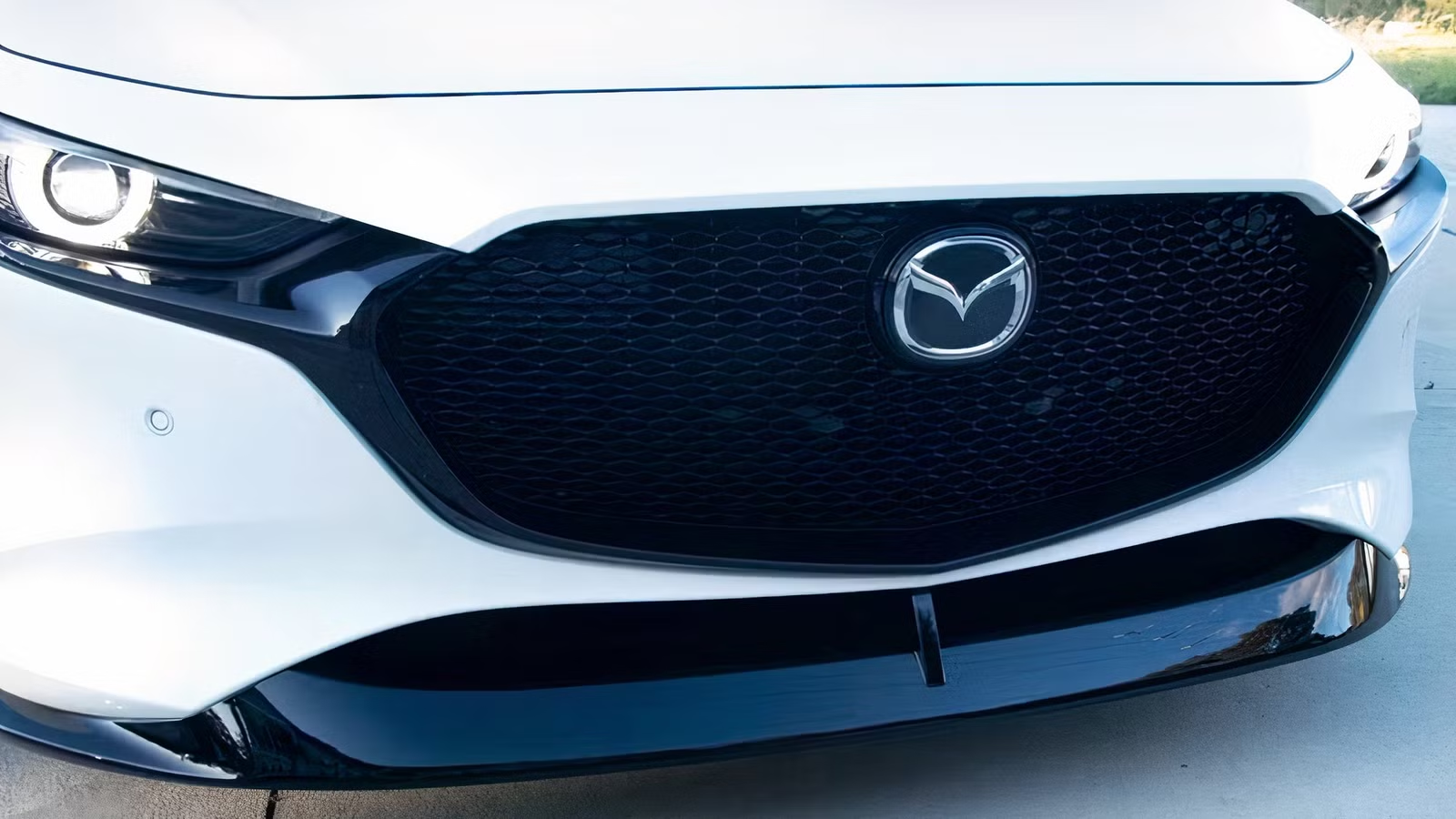
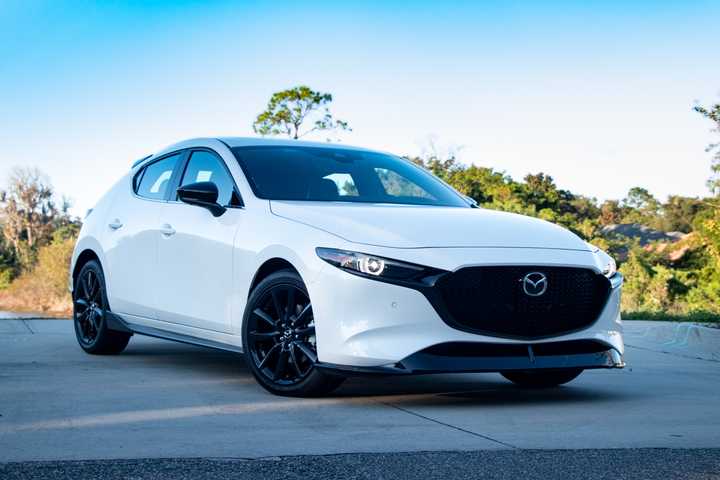
While German sedans and American luxury cars may steal attention immediately, the new Mazda3 Hatchback is the kind of car that looks better the more you look at it. Mazda’s Kodo design philosophy gives it a long nose, heavily sculpted sides, sharp lights up front, tight packaging, muscular body lines, and a chunky rear end, while the black rear spoiler and matte-black grille keep it from looking too sensible for a budget-friendly hatchback.
LED headlights and daytime running lights are standard, so even the cheapest trim gets a certain look that can take attention away from the bigger players. The trim changes are mostly about making the shape a little more interesting. With the Select Sport, you get 18-inch black alloys and black heated mirrors; the Preferred swaps in gray metallic 18-inch wheels; and the Carbon Edition is arguably the sweet spot.
Front action shot of 2026 Mazda3 Hatchback driving on canyon roadMazda
Here you get black 18-inch wheels and gloss-black heated mirrors, available with Jet Black Mica, Snowflake White Pearl Mica, or Polymetal Gray Metallic paint schemes. The Premium is equipped with black-finish 18-inch wheels, signature LED headlights and taillights, while the Turbo Premium adds black aerodynamic accents, a rear spoiler, and a front air dam.
It may not be one of the fastest hatchbacks on the market at the moment, but it certainly looks sporty and distinctive considering how much you have to pay for it. Even at the low end. The styling gets you to look. But the part that keeps you from walking away is what happens when you actually drive it.
The Mazda3 Backs Up Its Looks With Real Driving Talent
A parked 2026 Mazda 3 hatchback 3/4 frontMazda
We can’t consider the new Mazda3 a hot hatch the way we do something like the Golf, but it does have some tricks up its sleeve in the performance department. There are two engine options this year. A 2.5-liter Skyactiv-G naturally aspirated inline-four good for between 186 and 191 horsepower (dependent on driveline) and 186 pound-feet of torque is standard in the non-turbo models. A 2.5-liter Skyactiv-G turbocharged inline-four good for 227 horsepower when run on regular gas, and 250 horsepower when run on premium gas, is standard in the Turbo model.
Torque output of the turbo engine is also dependent on what gas you run it on, with regular gas allowing it to wind out 310 pound-feet of torque, and the premium stuff allowing for 320 pound-feet. The Mazda3 is one of the only models in 2026 to offer a manual transmission as well.
Close-up shot of 2026 Mazda3 Hatchback engine bayMazda
As standard, a six-speed automatic (with paddle shifters) is equipped for all trims, but you can also opt for a six-speed manual in all trims except for the Turbo model. Rest-to-60 times of the NA models are tepid at around 7.3 to 7.6 seconds, depending on whether you opt for FWD or AWD, while the Turbo model is genuinely impressive with 0–60 mph times of 5.9 seconds with regular gas and 5.5 seconds with premium gas.
Sporty Handling Gives The Mazda3 An Edge Over Its Rivals
Rear shot of Mazda3 hatchback parkedMazda
As most hatchbacks dictate, front-wheel drive is standard for all non-turbo models. The Turbo model is only available with all-wheel drive. AWD models are equipped with Mazda’s i-Activ system, which constantly monitors things like wheel loads, steering input, and acceleration to determine where the grip is, then sends torque to the wheel that can use it best. It can even decouple the rear axles when extra traction isn’t needed, and helps to reduce drag.
Rear 3/4 action shot of 2026 Mazda3 Hatchback driving on canyon roadMazda
Underneath, the Mazda3 gets MacPherson struts up front and a torsion beam rear. It isn’t quite a hot hatch in disguise, but the steering is very sharp for its class and will make you want to go out and actually drive it. A recent TopSpeed review of the Mazda3 Hatchback sums up the surprisingly tight steering nicely.
Nevertheless, this car can really get after it on your favorite curvy road and is truly fun-to-drive if not particularly sophisticated in its manners. The seating position is low but the forward visibility is good, the steering is light and precise and the turbo’s power delivery is more linear than expected; there’s even a subtle but gutsy exhaust sound to accompany it.
The Mazda3 Makes Premium Cars Look Overpriced
A side profile view of a 2026 Mazda 3 hatchback in motionMazda
Should you buy a new Mazda3 Hatchback over more typically luxurious cars out there? If you want immediate on-road looks, no; if you want to spend the least amount of money but still get a very good deal of luxury appointments and something a little different, yes. If you are happy with paying stereotypically German costs, there is no need to buy one; if you want sensible ownership costs, you’re best off looking at one of these.
The lower starting prices than the likes of the new Series 3 ($48,000), the new CT4 ($37,795), and the new C-Class ($51,000) look appealing, but you should keep in mind that performance is likely going to be a tad more exciting in these luxury models. However, now that prices in all our lives seem to have gone up, some luxury living at a lower cost looks more and more like a savvy move.
Profile shot of 2026 Mazda3 interior showing cabinMazda
Mazda has a relatively good relationship with dependability as well; the new Mazda3 Hatchback is rated 77 out of 100 for reliability on J.D. Power. It is estimated by RepairPal to cost you $433 a year for maintenance; something like the Audi A4 will cost you, on average, $739 a year for maintenance. Then there is lifespan.
iSeeCars says the Mazda3 has an expected lifespan of 155,129 miles or 14.1 years, a very impressive 17.8 percent chance of reaching 200,000 miles with proper maintenance, and an overall reliability rating of 8.4 out of 10.
Profile shot of 2026 Mazda3 Hatchback parkedMazda
The Mazda3 Hatchback isn’t trying to be a BMW or an Audi, and that is why it works so well. It gives you the bits that actually matter daily: a cabin you enjoy sitting in, styling with a bit of attitude, and enough mechanical character to keep a back road interesting. It also keeps the useful dimensions and manners that make hatchbacks a sensible choice in the first place.
Yes, there are the likes of the GR Corolla and Golf GTI that offer more power and driving excitement, but the Mazda3 Hatchback is the kind of little car that offers a lot without making you second-guess the purchase.
Base Trim Engine
2.5L SKYACTIV-G I4 ICE
Base Trim Transmission
SKYACTIV-Drive 6-speed automatic
Base Trim Drivetrain
Front-Wheel Drive
Base Trim Horsepower
186 HP @6000 RPM
Base Trim Torque
186 lb.-ft. @ 4000 RPM
Base Trim Fuel Economy (city/highway/combined)
26/34/29 MPG
Make
Mazda
Model
Mazda 3 Hatchback
Segment
Compact Hatchback
Sources: Mazda, iSeeCars, J.D. Power, Kelley Blue Book, RepairPal, and FuelEconomy.gov.










No Comments