
The Tiny Honda Kei Car With A 9,000-RPM Engine
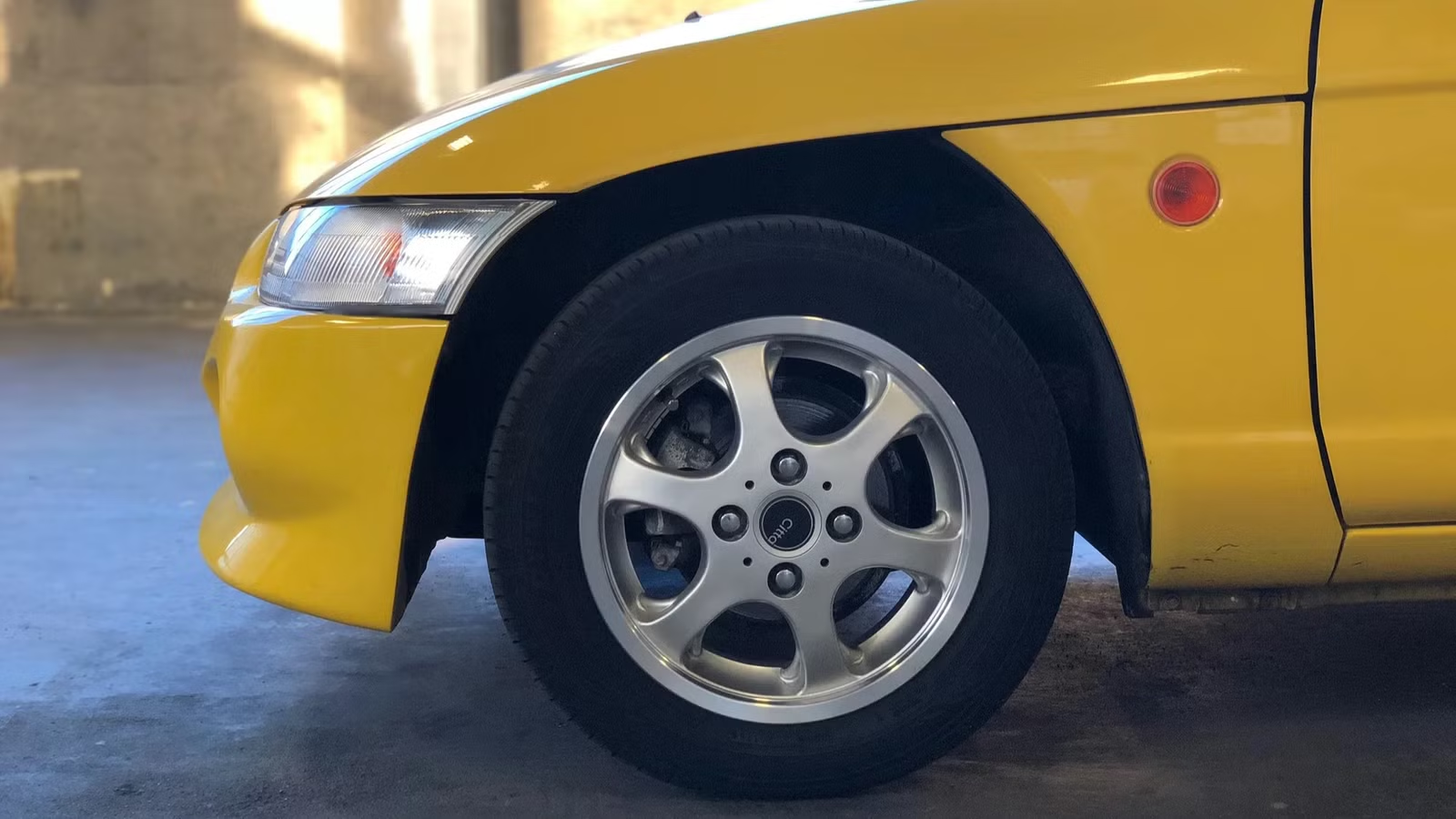
Out of all the Japanese automakers, Honda has perhaps gained the best reputation for making enthusiast-centric cars. Even fairly mundane Hondas have received praise for being fantastic to drive. That driver-focused approach is perhaps illustrated the best in one of Honda’s smallest and quirkiest cars to date. Built to a specific set of stringent regulations that were designed to create affordable cars in the Japanese domestic market, this tiny car quickly became an enthusiast favorite.
Japan’s Kei Car Niche Has A Whole Host Of Quirky Vehicles

There aren’t many Japanese Cars that are more emblematic of the uniqueness of the Japanese domestic car market than Kei cars. These tiny vehicles are designed to very specific regulations that you don’t see anywhere else. Those regulations were originally written in 1949, and were intended to both help create cheap cars for the masses and to help Japan’s car industry grow. To fit within these regulations, cars have to fit within very specific size specifications (11.2 feet in length, 4.9 feet in width and 6.6 feet in height) and must have an engine size no bigger than 660 cc. There’s also a gentleman’s agreement that these engines can’t be any more powerful than 63 hp. If a car meets these Kei regulations, they’re cheaper to tax and insure. They’re also free from the requirement of needing a dedicated parking space.
A result of these strict regulations is that you get a whole host of quirky cars, microvans and mini-trucks that you’d never see anywhere else. Many Kei cars end up looking like quirky boxes on wheels, due to designers wanting to make as much space as possible out of the limited dimensions. Because there are no restrictions on what kind of drivetrain they can have, quite a few vehicles built to the Kei regulations have all-wheel drive.
Quite A Few Kei Cars Are Sports Cars, Specifically Designed For Enthusiasts


While Kei cars are mainly designed to be utilitarian daily drivers, that isn’t always the case. The Kei car regulations do allow for models that are a bit more fun, and geared more towards enthusiasts. That’s thanks to the rules not specifying what body styles Kei cars can be, or how many seats they must have. Turbocharging is also allowed on their tiny engines, so long as it doesn’t push them over the gentleman’s agreement regarding power. Some manufacturers do take advantage of this, and design sports cars that manage to fit within the ultra-restrictive Kei rules.
A few of these Kei sports cars have ended up becoming proper enthusiast favorites. That includes the Daihatsu Copen (a surprising favorite among tuners who love to outlandishly customize their cars), and the car we’re going to talk about now. This car has become absolutely beloved by JDM aficionados. When you learn more about it, it’s not hard to see why.
The Honda Beat Is One Of The Most Beloved Kei Sports Cars Ever

If you know even a tiny bit about Japanese Kei cars, you’ll know about the Honda Beat. This tiny sports car has gained a legendary reputation. That’s made it incredibly sought-after by the small niche of Kei car enthusiasts, especially outside of its native Japan (the only place where it was officially sold).
Thanks to those required Kei car dimensions, it’s very small (10 feet 9.7 inches long, 4 feet 7.9 inches wide and 3 feet 10.3 inches high, with a wheelbase of 7 feet 5.8 inches) and very light (1,676 pounds). It’s also mid-engined with the engine being transversely mounted (giving it the best possible weight distribution for a small sports car), and rear-wheel drive. That alone is a recipe for a fantastic, pure driver’s car. But there’s even more to the Beat’s appeal, if we take a look at what’s sitting there in the middle.
It Has A Tiny Engine That Loves To Rev

A big part of why people absolutely love this car is its engine. You’d think it might not be that fun, due to the size and power limits of Kei car engines. But it’s still a proper Honda engine from the ’90s, and it has all those classic Honda engine qualities people love. That includes it absolutely loving to rev. The Honda Beat’s 656 cc inline-3 will happily scream up to 9,000 RPM, giving it an almost motorcycle quality. It’s able to do this thanks to surprisingly racy internals. It has an MTREC (Multi Throttle Responsive Engine Control) system, using individual throttle bodies for all three cylinders. This is a setup that comes from Honda’s background in motorcycle racing — those motorbike-style engine characteristics, therefore, aren’t that surprising. That engine sends its power to the wheels through a 5-speed manual transmission.
Surprisingly for a Kei sports car, the Honda Beat doesn’t have a turbocharger. All 63 horsepower and 44 lb-ft of torque is pure, naturally aspirated power. That gives it even more enthusiast appeal, as it’s got the pure power band and throttle response of a naturally aspirated unit. Combine that with the Beat’s rear-wheel drive and the ability to have it with a manual transmission, and this really is a pint-sized version of a classic pure sports car.
It Was The Final Car Soichiro Honda Personally Signed Off On
While the Honda Beat is a fantastic piece of engineering and incredibly fun to drive, that’s not the only big enthusiast appeal behind this Kei-sized pocket rocket. It’s got a lot of sentimental value as part of the story of Honda as a company, too. The Beat was the final car that the company’s founder Soichiro Honda personally signed off on. As a result, it’s the last Honda to have been designed, developed and signed off on according to the philosophy of Honda’s founder. That puts it in a similar position for Honda as the F40 is for Ferrari – the F40 was the final car that Enzo Ferrari signed off on.
It’s Still A Bargain On The Used Market

The Honda Beat has become a very desirable car among JDM enthusiasts in recent years. But it’s still a bit of a used bargain. The average used value for a Honda Beat today is only around $8,251. Even on the more expensive end of things, Beats typically sell for less than $10,000 (this example sold for $9,600). Will those prices stay that cheap for long? Likely not. But, if you’ve ever wanted to own a Beat, right now could be the right time to go for it.
Honda Made A Spiritual Successor For It Years Later
While the Beat went out of production in 1996, Honda clearly didn’t forget about it. That’s because in 2015, Honda launched a proper spiritual successor to it. Called the S660, it shares a lot of similarities with its ’90s predecessor. It fits within the same Kei regulations, and it has the same drivetrain setup (a transverse mid-engined layout with rear-wheel drive). It even has the same power output. The big difference with that power now is that it comes from a turbocharged inline-3 instead of a naturally aspirated one.
It uses the newer S07A Turbo engine, which is also used in more powerful versions of the Honda N-One and N-Box. Like the Beat, true driving enthusiasts could have a proper manual transmission (this time, a 6-speed manual), with the old automatic transmission being replaced by a CVT with 7 simulated gears.
Sadly, the S660 is no longer around either. The final examples were made in 2022. It was also only ever made available for Japanese buyers, in the same way the Beat was. North American enthusiasts will, sadly, still have to wait quite a while to be able to import one of these.
Sources: Bring A Trailer, Classic.com, Honda

Related posts


Latest Post


No Comments