
The First American V8 To Actually Break 450 Horsepower May Surprise You
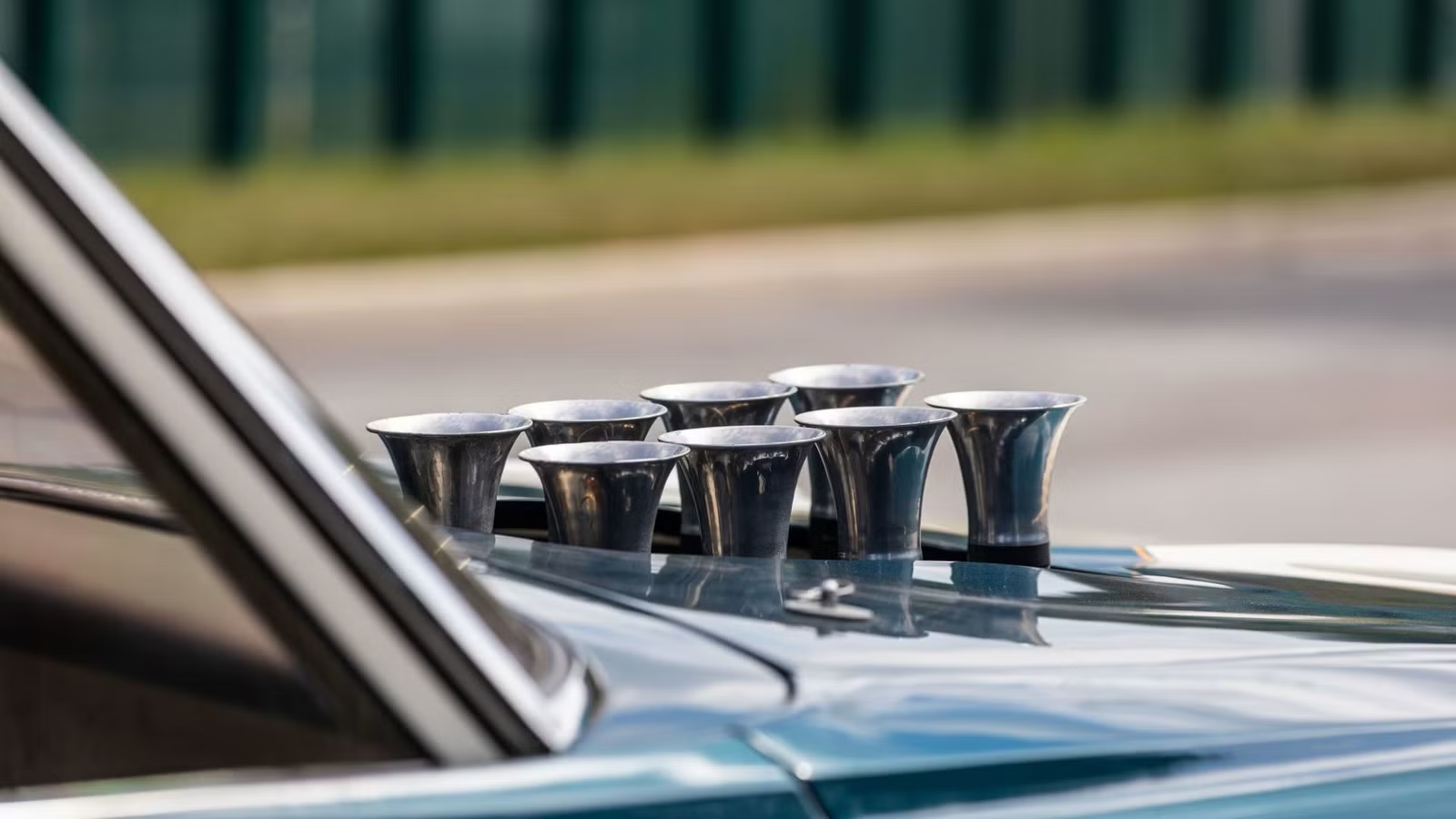
Muscle car fans know that the first of the Detroit Three to claim a 450 horsepower V8 was Chevrolet. In 1970, Chevy debuted the 454 cubic-inch “LS6” V8 with a factory rating of exactly that. But in all truth, it probably wasn’t Detroit’s first mass-produced 450-hp V8.

What fewer folks know is that by 1970, American automakers were understating how much power their engines actually made. When GM made its historic claim, an engine that actually made 450+ hp had already been on the market for four years. Read on to find out why Detroit lied.
The 1970 Chevy “LS6” 454 Cu-In Was The First V8 To Claim 450 Horsepower
For the 1970 model year, Chevrolet pulled out all the stops with its “LS6” V8. The powerplant’s motto might as well have been, “In displacement we trust.” At 454 cubic-inches, it’s still the largest displacement engine ever dropped into a Chevrolet passenger car.

With a compression ratio of 11.25:1, it wasn’t the most tightly-wound engine GM had ever built. But with all that displacement, it didn’t need to be. It featured a low-rise aluminum intake and 780-cfm Holley four-barrel carb. All eight cylinders breathed through 2.19-inch rectangle-port intake valves and 1.88-inch exhaust valves. When Chevrolet announced its 1970 LS6 made exactly 450 hp at 5,600 rpm and 500 lb-ft of torque at 3,600 rpm, no one doubted it.
In 1970, Chevrolet offered the LS6 as an option in the Chevelle car or the El Camino—creating a muscle truck that was too wild for the era. In 1971, factory literature shows the LS6 was still an option in the Chevelle, but GM didn’t sell any LS6-powered Chevelles in 1971 (according to Hemmings). Perhaps this promotional material was printed before company brass changed its mind. Instead, GM offered an LS6 V8 in the 1971 Corvette which had been detuned to meet emissions regulations and run on lower-octane, low-lead fuel. GM claimed this new LS6 made 425 hp at 5,600 rpm and 475 lb -ft at 4,000 rpm. The 1971 LS6 had a compression ratio of just 9.0:1, but it saved some weight with aluminum cylinder heads borrowed from the historic L88 V8. And of course, the 1971 LS6 was installed in a car that weighed as much as 400 pounds less than the 1970 Chevelle.

The difference between the 1970 and 1971 LS6 V8s signaled a coming change in the muscle car landscape. For many fans of muscle car history, this iconic engine shift represents the end of an era. The muscle car party was over in Detroit, after just one year of 450 hp engines. But the truth is that multiple automakers had been secretly selling engines this powerful for years.
Why 1960s Detroit Lied About Horsepower

Many historians agree that by the 1960s, all the Detroit Three were downplaying the horsepower their largest engines made. But there are different theories as to why.
Ask around at most car shows, and the most common opinion is that the Detroit Three were just doing buyers a favor, minimizing output numbers to keep insurance premiums lower. It’s a good story, but the truth might not be so simple.
In Hot Rod magazine, Diego Rosenberg wrote that horsepower-based insurance premiums weren’t common until 1969. He theorizes that manufacturers were underrating horsepower to qualify for more competitive NHRA classes. These classes were based on a car’s weight-to-horsepower ratio.

Dennis Manner, a retired Buick engineer, revealed that the 1970 455 Stage 1’s V8 made 372 hp at 5,200 rpm on the dyno, but got an official rating of just 360 hp. “The shipping weight of the car was 3,603 pounds, and we wanted to get it into a class that factored 10-to-1 pounds per hp.”
This would explain why the first 450+ horsepower engine was severely misrepresented. It was originally engineered for racing.
Mopar’s 1966 “Street Hemi” 426 Made 450 Horsepower Without Breaking A Sweat

|
Engine |
1966 426 Street Hemi |
|---|---|
|
Displacement |
426 cu-in (7.0 L) |
|
Bore × Stroke |
4.25 × 3.75 in (107.9 × 95.3 mm) |
|
Compression Ratio |
Compression Ratio 10.25:1 |
|
Carburetion |
Dual 625-cfm Carter AFB four-barrel carburetors |
|
Factory Horsepower Rating |
425 hp @5,000 rpm (SAE gross) |
|
Factory Torque Rating |
490 lb-ft @4,000 rpm (SAE gross) |
|
Replica Engine Horsepower |
494.4 hp @5,950 rpm |
|
Replica Engine Horsepower |
498.3 lb-ft @ 4,500 rpm |
Mopar muscle fans got one of the best Christmas presents in history, at the end of 1965. During December of that year, Chrysler Corporation began shipping its Hemi V8 engine in certain 1966 Dodges and Plymouths.
The engine was already legendary on drag strips and at the NASCAR track. For its February 1964 debut, the new engine powered Richard Petty to a Daytona 500 victory. The next three finishers at Daytona also had Hemis under the hood. NASCAR panicked and announced that it was banning the V8 for the 1965 season unless Chrysler Corporation sold a homologation version to the public, qualifying it as a “stock” engine.
Chrysler Corporation focused on drag racing instead. The Hemi swept the Stock Eliminator final at the NHRA 1964 U.S. Nationals and continued to dominate Super Stock in the ’65 season.

Chrysler finally built a detuned version of the 426, the “Street Hemi,” for production cars. The automaker announced the engine made 425 horsepower at 5,000 rpm and 490 lb-ft at 4,000 rpm. But Hemi fans have long suspected the 7.0-liter V8 made a lot more power than that.
The experts at Hemmings actually tracked down a 1966 Street Hemi, freshly rebuilt to factory specifications. The engine builders carefully replicated the factory compression ratio, intake, exhaust, and carburetor calibration. The only major way it differed from a stock 1966 engine was an aftermarket camshaft with a +8 degree duration, which is the profile of a 1968-69 Stage II cam. The upgrade probably increased the Hemi’s output by between five and 15 horsepower.
Hemmings hooked this engine up to a dyno and spun it to 6,000 rpm. It made peak horsepower at 5,900: 494.1 ponies. Its peak torque was 498.3 at 4,500 rpm.
That’s a far cry from a 425 hp peak at 5,000 rpm. It’s safe to say that in 1966, a stock “Street Hemi” anyone could buy off a dealership lot was making well over 450 hp.
The Street Hemi Was a Detuned NASCAR Engine

During NASCAR’s 1960 Daytona Speedweeks, the Association did something unprecedented. It held a compact car exhibition race. The field was packed with capable Ford Falcons, Studebaker Larks, AMC Ramblers, and rear-engine Chevrolet Corvairs. But they might as well have stayed home. The Plymouth Valiants from Mopar’s factory race team swept spots one through seven.
No, the little A-bodies weren’t secretly smuggling V8s. Chrysler Corporation’s Tom Hoover had slapped on intakes and headers so long, the plumbing nearly filled the little engine bays. The concept was simple: if the engine can breathe easier, it can make all the power you need. The result of this “Hyperpak” Slant Six was 200 hp and legendary racing results.
When the Valiants dominated again in 1961, NASCAR ended up cutting the event altogether. Chrysler Corporation was already dreaming of dominating the full-size stock car Cup series. But they’d need an engine. Hoover told Hot Rod magazine, “We had an inkling that the upper management wanted to win Daytona, so we were already working on it.”

Did Hoover use the same approach the 1970 GM LS6 would take? (Brute forcing output through displacement). No, he focused on airflow. He dug through Chrysler’s parts bin and dusted off the old “Firepower” V8 (1951–58) with its hemispherical cylinder heads. That engine, in turn, had been inspired by cylinder heads Chrysler developed for WWII fighter planes.
The cylinder shape was originally conceived to better combust the fuel-air mixture swirling around inside. But it also opened up room for larger ports. The intakes had a cross-section of three square inches, the exhausts came in at 2.24. The original NASCAR-winning Hemi engine had a 12.5:1 compression ratio. In early tests, Chrysler engineers found it was putting out a staggering 550 horsepower. The 1966 Street Hemi was detuned for 10.25:1 for drivability. But with its improved airflow, it still punched way above its class, challenging GM’s 454 cu-in V8 in output.
Ford And Chevy Were Hot On The Hemi’s Heels

If the horsepower wars of the 1950s could be described as some minor skirmishes, Chrysler had dropped an atom bomb with its 1964 Hemi V8. General Motors answered in kind with its 1967 “L88” V8. Available exclusively in the Corvette, the L88 took the Hemi’s formula and dialed it up to 11. The 427 V8 featured high domed pistons, a solid-lifter racing cam, aluminum cylinder heads, and a 12.5:1 compression ratio. GM rated it with five more horsepower than the Hemi, as if thumbing its nose at Chrysler: 430 hp at 5,200 rpm and 460 lb-ft at 4,000 rpm.
A savvy muscle car fan might be suspicious of those numbers, given that the L88 didn’t redline until 6,500 rpm. This was exactly Hemmings logic when it built a replica of a stock L88 427 to test on an engine dyno. This modern reproduction made 574.4 hp at 5,900 rpm and 553.6 lb-ft at 5,000 rpm. Even if it slightly outperformed a true 1967 engine, there’s no doubt the L88 was Detroit’s first 500 hpproduction V8.

In 1969, Ford’s NASCAR homologation Boss Mustang 429 entered the chat. Again, similar displacement and NASCAR-caliber technology to the 426 Hemi V8 and 427 L88 V8. Ford rated it at a modest 375 hp. Compared to the Hemi and L88, it came with more restrictive intakes, conservative carburetors, and relatively low compression. But they were favorite engines among builders, and period spec sheets reveal it was relatively easy to get 570 hp out of them.
Sources: Hemmings, Hot Rod Magazine, Chevrolet, Ford, Chrysler

Related posts




Latest Post


No Comments