
7 Predatory 1960s Muscle Cars Named After Dangerous Animals
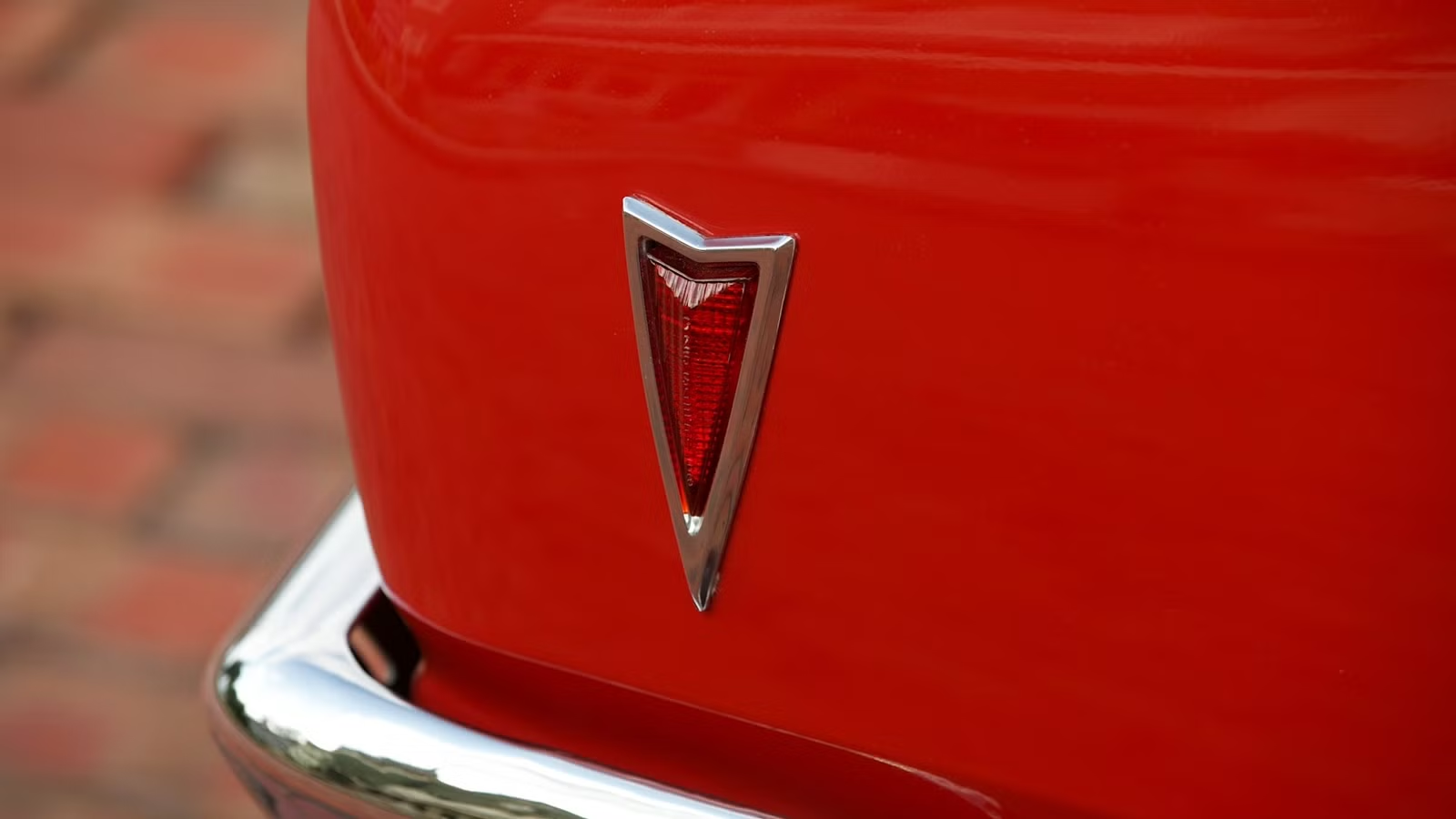
Slow your horses, alright? The Ford Mustang is objectively a cool 1960s muscle car that’s named after an animal. But it doesn’t deserve the entire spotlight. There are other remarkable muscle cars and racers of the era with striking names. In fact, some names are even more aggressive than a horse-themed name. Decades later, they survive as legendary icons, and I’ve listed the top seven coolest models with their most powerful engine variants for you to drool over.
7
1964 Plymouth Barracuda
HP: 235 Torque: 260 LB-FT

Buckle up because going from a horse to a fish is only the first stop on this wild list of predatory muscle cars. The 1964 Plymouth Barracuda had an earlier development working title of “Panda” that was rejected. Which is great, because nothing about Pandas seems sleek or fast. Then Chrysler designer John Samsen suggested the name “Barracuda.”
It is inspired by the sleek and aggressive fish with plenty of sharp teeth. It is sharp, aggressive, and fast, like the sporty styling of the new Valiant-based fastback design that was developed to compete with the Ford Mustang. It was racing Ford to provide the market with an affordable pony car, and actually hit the market 16 days before the Mustang.
The 1964 Plymouth Barracuda’s 273 cubic-inch V8 is the most powerful variant in the lineup. It delivers 235 hp and 260 lb-ft of torque with the ability to accelerate from 0 to 60 mph in 8.8 seconds and complete a quarter mile in 16.5 seconds at about 85 mph. This sea creature has a top speed of roughly 114 mph.


With the Formula S package that became available in 1965, you got heavy-duty torsion bars, stiffer rear springs, an anti-roll bar, wider wheels, and special tires. The setup could be paired with a push-button TorqueFlight automatic or four-speed manual floor shifter and heavy-duty drum brakes on each wheel.
6
1962 Shelby Cobra
HP: 260 Torque: 269 LB-FT

You could say that the 1962 Shelby Cobra is quite striking. The first prototype, CSX2000, was completed early in the year by Carroll Shelby and his team. Reportedly, Carroll had a dream where a sports car approached him with the name “Cobra” written on the hood. Then he felt it was the perfect fit for a sports car with the ability to antagonize rivals.
The name is a perfect fit, as cobras are sleek, fast, aggressive, and dangerous to match the dominant and high-performance attitude of his new race car. It came to life when Shelby used the chassis of AC Ace, a two-seater British car, and paired it with the Ford Windsor small-block V8 engine.
With the 260-cubic-inch (4.3-liter) V8 engine, the car delivers 260 hp and 269 lb-ft of torque. It races from 0 to 60 mph in about 4.2 seconds and finishes a quarter mile in roughly 13.8 seconds with a trap speed of 112 mph. Its top speed hovers around 153 mph. Because it weighs in at about 2,019 to 2,121 lbs, it has an excellent power-to-weight ratio.

The predatory car features an aluminum roadster body with hand-formed panels. Also, the setup includes a Borg-Warner four-speed manual transmission and a single four-barrel Holley carburetor. The Shelby Cobra rides on an independent transverse leaf spring front and rear suspension and 5.5-inch wire knock-off wheels.
5
1964 Ford Mustang
HP: 271 Torque: 312 LB-FT

It’s finally time for the Ford Mustang to shine with all its bucking glory. However, the name isn’t only inspired by the wild American horse. Executive Ford stylist John Najjar loved aviation and was inspired by the P-51 Mustang fighter plane and suggested the name during an early name concept back in 1961.
Reportedly, Robert J. Eggert, a Ford market research manager and horse enthusiast, also suggested the name after reading a book on wild horses. Marketing teams favored the horse imagery for its agile, youthful, untamed, and free spirit. Nothing provides independence like your own car.
Ford went with the galloping pony badge to portray freedom and motion while creating the “pony car” class. Halfway through 1964, the Mustang 289 K-Code was the most intense variant available, with a 289 cubic-inch four-barrel high-performance V8 that churns out 271 hp and 312 lb-ft of torque to gallop at full speed.

The 1964 1.2 K-Code Mustang has a 7.5-second 0-to-60 time and crushes a quarter-mile in nearly 14.68 seconds at 95 mph with a top speed of 128 mph. Selecting the K-Code package deleted things like air conditioning to make space for forged aluminum pistons, heavier-duty connecting rods, a high-revving harmonic balancer, and a dual-point distributor.
4
1967 Mercury Cougar
HP: 320 Torque: 427 LB-FT

Sorry, the Mercury Cougar doesn’t refer to an older woman looking for a younger man. But it’s still a predatory muscle car that strikes fear in opponents. In the early 1960s, the Cougar was a top contender as the name for the Ford Mustang before they settled on the pony-related name. As a result, Ford already had branding, marketing materials, and concept work related to the Cougar.
Marketing research found that the Cougar title was highly favored by the public. Plus, the large cat represents grace, speed, and beauty, which is what they were going for with the new luxury muscle car under the Lincoln-Mercury division. It’s closely related to the Mustang and rides on the same platform.
The 1967 Mercury Cougar 390 was the top performance option with a 390 cubic-inch (6.4-liter) FE-Series V8 Marauder engine with 320 hp and 427 lb-ft of torque. It accelerated from 0 to 60 mph in around 8.1 seconds with a 15.1-second quarter mile at about 93 mph and a top speed of 130 miles per hour.

With the GT Package, you get a performance handling package with stiffer springs, shocks, and a larger front stabilizer bar. It was paired with a low back-pressure dial exhaust system with chrome quad tips. Plus, the build featured wide-oval whitewall tires on wider wheels with power front disc brakes.
3
1963 Buick Wildcat
HP: 325 Torque: 445 LB-FT

I’ve got another cool cat for you! The 1963 Buick Wildcat made its debut in an attempt to shed its reputation for building boring, practical cars. Buick wanted to get in on the booming sports car market. The name is also related to earlier concept cars with fiberglass bodies that were built under General Motors’ styling chief, Harley Earl.
Buick first used the name on a high-performance Invicta Wildcat trim package, and the title quickly grew in popularity. It became a standalone model in 1963. The Wildcat name represents fierce independence, predatory instincts, and an untameable nature. But the car was also pretty luxurious and earned the “executive hot rod” nickname.
The 1963 Wildcat features a standard 401 cubic-inch (6.6-liter) Nailhead V8 engine with 325 hp and 445 lb-ft of torque. It pounces from 0 to 60 mph in roughly 8.1 seconds and finishes a quarter-mile in about 17.1 seconds at around 87 mph. Also, this cool cat has a top speed of 120 mph.

Luxurious amenities include front bucket seats with an upscale console layout, power steering, power brakes, available factory air conditioning, power windows, and an adjustable tilt steering wheel column. It pops with a distinct horizontal bar grille with a Buick crest housed in a central chrome circle.
2
1963 Bill Thomas Cheetah
HP: 360 Torque: 350 LB-FT

I’m not done with cat-themed cars just yet. The outlawed Bill Thomas Cheetah was developed with one purpose in mind. It was built to outrace the Shelby Cobra. The predatory car needed to hunt the Cobra down and kill it, which is why it also featured the project name, “Cobra-Killer.” But ironically, cheetahs and cobras often share the same habitat without conflict.
The Cheetah name represents aggressive speed, an agile performance, and predatory instincts that perfectly fit the race car’s style and attitude. It was an outlaw because it was secretly built during the General Motors racing ban. Also, the Cheetah GT designation refers to the traditional European endurance racing design.
The 1963 Bill Thomas Cheetah borrows the 372 cubic-inch (5.7-liter) small-block V8 engine from the Chevrolet Corvette. In stock form, it pumps out 360 hp and 350 lb-ft of torque. Racing-tuned variants provide up to 520 hp and 475 lb-ft of torque. The Cheetah GT sprints from 0 to 60 mph in 3.5 seconds with a 10.86-second quarter mile and a top speed of 215 mph.

This ultra-light car weighs in at 1,500 to 1,650 lbs for an excellent power-to-weight ratio. It has an intense front mid-engine layout where the transmission is bolted directly to the differential. Also, the Muncie four-speed manual transmission is bolted directly to the Corvette-derived independent rear suspension.
1
1967 Pontiac Firebird
HP: 360 Torque: 410 LB-FT

Now a mythical animal has entered the chat. General Motors first developed the Firebird name for experimental turbine vehicles in the 1950s. Then its first production pony car in 1967 gained the name to capture high-speed jet-performance energy. The car was almost named ‘Banshee’ after a fighter jet, but it was dropped after Pontiac learned that the name was related to an Irish death spirit.
Then designers decided that the Firebird, or mythical phoenix, was a better fit. The early 1967 emblem was based on the Hopi Native American bird pendant. You can see the inspiration behind the outward wing and closed beak appearance. But it’s also jokingly referred to as the sick chicken.
The 1967 Pontiac Firebird 400 Ram Air was the most potent option available. With the 400 cubic-inch (6.6-liter) V8, you got 360 hp and 410 lb-ft of torque. This Pontiac soars from 0 to 60 mph in about 5.2 seconds with a 13.9-second quarter-mile time at 103 mph and a top speed of around 116 mph.

Upgrading to the rare Ram Air package included functional hood scoops, a heavy-duty 10-bolt rear axle, and a Safe-T-Track limited-slip rear differential. Plus, it featured specialized camshaft timing, stiffer valve springs, and enhanced cylinder heads with D-shaped intake ports. It was often equipped with 4.33 rear axle gearing.
Source: Hillbank USA, Fastest Lap, Classic Industries, Hagerty

Related posts
Latest Post


No Comments