
The Highest Horsepower Ever In A Small-Block V8 Produced In The ’70s
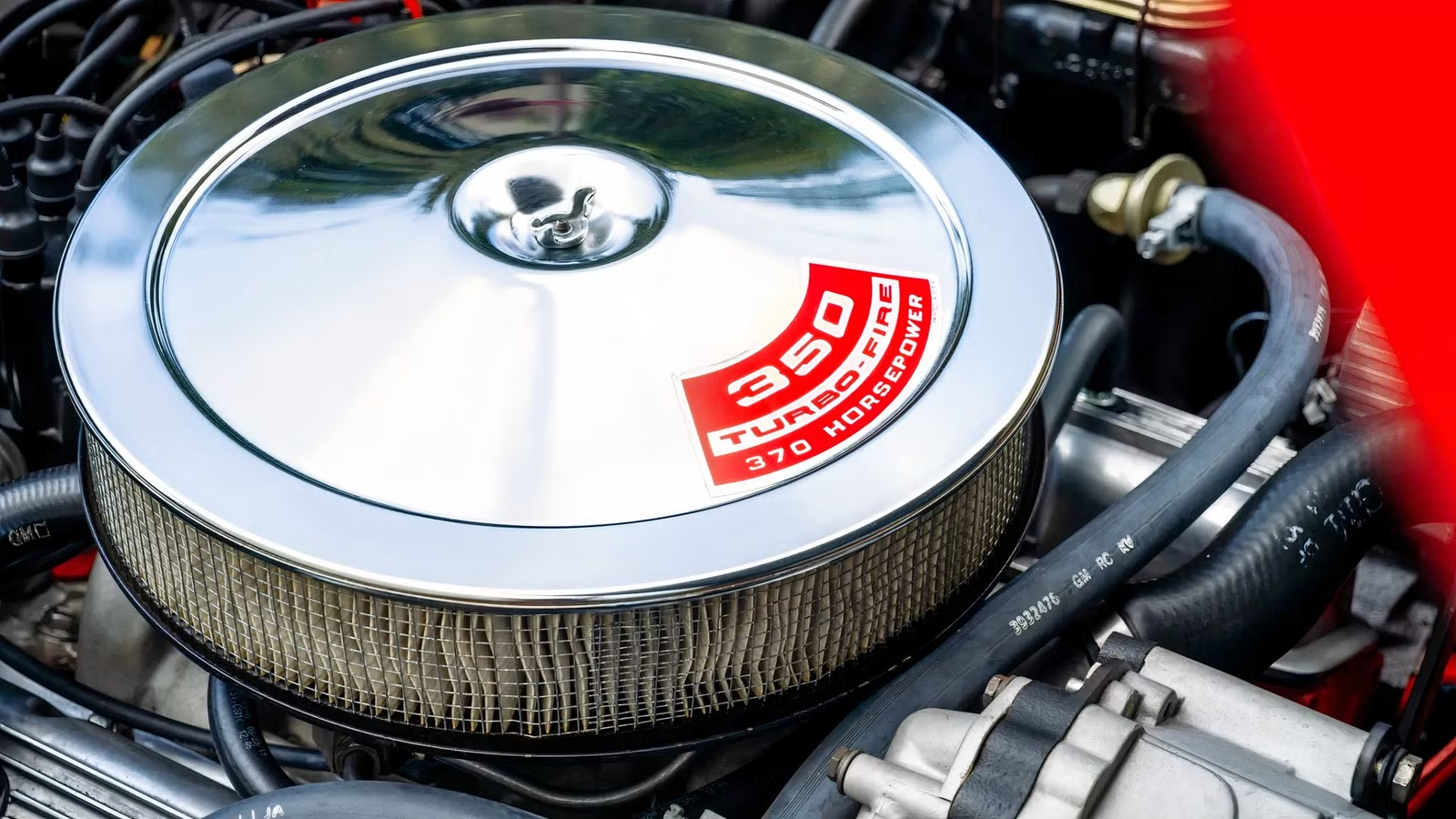
Few engine families have shaped American performance culture quite like the small-block V8. Born in mass production in the mid-1950s, it went on to power everything from pickup trucks to SUVs, from muscle cars to purpose-built performance machines. Ford, Chevrolet, Chrysler — every major American automaker had one, and enthusiasts have been arguing about which was best ever since.

As their name suggests, small-block V8 motors are generally more compact and lighter than traditional big-block V8s, and therefore are easier to install in the engine bay. Because of this, a car powered by a small-block V8 will generally handle better thanks to improved weight distribution; it will also accelerate faster and burn less fuel than a car fitted with a big-block V8, which is typically heavier.
Furthermore, the smaller dimensions of a small-block V8 make it easier to fit into a wider variety of cars, making it a default choice for builders. Generally, small-block V8 engines are also designed to achieve higher engine speeds than big-block V8s, which makes them an obvious power source for performance car builds. On the other hand, big-block V8s have their advantages as well.
For example, the fact that they are engineered to offer as much torque as possible at lower engine speeds makes them ideal for towing and high-durability applications in vehicles like pickups, vans, and heavy-duty trucks, as well as high-power applications like drag racing, where their larger displacement and torque come in handy.

The LT-1 Was The King Of Small Block Power In The ’70s
Now, everyone has their favorite small-block V8 engine, but one of the most iconic has to be General Motors’ original LT-1 motor (Gen I), produced from 1970 through the 1972 model year. This short-lived engine left a lasting impression on the market, mainly because it absolutely destroyed most big-block V8s in terms of output and performance when it launched at the peak of the muscle car era.

Available exclusively in the C3 Corvette and second-generation Camaro Z/28 high-performance models, the racing-inspired LT-1 was produced in relatively small numbers — a total of 21,147 were made over three model years (4,977 Corvettes and 16,170 Camaro Z/28s). Those included some 53 LT-1 V8s that found their way into the first-ever Corvette ZR-1.

The modest Corvette production numbers are largely explained by the LT-1’s price: it was a costly option at $447.60 for the 1970 model year, representing close to 10 percent of the price of a new Corvette. Additionally, for the 1970 and 1971 model years, the LT-1 could not be paired with air conditioning because it would throw off belts at high rpm, according to Hemmings. This limited sales further.
The Z/28 option for the Camaro was also a costly one, with an original list price of $572.95 on top of the 1970 Camaro’s base price of $3,412. But buyers who got an LT-1-powered car did not regret it.
Why The LT-1 Was So Underrated Compared To Big-Block Rivals

At the height of the muscle car era, big-block V8s dominated headlines thanks to their massive displacement and headline-grabbing torque figures. Engines like Chevrolet’s 454 and Ford’s 429 often stole the spotlight, leaving smaller engines like the LT-1 somewhat overlooked by casual buyers at the time.
However, what many enthusiasts didn’t fully appreciate back then was how advanced the LT-1 actually was. Rather than relying on sheer size, the LT-1 delivered its performance through high-revving capability, efficient airflow, and a race-inspired design. This made it far more balanced than many big-block competitors, especially in real-world driving scenarios.
In lighter cars like the Corvette and Camaro Z/28, the LT-1’s reduced weight over the front axle significantly improved handling and braking. This gave LT-1-powered cars a more agile, responsive feel — something that big-block muscle cars often struggled to match. In many cases, this allowed LT-1 models to outperform larger-engined rivals on twisty roads and road courses, not just in a straight line.
Over time, enthusiasts have come to recognize that the LT-1 wasn’t just a smaller alternative — it was a smarter performance solution that helped shape the future of high-performance small-block engines.
The Hard Numbers Of The Gen-I LT-1 V8

With a displacement of 350 cubic inches (5.7 liters), the LT-1 was built for performance by a team of engineers led by the legendary Zora Arkus-Duntov, the Father of the Corvette. It featured a cast-iron block engineered to withstand the high 11.0:1 compression ratio and the heat generated by its demanding performance setup.
GM records show that the motor featured an overhead valve (OHV) design, forged aluminum pistons, a ‘178’ high-performance camshaft, solid lifters, a high-rise aluminum intake manifold, a Holley 780 CFM four-barrel carburetor, a transistorized ignition system, low-restriction exhaust, a baffled oil pan and high-volume oil pump, among other performance-oriented components.
LT-1 V8 Engine Specifications (1970 Chevrolet Corvette Stingray)
|
Type |
Water-cooled, 90-degree V8 |
|
Displacement |
350 c.i. (5.7 liters) |
|
Configuration |
Naturally aspirated, overhead valve (OHV) with two valves per cylinder |
|
Bore x stroke |
4.00 in x 3.48 in (101.6 mm x 88.4 mm) |
|
Compression ratio |
11.0:1 (1970MY) / 9.0:1 (1971-1972MY) |
|
Power |
370 hp at 6,000 rpm |
|
Torque |
380 lb-ft at 4,000 rpm |
|
Transmission |
4-speed manual / 3-speed automatic (Camaro Z/28) |
This setup allowed engineers to give it a redline of 6,500 rpm, although power fell off significantly after 6,200 rpm. As for the official ratings, the LT-1 was factory-rated at 370 hp at 6,000 rpm and 380 lb-ft of torque at 4,000 rpm in the 1970 Corvette — a massive output figure for the era. Interestingly, the 1970 Camaro Z/28 carried a slightly lower power rating of 360 hp at 6,000 rpm and the same torque figure of 380 lb-ft at 4,000 rpm, even though it was essentially the same engine. This likely reflected Chevrolet’s policy of maintaining the Corvette’s status as the absolute top dog in the lineup.
In both cars, the LT-1 motor was paired with a standard close-ratio Muncie M21 4-speed manual gearbox, although a 3-speed Turbo-Hydramatic automatic transmission was also available in the Camaro; the Corvette was manual-only.
1970 Was The Best Model Year For The LT-1 V8

It’s worth noting that power ratings for all engines prior to 1972 were gross hp figures, versus the net hp ratings that became standard beginning in 1972. Gross hp was measured at the flywheel on an engine stand with no accessories connected — no alternator, water pump, power steering pump, or AC compressor — and with an open exhaust.
That may be why some owners complained that their C3 Corvettes and Camaro Z/28s did not feel as powerful as GM advertised them to be. The switch to net hp measurements partly explains the LT-1’s dramatic drop in rated output for the 1972 model year, when it was listed at 255 net hp and 280 lb-ft of torque with all accessories connected, emissions hardware in place, and a completely stock exhaust system.
But that wasn’t the only cause. The year before, GM rated the LT-1 at 330 hp gross/255 hp net and 360 lb-ft of torque, as the compression ratio had been lowered to 9.0:1 to comply with emissions regulations. That means the best year to have the LT-1 was in the 1970 Corvette and 1970 Camaro Z/28. So, how quick were these LT-1 V8-powered cars?
The Performance Was Sensational For The Era

In a MotorTrend road test from May 1970, the 1970 Corvette with LT-1 power covered the standing quarter-mile in 14.36 seconds at 101.69 mph. The 0–60 mph time is estimated by various sources to be as low as 5.7 seconds. These were impressive numbers for 1970.
The 1970 Camaro Z/28 offered similar performance, with a Car and Driver road test from May 1970 revealing a 0–60 mph time of 5.8 seconds, a top speed of 118 mph, and a standing quarter-mile time of 14.2 seconds at 100.3 mph.

With this kind of performance, the 1970 Corvette LT-1 was found to have an edge on its main rival, the 1970 Porsche 911E, both in a straight line and through corners, according to MotorTrend. As for the 1970 Camaro Z/28, its only worthy opponent was the legendary Ford Mustang Boss 302. While the Z/28 had more straight-line speed, the Boss 302 was more track-focused and handled better in corners.
And if you want further proof of how advanced the LT-1 was for its time, look no further than its spiritual successor, the Gen-II LT1 V8, launched in 1992 on the C4 Corvette. The original LT-1 was so well-regarded that GM chose to resurrect the name two decades later and use the original as the basis for the Gen-II LT1 motor.
The second-generation LT1 V8 shared many dimensions and components with the original LT-1, including the 350-ci displacement, a similar crankshaft, bore spacing, and engine mount locations, but was updated with modern technology such as port fuel injection, a reverse-flow cooling system, and much more. The legend of the original LT-1 lives on.

Related posts




Latest Post


No Comments