
The Motorcycle That Gives Harley Riders A Reason To Try Something Different
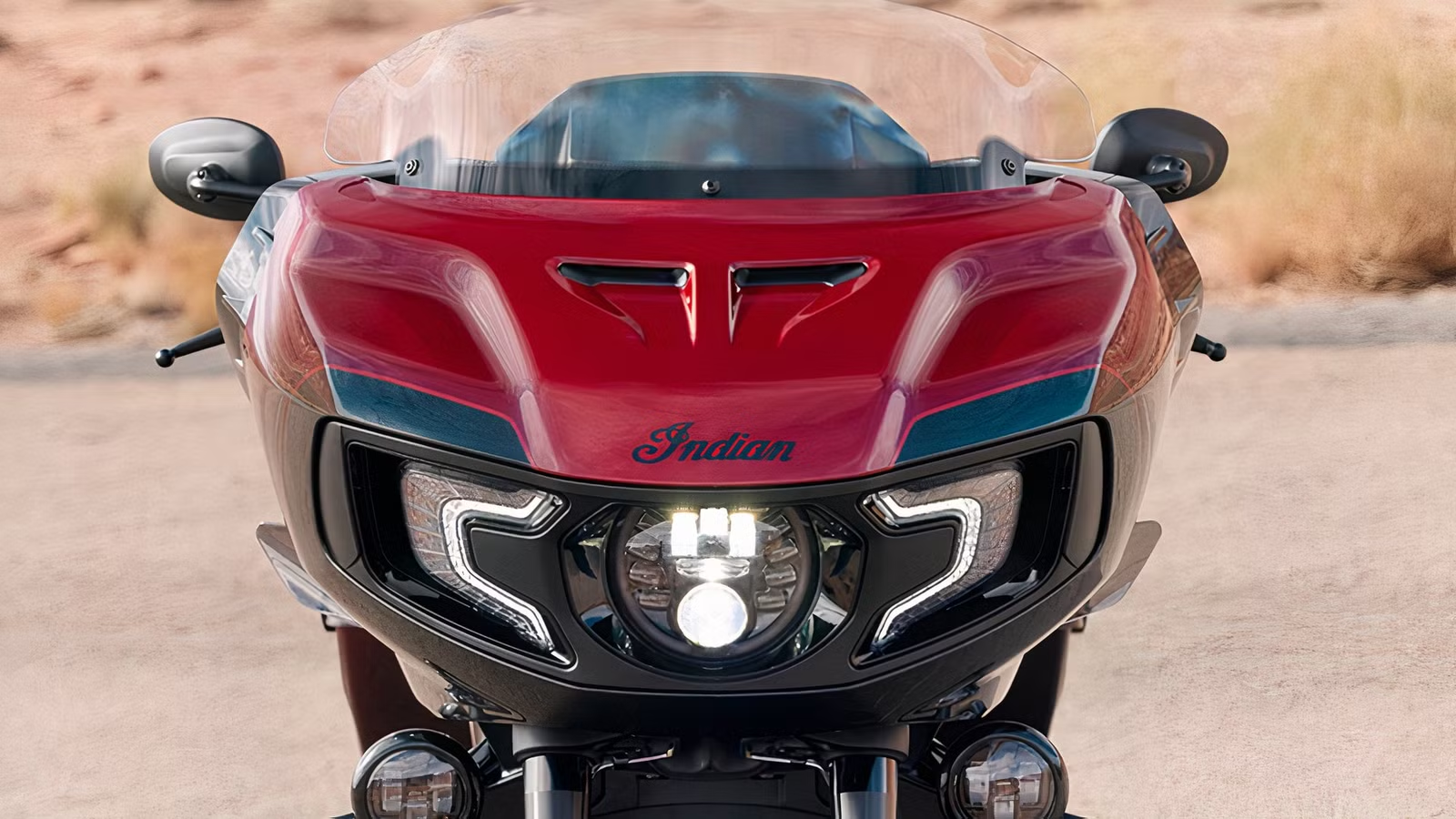
For decades, the American bagger conversation has started in roughly the same place: a Harley-Davidson Road Glide or Street Glide. For a loyal Harley rider, looking elsewhere can feel almost unnecessary. Why change a formula that already works? The more interesting question is what another American V-twin would need to do differently to make that change worthwhile. There is one answer: a chassis-mounted fairing, a liquid-cooled engine, serious performance hardware, and technology that comes standard instead of living on the options list. It still looks unmistakably like a big American bagger, but the thinking underneath is rather different.
Harley Still Owns The American Bagger Conversation
Heritage, Dealerships, And An Aftermarket That Takes Years To Master

There is a reason Harley-Davidson remains the first name that comes to mind when the subject turns to American touring motorcycles. The company has the heritage, the styling language, the dealership infrastructure and an enormous accessories ecosystem that make ownership feel like more than simply buying a motorcycle. The aftermarket is another major part of the Harley experience. A rider can spend years modifying their machine, changing suspension, exhaust, bars, audio, lighting, and nearly everything in between. That familiarity matters, particularly to somebody who has owned Harleys for years and already knows the ecosystem.
Where The Loyalty Starts To Wobble

The problem arises when a rider starts asking for something beyond the traditional formula. For instance, the 2026 Road Glide’s 105 horsepower is respectable, but the number looks modest compared to a rival that makes 126 horsepower from a smaller-displacement V-twin. The torque figures are much closer, with Harley claiming 130 pound-feet and Indian claiming 133 pound-feet. In other words, the big difference is not about having some enormous torque advantage. It is about how much harder the competing engine is willing to work higher in the rev range.

Harley has also added more electronic assistance to its latest touring models, including cornering ABS, linked braking, traction control, drag-torque slip control and vehicle hold control. That puts the Road Glide firmly into the modern era. Still, riders looking for a distinctly performance-oriented American bagger have traditionally had limited choices. There is one rival, however, that offers everything a Harley rider anticipates from an American bagger.
The Indian Challenger 112 Gives Harley Owners A Strong Reason To Switch
How The Challenger Undercuts the Road Glide Limited — Then Adds More

The rival in question is the Indian Challenger with the PowerPlus 112, which starts at $30,999 before destination, setup, taxes and other fees. What makes the Challenger so relevant to Harley riders is its basic architecture. Like the Road Glide, it uses a frame-mounted front fairing rather than attaching the fairing to the fork. That immediately makes it feel familiar while also setting up one of the biggest differences between the two bikes: Indian has treated the bagger as a performance motorcycle first and a cruiser second.
The blacked-out Challenger Dark Horse 112 lists at $31,999. At the top of the range, the Elite starts at $39,999 and the 125th Anniversary Edition at $41,999. Indian is also offering a $1,500 trade-in credit plus a free Stage 1 exhaust on new 2026 Challengers, and that exhaust is an accessory Indian sells for $839.99 on its own. This goes up directly against the Road Glide Limited, which is priced at $32,999. Against the latter, the Challenger Limited comes in $2,000 lower, or $500 lower with PowerBand audio.
A Liquid-Cooled V-Twin That Comes With Racing Credentials
Unpacking The Numbers: 126 HP And 133 Pound-Feet

Indian claims 126 horsepower and 133 pound-feet of torque from the PowerPlus 112, a 1,834 cc V-twin with a 4.33-inch bore and a 3.8-inch stroke along with an 11.4:1 compression. It is not only a brochure number, either. The same engine won three MotoAmerica King of the Baggers championships, the racing series built around big American baggers. Now stack that against the Road Glide’s 105 horsepower and 130 pound-feet. Torque is nearly a tie, 133 versus 130. The Indian’s torque peaks at 3,600 rpm, a bit higher than the Harley’s 3,250, so the Road Glide’s shove arrives a touch earlier in the rev range.
Horsepower is where the gap opens up: 126 versus 105. That is the kind of difference you would expect to notice when passing a truck on a two-lane road or merging with a fully loaded bike. Look closer at the internals, and you’ll also notice a difference in philosophy. Harley’s Milwaukee-Eight 117 offers a longer stroke of 4.5 inches, which might explain the more relaxed nature of the Harley.
Liquid Cooling And Cylinder Deactivation Solve The Heat Problem Harley Riders Know Well

The liquid-cooled layout is another major departure from the traditional air-cooled American V-twin recipe. The PowerPlus is designed around a 60-degree liquid-cooled architecture, and the Challenger also uses rear-cylinder deactivation when conditions are met. Indian says the system shuts down the rear cylinder when the motorcycle is stopped and the engine is hot, helping reduce heat around the rider in slow-moving traffic and warm weather. That is not a glamorous feature, but it is the kind of thing you notice after an hour sitting in summer traffic.
A Bagger That Doesn’t Ride Like One
Frame-Mounted Fairing And Aluminum Chassis

Indian bolts the fairing to the chassis rather than the fork and pairs it with a cast aluminum front frame and an inverted fork. A fork-mounted fairing, like the batwing on Harley’s Street Glide, rides on the steering and makes you muscle its weight around every turn. Fix the fairing to the frame and steering feels lighter, while the wind protection stays steady in front of you. Indian says the setup delivers best-in-class wind protection.
To be fair, the Road Glide uses the same frame-mounted idea. According to discussions across online forums, handling is where the Challenger truly shines. Former Harley-Davidson riders — including those coming from Road Kings, Softails, and Dynas — praise the Challenger as the superior performance machine, even with occasional software error codes noted by some.
Brembo Brakes And A Fox Rear Shock On An 855-Pound Bagger — That’s The Performance Argument

Up front, 43mm inverted forks soak up highway bumps, and an adjustable Fox shock in the rear keeps the bike composed. Radially mounted Brembo calipers clamp twin 320mm discs, which is welcome on a machine that weighs roughly 855 pounds ready to ride. Rubber comes from Metzeler Cruisetec tires on a 19-inch front wheel and a 16-inch rear. Harley’s Road Glide also rolls on a 19-inch front, but its rear wheel is 18 inches. Seat height is nearly identical too, 26.5 inches versus 26.6 laden on the Harley, so switching shouldn’t feel foreign.
Tech That Goes Beyond The Harley Playbook
Blind-Spot And Rear-Collision Alerts: Safety Tech The Road Glide Still Doesn’t Have

Here is where Indian really raises the bar. The Challenger comes with Blind Spot Warning, Tailgate Warning, Rear Collision Warning, Bike Hold Control, linked braking, Smart Lean ABS, and traction control. In contrast, Harley’s Road Glide offers cornering ABS, traction control, linked braking and Vehicle Hold Control, but no blind-spot or rear-collision alerts. Three ride modes — Rain, Standard and Sport — let you tune the bike’s manners to the road.
A Seven-Inch Ride Command Screen With Apple CarPlay — And The Audio Setup To Match

PowerBand audio brings four 100-watt speakers and 400 watts in total, though it is a $1,500 upgrade over the standard setup, which has two 50-watt speakers. Riding info runs through a seven-inch Ride Command display with navigation and Apple CarPlay, and Ride Command+ adds account sync and connected search over your phone’s cellular data. Touring hardware is strong, too. The Challenger gets keyless ignition, remote-locking hard saddlebags with more than 18 gallons of combined storage, cruise control and a windshield that adjusts at the push of a button.
Does the Challenger give a Harley loyalist a real reason to look across the aisle? A Harley rider considering something different does not necessarily want something completely different. They may still want the big V-twin, the low seat, the fairing, the bags, the highway miles and the unmistakably American silhouette. The Indian Challenger Limited with PowerPlus 112 gives them all of that. Then it adds a liquid-cooled engine, 126 horsepower, a performance-oriented chassis, sophisticated rider aids and a surprisingly capable cornering attitude. It is still a bagger. It just doesn’t feel obligated to behave like one.
Source: Indian Motorcycle

Related posts




Latest Post


No Comments