
The $4,999 Royal Enfield That Sells Triumph’s Heritage Feeling For Half The Price
Retro motorcycles have developed a strange relationship with money. We now happily pay five figures for fuel injection, ABS, LED lights, and modern suspension packaged to resemble something our grandparents might’ve ridden to work in 1955. There’s nothing inherently wrong with that, but it raises an interesting question. If the styling, history, and experience are a huge part of the appeal, how much modern motorcycle do you actually need to buy before you’ve captured the thing you wanted in the first place?
Retro Motorcycles Have Turned Nostalgia Into A Premium Product

Look around the retro category and some of its most desirable motorcycles aren’t cheap. The Yamaha XSR700 starts at $8,599, while Kawasaki asks $8,999 for the Z650RS and considerably more for the bigger Z900RS. These machines aren’t expensive simply because somebody fitted a round headlight and painted the fuel tank an old-fashioned color. They’re modern motorcycles underneath, with real performance, capable chassis hardware, contemporary electronics, and engineering that happens to wear yesterday’s clothes.
Triumph Shows How Valuable Heritage Can Be

Triumph might be the clearest demonstration of how powerful that proposition can become. The current Triumph Speed Twin 900 starts at $11,495 and backs its looks with a 900cc liquid-cooled parallel twin producing 64 horsepower and 59 pound-feet of torque. It also gets a 43mm Marzocchi inverted fork, an aluminum swingarm, cornering ABS, traction control, and a level of finish expected from a considerably more expensive motorcycle. In other words, there’s plenty of actual motorcycle behind the heritage pitch.
But the Speed Twin’s appeal doesn’t begin and end at 64 horsepower. The tank shape, proportions, twin exhausts, Bonneville-derived engine architecture, Triumph badge, and connection to decades of British motorcycling are all part of the experience. That’s why comparing retro bikes on spec sheets alone misses something important. Some buyers want the performance too, but others primarily want a motorcycle that looks right parked outside a coffee shop, sounds appropriately mechanical, and comes with a backstory that existed before Instagram did.

The Cheapest Way Into Retro Motorcycling Usually Comes With A Catch

Move downmarket and finding that combination gets trickier. Plenty of affordable motorcycles borrow the visual language of the past, and there’s nothing wrong with that. Round headlights, ribbed seats, wire-spoke wheels, and teardrop tanks aren’t protected historical artifacts. The problem comes when nostalgia itself is the product. Once a motorcycle is asking you to care about an imagined old-school experience, having an actual connection to the era suddenly becomes a meaningful part of the package.
Royal Enfield Has Been Building This Kind Of Motorcycle For Generations

Royal Enfield has an advantage most retro brands would love to have: it doesn’t need to invent a past. The company can trace its motorcycle history back well over a century, and its name became closely associated with simple, upright British singles long before modern retro bikes became a lifestyle category. Even after production shifted to India, that basic visual and mechanical identity stayed unusually intact, giving Royal Enfield a continuous thread that many revived or repositioned brands simply don’t have.
That continuity is what makes Royal Enfield especially dangerous in the affordable retro space. It can sell motorcycles that look old because its own catalog actually looked that way, then combine those proportions with fuel injection, ABS, electric starting, and modern production. Instead of turning heritage into an expensive luxury add-on, Royal Enfield has made it the foundation of the brand itself. And that gives it room to offer a very convincing old-school experience at a price few heritage rivals can touch.
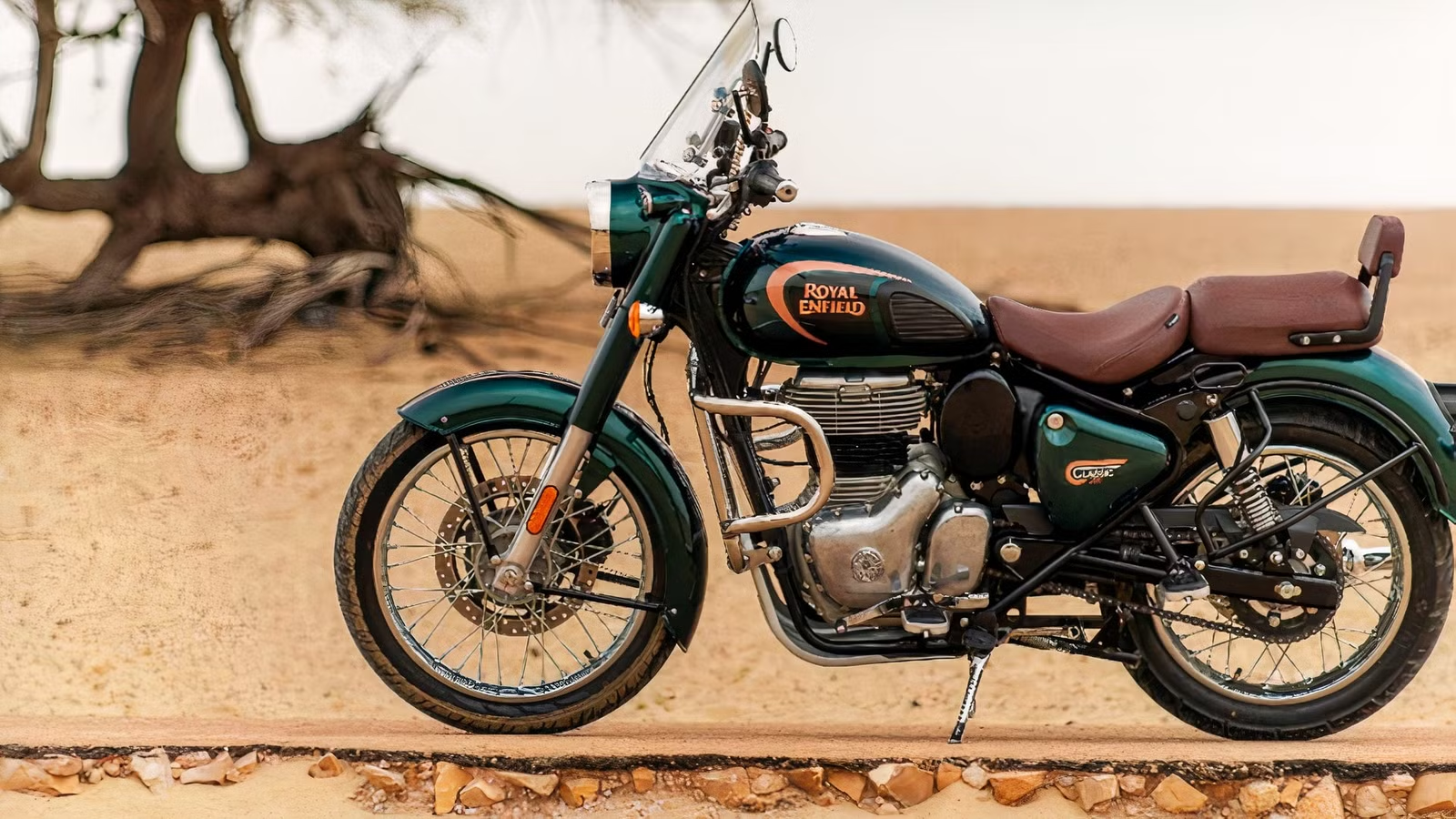
The Royal Enfield Classic 350 Delivers The Retro Experience For $4,999

The Royal Enfield Classic 350 starts at just $4,999 in the US, less than half the current $11,495 starting price of the Triumph Speed Twin 900. At its center is Royal Enfield’s familiar 349cc air-and-oil-cooled, fuel-injected single-cylinder J-platform engine. It produces 20.2 horsepower at 6,100 rpm and 19.9 pound-feet at 4,000 rpm, sending power through a five-speed gearbox and wet multi-plate clutch. Those aren’t intimidating numbers, and that’s rather the point.
The engine sits inside a twin-downtube spine frame, with a 41mm telescopic fork providing 130mm of travel and twin rear emulsion shocks offering six-step preload adjustment. Braking comes from a 300mm front disc and 270mm rear disc with dual-channel ABS. The Classic rolls on a 19-inch front and 18-inch rear wheel, carries around 3.4 gallons of fuel, has a 31.7-inch seat, and weighs roughly 430 pounds ready to ride. Simply put, the Classic 350 embodies straightforward hardware designed around approachability rather than an impressive spec sheet.
It Doesn’t Need More Than 20 Horsepower To Make Its Point

Put the Classic beside an XSR700, Z900RS, or Speed Twin 900, and the performance argument ends almost immediately. Those motorcycles are dramatically faster and substantially more sophisticated. But Royal Enfield isn’t really asking its 20.2-horsepower single to beat them. It’s asking whether the rider shopping primarily for relaxed road manners, old-school proportions, an upright riding position, a thumping single-cylinder soundtrack, and genuine heritage needs to pay for all that additional capability in the first place.
That changes how its modest performance looks. The Classic isn’t a cut-price Triumph Bonneville and would make very little sense judged as one. It’s a modern interpretation of a much simpler motorcycle, built for commuting, back-road wandering, and enjoying speeds at which 20 horsepower can still participate. Royal Enfield has effectively identified the expensive parts of the retro formula that its particular customer can live without, then spent its money preserving the portions that make the bike emotionally recognizable.
Royal Enfield Can Sell Nostalgia Cheaply Because It Actually Owns The History
The Classic’s biggest advantage might be that Royal Enfield doesn’t need to manufacture a heritage story around it. The company directly traces its visual bloodline to the 1950 G2-generation Royal Enfield Bullet, and the relationship isn’t difficult to spot. The nacelle-style headlight, rounded fuel tank, upright stance, prominent engine, broad fenders, and twin-shock profile all speak the same design language. Modern regulations and engineering have changed the details, but the family resemblance does most of the storytelling on its own.
That gives Royal Enfield an unusual way to compete. Rather than taking a high-performance platform and adding retro design on top, it can start with the historical experience and provide only as much modern hardware as needed to make that experience pleasant to own today. Fuel injection replaces carburetors, ABS helps keep panic stops uneventful, an electric starter gets rid of old rituals, and LED lighting improves visibility. None of those additions require the motorcycle to stop looking like it wandered out of an old photograph.
Royal Enfield Figured Out That The Feeling Is The Feature

This doesn’t make the Classic 350 a better motorcycle than the Speed Twin 900, XSR700, or Kawasaki’s retro offerings. Those bikes deliver levels of speed, chassis capability, refinement, and technology that explain much of their higher prices. The Royal Enfield simply competes on another axis. It separates the emotional promise of heritage motorcycling from the assumption that heritage must come bundled with increasingly expensive performance, then sells that experience at a price accessible to beginners, returning riders, and people who just don’t need 60-plus horsepower.
That might be the cleverest thing about the Classic 350. Royal Enfield hasn’t figured out how to build an $11,000 retro motorcycle for $4,999. It has figured out how much of the $11,000 retro experience some buyers actually came for. You still get modern reliability, usable everyday hardware, genuine historical continuity, and a motorcycle worth looking back at after you park it. What you don’t get is performance you may never have wanted, and Royal Enfield doesn’t make you pay for it.
Source: Royal Enfield

Related posts


Latest Post


No Comments