
The Cruiser That Will Quietly Become A Future Classic
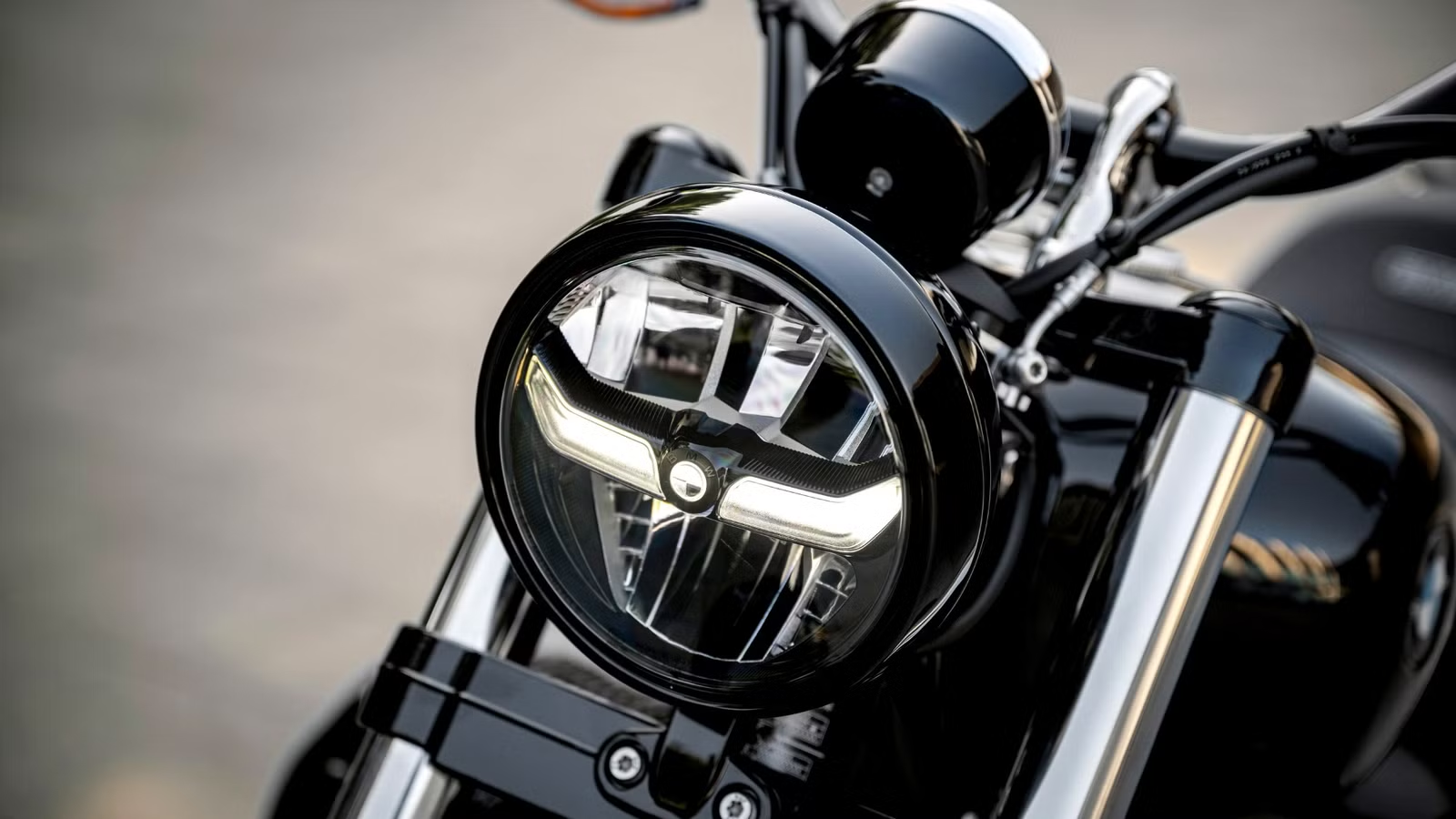
Cruisers have a strong cultural and historical significance among motorcycle types. Design and character also play a vital role in elevating a cruiser bike’s appeal. These are also key factors that determine a motorcycle’s ‘future classic’ appeal. Since the 2000s, we have had a few cool cruiser bikes like the Yamaha V-Max, which is a no-brainer future classic. But if we talk about new offerings that are underrated and sure-shot future classics, then a six-year-old Harley-rivaling BMW takes the podium for being bold, off-beat, and offering a gorgeous balance of classic vibes and modern features.
What Qualifies A Motorcycle As A Future Classic?

Many factors determine whether a motorcycle earns the ‘future classic’ tag. Cultural and historical significance plays a crucial role here. Motorcycles that represent a major shift in design, have won notable races, or have changed how manufacturers built and defined motorcycles can help earn the future classic tag. The Indian FTR is one fine example of this shift. While discontinued, the FTR is a refreshing showcase of a nimbler, sportier side of Indian Motorcycle that was otherwise confined to low-slung cruisers and tourers.

The Suzuki GSX-R1000 K5, the first-gen Yamaha R1, and the late-1990s Aprilia RS250 are future classics because of their racing pedigree. Other examples include the BMW R nineT, the Ducati M900 Monster, and the BMW S1000RR. All these bikes redefined modularity, styling, and trends, including normalizing top-spec electronic rider safety across the industry.

The end of an era also gives many new-age motorcycles the ‘future classic’ tag. The most recent example is the Triumph Thruxton RS. It stands out with a timeless design featuring classic 1960s cafe racer proportions, a Monza-style locking fuel cap, a knee-indented sculpted tank, and a minimalistic tail section. Under the gorgeous silhouette hides a lot of modern electronics to help tame this spirited cafe racer. It marks the end of an era as the final evolution of the traditional 1,200 cc parallel-twin British cafe racer muscle.


Among new cruiser motorcycles on sale, many are prospective future classics. The Indian Scout 101 showcases a high-performance evolution of the legendary Scout nameplate, balancing heritage styling with sharp, modern muscle. The Triumph Bonneville Bobber takes a different route, showcasing minimalism and factory custom styling that capture authentic post-war British style with modern engineering.

America also has the Harley-Davidson Heritage Classic, which revives quintessential retro touring charm, combining nostalgic design with lots of chrome, a modern Softail frame, and versatile Milwaukee-Eight power. While all these examples openly showcase their ‘future classic’ appeal, an underdog BMW cruiser bike climbs the same ladder more discreetly. The R 18 is relatively new but still shows the maturity of decade-old Harleys and Indian motorcycles, and it’s a future classic in the making.
The BMW R 18 Is An Underrated Future Classic Cruiser In The Making
Price: $15,395 (2025 MY)

The R 18 proves BMW did its homework cleverly. It doesn’t try to copy the quintessential V-twin formula of Harleys and Indian cruiser bikes. Instead, the R 18 goes bold and against the norms by replacing the V-twin engine with a boxer-twin. It’s not just a random attention-grabbing gimmick; everything from the styling to the engine layout has historical significance. The R 18 draws heavily on design and mechanical inspiration from classic BMW bikes, especially the R 5.

The solo seat, minimal bodywork, teardrop fuel tank, and triangular rear quarter frame design (among others) are an ode to BMW’s 1930s charm. This calculated formula has helped the relatively new BMW R 18 (launched in 2020) become a formidable ‘future classic’ rival to iconic Harley-Davidson cruiser bikes, including the Fat Boy, which carries a legacy spanning more than three decades.
A Worthy Harley-Davidson Alternative That Is Aging Like Fine Wine

The R 18 is a direct, uncompromised strike at the heart of the American heavyweight cruiser market. With a starting price of $15,395, the base R 18 cruiser locks horns with the most affordable 2026 Harley-Davidson cruiser—the $14,999 Street Bob. BMW has put in extra effort to focus on the “classic” elements on the R 18 to give it a timeless appeal.

Furthermore, just as Harley repackages its Milwaukee-Eight V-twin and sturdy, traditional chassis across cruisers, baggers, and full-dressers, BMW does the same with the boxer-twin and the R 18’s old-school chassis. Apart from the base bare-bones cruiser, the R 18 lineup also includes the R 18 Classic (a lite cruiser), the R 18 Roctane (a factory-custom bagger), and two touring-focused models—the R 18 B bagger and the R 18 Transcontinental.
Packs The Biggest Motorcycle Boxer Twin Engine On Sale Today

The modern-day “Big Boxer” on the R 18 displaces a whopping 1,802 cc. This air- and oil-cooled mill produces 91 horsepower at 4,750 RPM and 120 pound-feet of torque at just 3,000 RPM. BMW’s old-school commitment is evident here, with the R 18 borrowing its valve train layout directly from the 1930 R 5 motorcycle. It has twin camshafts above the crankshaft, rather than a single cam buried in the crankcase.

Each camshaft drives short pushrods through forked rocker arms that open two valves per side in pairs. Each cylinder gets four valves, but it has an old-school setting. Instead of a self-adjusting hydraulic lifter, each valve gets a screw and a locknut. The rider checks them by hand every 6,000 miles, evoking a nine-decade-old feeling, similar to how the BMW R 5 was serviced. Power is sent to the rear wheel through a six-speed manual gearbox and a Cardan exposed shaft drive.
Heavy-Duty And Traditional Underpinnings Add To Its Timeless Appeal

The BMW R 18 sits on a double loop steel frame with bolted beams. It is paired with a steel twin-sided swingarm. Telescopic forks up front handle suspension duties, with 4.7 inches of travel. The rear suspension mimics the Harley’s iconic hidden Softail layout. The R 18 hides a single central strut inside the chassis. Despite the visual-first layout, it still offers ample travel at 3.5 inches.
The 2025 updates revised the rear monoshock damping rates and added a new spring too. On top of that, BMW also gives the refreshed R 18 a bigger 18-inch rear wheel instead of the smaller 16-inch wheel. It is also wrapped with a chunkier 180/55-section rear tire (as opposed to the 2024 model’s 180/65 rear tire). The front wheel remains a 19-incher. Comfort has also been refreshed with a new solo seat that gets thicker padding. With a low seat height of 28.3 inches, the R 18 is accessible to shorter riders.
Old-School Charm Is On Point

While we are bummed that BMW ditched the chunky fork covers and the distinctive fishtail exhausts on the refreshed R 18, it still has the old-school charm that makes it a time capsule. Subtle details, such as the teardrop tank angles to align with the backbone as it meets the triangular rear-quarter chassis, show impressive attention to detail when recreating the aura of the 1930s BMW R 5.
The rear swingarm, with its exposed shaft and bolted connection, is another ode to the classic model. BMW offers the R 18 in five gorgeous paint options; some are dual-tones with pinstripes separating the two shades. The low-slung, minimal design makes the huge boxer-twin central to its visual appeal.
The BMW R 18 Has Neatly Hidden Modern Technology

On the surface, the BMW R 18 looks analog. The cockpit features a simple circular analog dial with a tiny LCD. This display was outdated even when BMW launched the R 18 in 2020, but it still carries on because the brand deliberately chose it to elevate the R 18’s analog side. However, under the skin, this Beamer surprises with plenty of modern technology. It offers three ride modes (Rain, Roll, and Rock), each adjusting throttle response and traction intervention, along with stability control and engine drag torque control.

Other standard electronic features include switchable ABS, keyless ignition, and an electronic immobilizer. BMW also offers a slew of optional extras, including Reverse Assist, Hillstart Control, and adaptive headlights. Despite the surprises, the BMW R 18’s electronics suite is relatively minimal. But the package has the right weight to help the R 18 stay relevant for a long time without feeling outdated.
Source: BMW Motorrad

Related posts


Latest Post


No Comments