
The Most Value-For-Money Suzuki Sports Bike On Sale Today
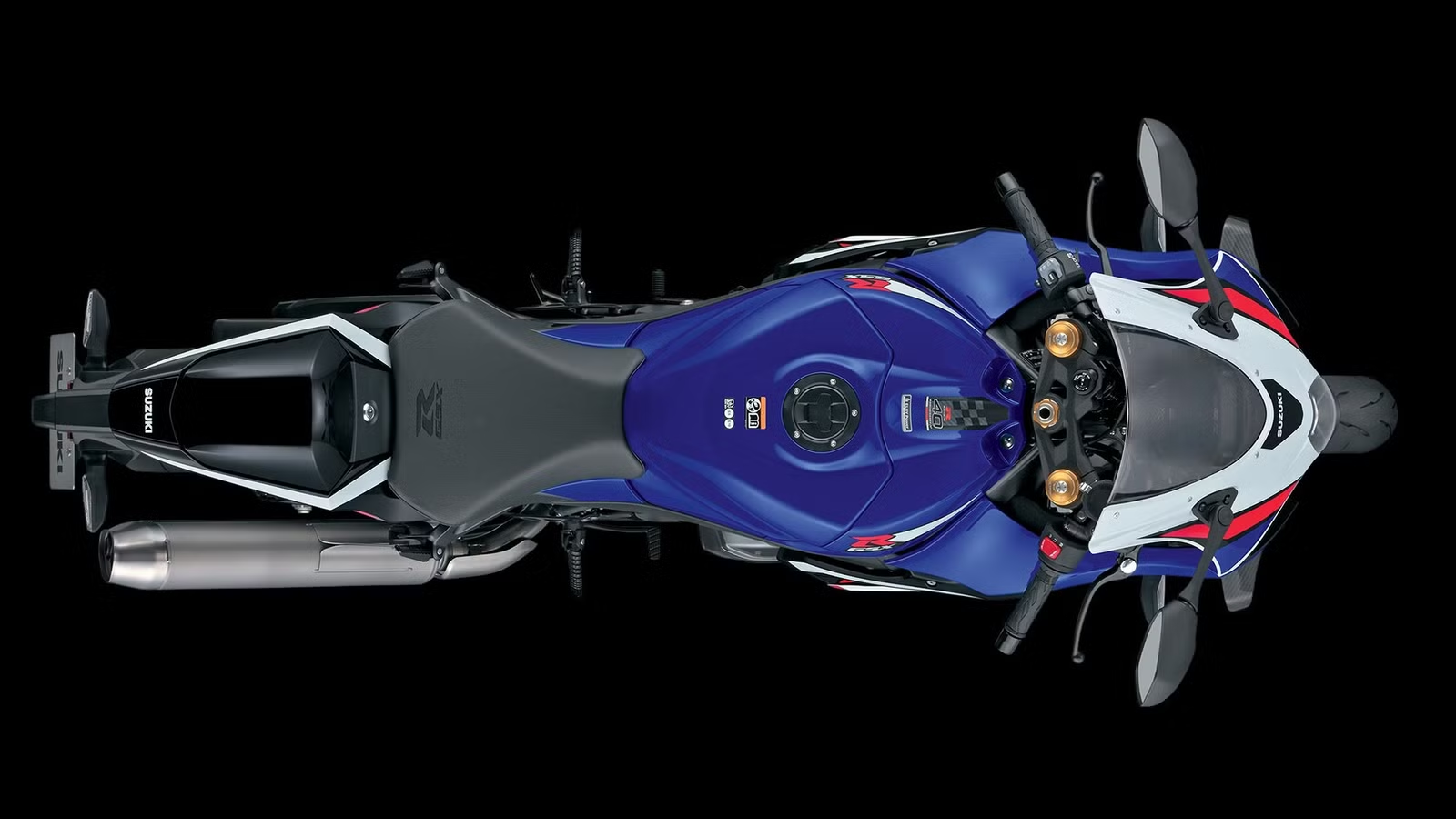
Value has always been synonymous with Suzuki. This is true for nearly everything the Japanese giant makes, be it ICE four-wheelers, electric cars, ATVs, and of course, motorcycles. Among the latter, the brand tries to invoke value in all of its two-wheeler products. Commuters, scooters, and middleweights are the obvious parties, but this even includes high-end sports bikes where value usually takes a back seat.

As a result, the Hayabusa-maker has a likable lineup of high-value sports bikes on sale in the US today. Out of these, the newest of the lot surprisingly offers the best bang for your buck. We say surprisingly because the latest tech and updates usually bring price hikes. Yet Suzuki has somehow made its liter-class superbike cheaper with the latest updates.
Suzuki Sells Five Sports Bikes Today
Diving deeper, there are a total of five sports bikes on offer right now. The GSX-8R starts things off with its sub-$10,000 MSRP, followed by the GSX-R600 and GSX-R750 priced between the $12,000 and $13,500 mark. Up next is the GSX-R1000 that sits between $16,000 and $18,500, depending on the variant you pick. Last but not least is the flagship Hayabusa, starting from $19,699.
It Has The Tightest Pricing Compared To Rival Brands


Out of all of its Japanese rivals, Suzuki’s sports bike lineup is the only one that tops out under $20,000. Honda, for instance, starts from the CBR500R, but the flagship machine–the CBR1000RR-R Fireblade SP–goes to almost $30,000. Likewise, Kawasaki’s Ninja lineup stretches from merely sub-$5,500 to well over $30,000 for the Ninja H2.
It’s a similar story for Yamaha, which has the sub-$5,500 YZF-R3 as the entry point and the over-$25,000 YZF-R1 M as the flagship. Compared to these, Suzuki’s lineup starts at a much higher price with the GSX-8R. But it tops out at under $20,000. That shows just how closely priced all of its sports bikes are. Sure, this makes finding the highest value option difficult, but there is a clear winner.
The GSX-R1000 Is The Most Value-For-Money Suzuki Sports Bike Today

The GSX-R1000 is the most VFM Suzuki sports bike in our books, and there are a few reasons. Chief among these is the fact that this is the freshest machine in the lineup. Yet somehow, it’s become cheaper in 2026. In comparison, the GSX-8R and Hayabusa haven’t had notable updates in almost half a decade, but they’ve still had minor price hikes. Whereas, the GSX-R600 and GSX-R750 have remained the same for well over a decade, while still getting small price revisions each year.
Things get better when you consider the MSRPs. The GSX-R1000 sells for $16,399 after its price cut. That makes the liter-class Gixxer $3,150 pricier than the GSX-R750 while being $3,300 cheaper than the Hayabusa. The three grand is well justified over the 750, considering the modern electronics and mechanical package. At the same time, it still offers a sharper and similarly loaded package than the pricier Hayabusa.
Incremental Updates Help The GSX-R1000 Make A Solid Case For Itself

As much as we like the price, staying relevant in 2026 is no easy task. Luckily for Gixxer fans, Suzuki has made some noteworthy updates this time around. All of these revolve around the mechanical and electronic side of things, though. That’s why the new bike still looks very much like the 2017 version. Here’s a lowdown on what all has been done.
VVT-Equipped Inline-Four Engine With Revamped Internals

Conventional inline-four engines are revvy and lack the punch of other configurations. That’s why bikemakers now plonk new technologies to boost the spread of power. And it was Suzuki that kickstarted the trend with the VVT-equipped Gixxer 1000.
In 2026, the MotoGP-derived technology remains relevant, thanks to the impressive grunt over rivals like the CBR1000RR and Ninja ZX-10R. The numbers are 193 horsepower and 81 pound-feet. The mill has also proven to be highly reliable under stress. The latest updates take another step in the same direction by making the internals even more solid. The tweaks include:
- New crankshaft with thicker journals
- New crankcases
- Wider cam chain
- New head gasket
- New piston circlips
- Revised head gasket shape
- New single-stage funnels for first and fourth cylinder
- Higher compression ratio
Updated Electronics Help You Manage The Power

With the engine tweaks, it’s only fair the electronics have new settings. That’s exactly the case. A new six-axis IMU works in tandem with the ECU to allow updated settings for the traction control (10 modes), wheelie control, cornering ABS, and roll-torque control. A revamped launch control system and two-way quickshifter are included, too.
What we’re not fond of is the instrument cluster. It’s the same inverse LCD from the 2017 without any updates, instead of a TFT that we’re used to seeing even on middleweight Suzukis. The inclusion of a Low RPM Assist and Easy Start System is a nice touch, though.
Showa Suspension And A Proven Chassis Round Things Off

The least change comes to the underpinnings. All of the elements are identical to the outgoing model, which had remained unchanged since 2017. As a refresher, you get fully adjustable Showa 43 mm Big Piston forks and a Showa monoshock to fine-tune the bumps. These are upgraded to Balance Free forks up front and a Balance Free Rear Cushion Light (BFRC-lite) monoshock on the R1000R.
What doesn’t change on the variants are the other bits. The aluminum perimeter frame and 17-inch wheels are common between all three Gixxer 1000s, and so are the dual 320 mm disc brakes up front and a 220 mm rear disc. Brembo monoblock calipers are present, too, but these aren’t the fancy Stylemas or Hypure units. A bummer if you ask us.
With no real effort to shed weight, the GSX-R1000 is still identical to the outgoing model in terms of dimensions. The wet weight is 447 pounds, which is lighter than the ZX-10R but slightly up from the YZF-R1. This is aided by a rather low 32.5-inch saddle height and a sub-56-inch wheelbase. We believe these will make the package quite comfortable and easy to live with for the masses.
Source: Suzuki Cycles

Related posts


Latest Post



No Comments