
Toyota’s First Sports Car Weighed 1,280 Pounds And Predated The Porsche Targa
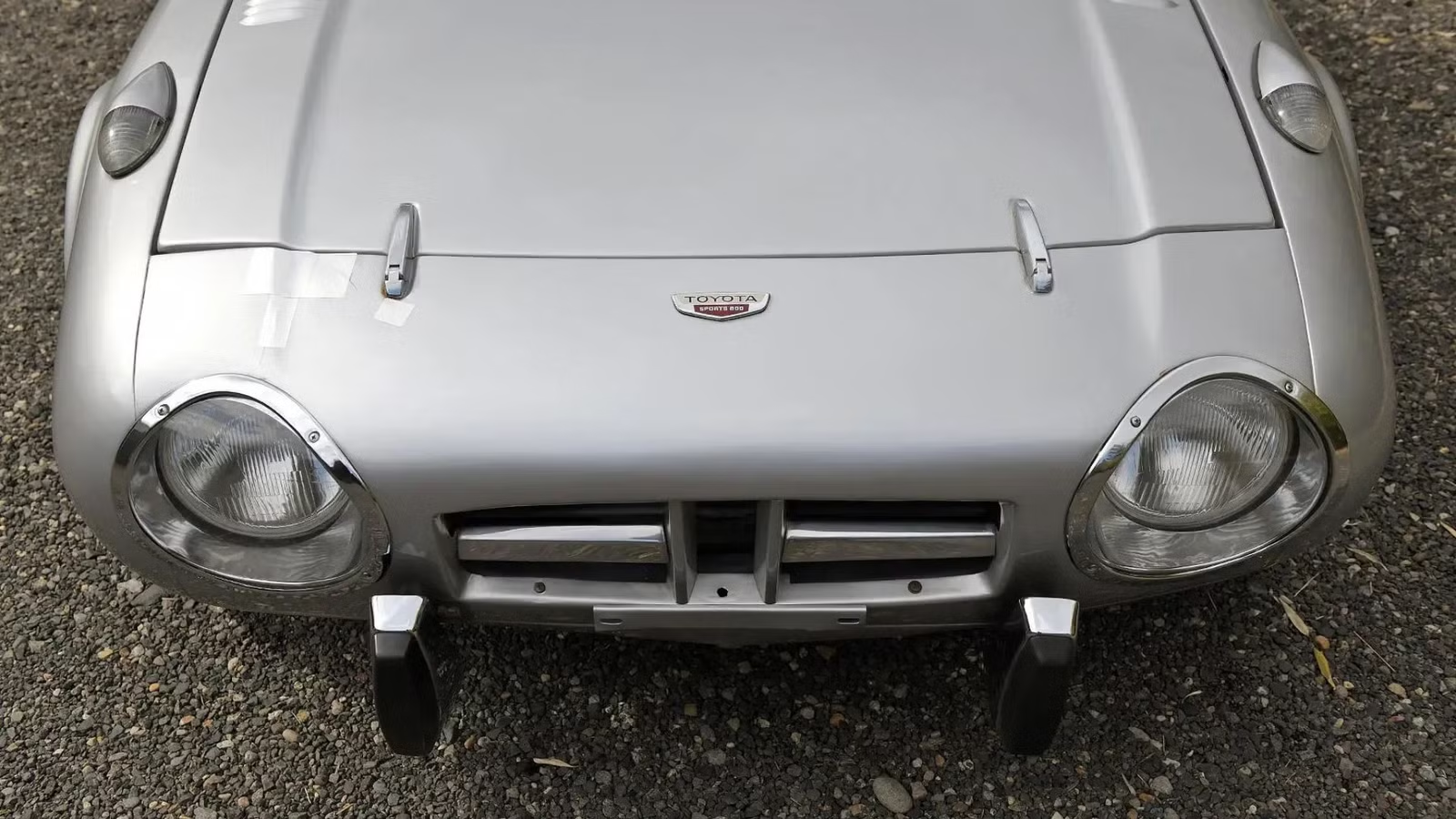
In its early days, Toyota established itself as a manufacturer of dependable yet largely uninspired economy cars. While the early ancestors of today’s ubiquitous Corolla and Camry successfully challenged rivals from Europe and the United States, it can be argued that the automaker’s lineup lacked excitement. However, the 1960s marked a pivotal turning point in the Japanese automotive industry, when Toyota engineers took the chassis of one of the brand’s unassuming family cars and revised it to create a dedicated sports coupe with minuscule dimensions and sprightly handling.
Toyota’s Lineage of Affordable Sports Cars

Toyota has a knack for small, affordable sports cars, and it has managed to carry on this philosophy into the modern age, despite safety regulations and heavy electronics making the idea of a small two-door coupe increasingly difficult to justify. Toyota’s modern sports car blueprint is commonly traced back to the AE86, which debuted in 1983 as a rear-wheel-drive, two-door variant of the Corolla. It paired a highly affordable price tag with an unfiltered, unassisted handling character, and its rejection of the standard Corolla’s front-wheel-drive layout harkened back to earlier Toyota coupes.
Exactly 25 years after the AE86 gave way to a rather disappointing front-wheel-drive replacement, Toyota took the wraps off the Scion FR-S. Placed under the umbrella of Toyota’s affordable, youth-oriented subsidiary in North America, the FR-S represented a return to rear-wheel drive roots. Developed jointly with the Subaru BRZ, the FR-S featured a Subaru-sourced 2.0-liter four-cylinder boxer engine under the hood, and like its spiritual predecessor, it focused on relatively modest power figures with 200 horsepower and 151 lb-ft of torque, as well as communicative steering and a tail-happy driving disposition.

As a result of its widespread popularity, the FR-S managed to survive the fall of the Scion brand in 2016. It carried on as the Toyota 86, effectively aligning the North American model with the Japanese and European variants, which had already been sold with Toyota badges since the sports car’s debut. The platform’s production run continued until the 2022 model year, when the sports car was fully redesigned and rebranded globally as the GR86. The current model offers a slightly larger 2.4-liter boxer four-cylinder and retains the classic rear-wheel-drive layout, and it continues to exist alongside a Subaru twin.
While the AE86 is often credited with starting the philosophy that has underpinned the Scion FR-S and today’s GR86, there is one lesser-known sports car from Toyota that set the affordable, lightweight, rear-wheel drive foundation many years earlier.
The Toyota Sports 800 Started It All

Contrary to popular belief, Toyota’s low-slung 2000GT grand tourer was not the first sports car to come out of Japan. Furthermore, the aforementioned AE86 that entered the scene decades later was not the first Toyota to offer an agile, tail-out driving experience. While both of those cars successfully shattered the common perception of Toyota as the manufacturer of uninspiring economy cars, it was not the brand’s first time producing a front-engined two-door that could be properly thrown around corners.
In 1962, Toyota revealed the Publica Sports concept car at the Tokyo Auto Show, shocking onlookers with a novel sliding canopy roof and curvy exterior panels. Three years later, in 1965, the production version made its debut with the Sports 800 nameplate, borrowing its chassis and mechanical components from the Publica 700 economy car. Toyota would produce just 3,131 units between 1965 and 1969, before it ultimately moved on to larger, more complex vehicles that chased higher power figures and cutting-edge technology.
Lightweight With Modest Power

The Sports 800 was charmingly simple beneath its lightweight sheet metal. The sports car underwent extensive weight-saving measures derived from the aircraft design background of chief engineer Tatsuo Hasegawa. The hood, roof, and trunk lid consisted of aluminum, and thin-gauge steel panels made up the rest of the exterior. The interior carried on the spartan theme, featuring a minimalist dashboard, two fixed seats, a slim steering wheel, and plain aluminum door panels without trim or upholstery. As a result, the Sports 800 weighed in at just 1,279 pounds (580 kg).
The sports car was admired for its agile, tossable handling thanks to its exceedingly lightweight build, but it was not exactly quick in a straight line. Under the hood, Toyota fitted the Sports 800 with a 790cc, air-cooled flat-twin engine positioned at the front of the car, delivering a mere 44 hp and 49 lb-ft of torque. The engine was derived directly from the Publica economy car, and its small dimensions eliminated the need for a complex cooling system, further shaving weight.
In addition to the feather-light curb weight of the Sports 800, its aerodynamic teardrop silhouette allowed for a rather impressive top speed of 96 miles per hour, as well as a massively impressive fuel efficiency claim of 72.9 mpg (24.5 km/l), which today’s heavier and more complex vehicles could never match. As a result of its aerodynamic, efficient nature, the Sports 800 was very successful in endurance races such as the 1966 Suzuka 500 km and 1967 Fuji 24-hour, as it required very few pit stops.
An Early Iteration of the Targa Top

One of the most notable features of the Sports 800 is its removable aluminum roof. The lift-out targa top allowed drivers to unscrew the roof panel above their heads and store it directly in the sports car’s rear trunk, while retaining a fixed rear section. As a result, Toyota’s sports car could offer a drop-top experience on demand without sacrificing chassis rigidity or aerodynamics.
Even more notably, the Sports 800’s targa top slightly preceded the more widely known Porsche 911 Targa, solidifying Toyota as one of the first manufacturers to implement the novel roof design. While Porsche’s open-air sports car entered production in late 1966, with the German automaker boasting the addition of a stainless steel roll bar to address rollover safety concerns in convertibles, Toyota had already been producing the Sports 800 with a Targa-style roof for more than a year.
An Exceedingly Rare Collector’s Gem Today

Today, only 10% of the original Sports 800 production cars remain in existence. Many were scrapped due to rampant rust throughout their thin steel exterior panels, while others fell victim to a severe lack of spare parts due to the sports car’s limited production run. The latter left many cars unrepairable, though some owners turned to “cannibalization” as a last resort, which meant that other Sports 800 examples had to be stripped for parts. Japan’s strict standards in its routine Shaken vehicle inspections also required rigorous and costly maintenance that some owners could not keep up with.
A vast majority of the surviving examples reside in Japan, though a handful of sports cars, including rare left-hand drive models, are located in the United States. One right-hand drive example from Tennessee notably appeared on Bring a Trailer in 2024, and it ultimately sold for $28,500 with roughly 23,000 miles on the odometer. Another Sports 800 with around 32,000 miles emerged from Oregon in 2023, selling for $41,000.
With its airy curb weight and agile handling prioritized above large power figures, the Sports 800 very clearly laid the groundwork for the philosophy that Toyota still uses for the GR86 today.
Sources: Bring a Trailer, Toyota, Porsche

Related posts



Latest Post


No Comments