
The Most Beautiful Japanese Motorcycle Ducati Never Wanted You To Notice
Modern superbikes seem increasingly determined to win fights with air. Their noses carry winglets, their fairings have fairings, and their bodywork contains enough holes to make you wonder whether someone misplaced the rest of the motorcycle. They are, without a doubt, technical masterpieces.

One Japanese manufacturer took a different approach during the late 1980s. It built a compact homologation special with two round headlights, a gorgeous single-sided swingarm, and bodywork so beautifully restrained that it still makes many modern Italian exotics look overdressed. Better still, this thing was no delicate fashion accessory. Underneath that clean skin lived a snarling V4 and enough racing hardware to ruin everybody else’s weekend.
This Japanese Superbike Made Simplicity Look Expensive
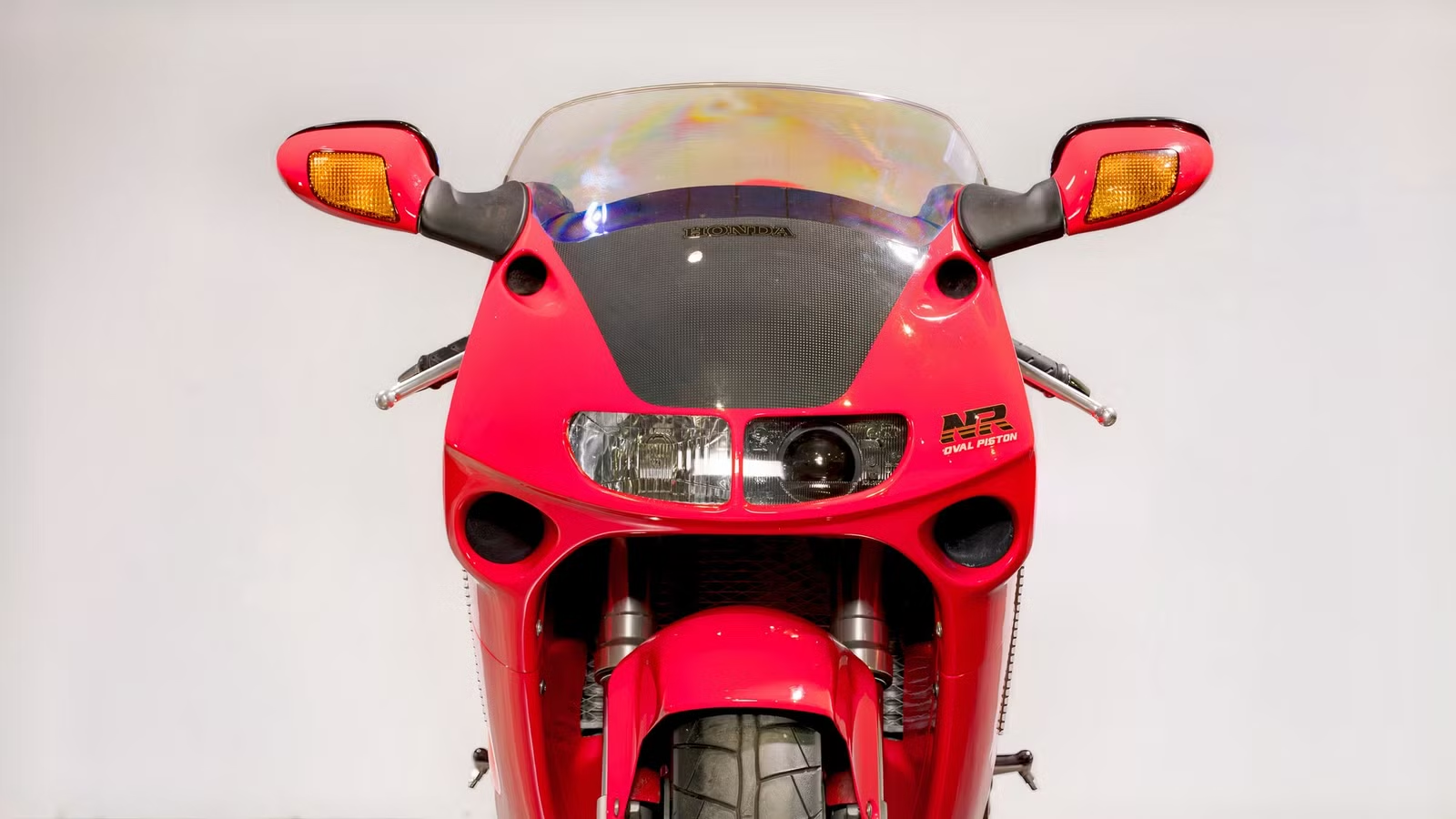
This mysterious machine arrived before sportbikes started growing aerodynamic parts all over body panels. Its deep red bodywork flowed from the pointed nose to the tiny tail without random fins, stacked panels, or plastic vents fighting for attention. The narrow headlights gave it a face that looked focused rather than furious. A sculpted fuel tank, single-sided swingarm, and perfectly integrated underseat exhaust completed a design that still looks modern more than three decades later.

It also used carbon-fiber body panels, side-mounted radiators, and a titanium-coated windshield. These features sound familiar now, but they bordered on science fiction when this motorcycle appeared. Park it beside a modern Ducati Panigale, and the Japanese bike looks like it arrived wearing a perfectly tailored suit. The Ducati appears to have brought its entire wardrobe and stapled half of it to the fairings.
The Honda NR750 Had Pistons Shaped Like Bread Loaves

The motorcycle was the 1992 Honda NR750, one of the most technically outrageous production machines ever built. Its 747cc V4 did not use conventional round pistons. Honda gave it four enormous oval pistons, each supported by two titanium connecting rods. Every cylinder had eight valves, two spark plugs, and two fuel injectors, creating a 32-valve engine that behaved more like a tiny V8 squeezed into four combustion chambers.
Honda developed this madness after Grand Prix regulations limited engines to four cylinders. Its engineers essentially joined pairs of cylinders together, allowing the engine to breathe like a V8 while technically remaining a V4. That is less like finding a loophole and more like attacking the rulebook with industrial machinery.
The road-going NR produced around 125 horsepower in unrestricted form and could rev beyond 14,000 rpm. Those numbers no longer appear terrifying, but the engineering required to achieve them remains spectacular.
Unfortunately, the bike was also heavy, complicated, and violently expensive. Its enormous $50,000 price in 1992 made it the world’s most expensive production motorcycle. Honda reportedly built only 322 examples, presumably because the company had already proven its point and its accountants needed medical attention.
An NR750 Can Still Cost Nearly $100,000 Today

The NR750 was never a bargain, and more than three decades later, collectors still require a seriously healthy bank account to grab one.
A remarkably preserved 1992 NR750 from the Dare to Dream Collection sold for $69,600 at an RM Sotheby’s auction on June 1, 2024. Another example sold through Iconic Motorbike Auctions for $72,332, showing that desirable bikes can comfortably break through the $70,000 barrier.
Could a pristine, ultra-low-mileage NR750 approach $100,000? Absolutely. Its value depends heavily on originality, condition, mileage, and documentation, so not every example will command that amount. However, one of the finest bikes appearing before the right collectors could realistically flirt with six figures.

The NR750 was not the fastest superbike of its era, and its racing ancestors were famously difficult to develop. None of that damages its appeal today. This machine exists because Honda refused to accept that oval pistons were ridiculous, even when almost everyone else probably suggested using normal ones.
Modern superbikes demolish it on performance, electronics, and affordability. Yet few can match its visual restraint, engineering audacity, or ability to make knowledgeable riders stare at an engine diagram for 20 minutes. The NR750 did not need winglets to appear exotic. Four oval pistons and a body that still looks this damn good were more than enough.

Related posts





Latest Post


No Comments