
The Most Affordable EV From 2024 With Over 350 Miles Of Range
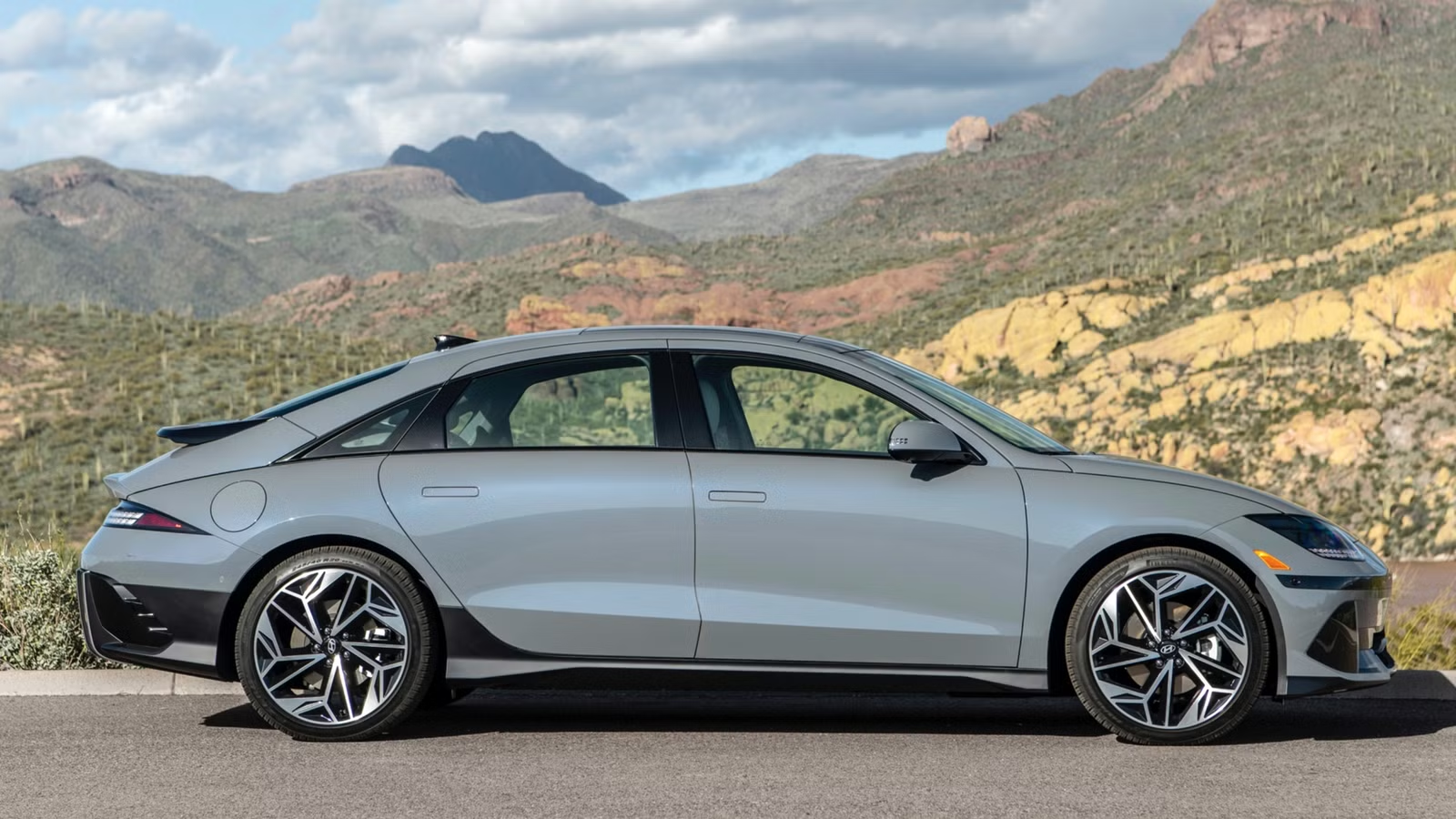
Range anxiety remains one of the biggest hurdles keeping drivers from making the switch to electric — and for good reason. While a 300-mile EV is genuinely impressive and hits the sweet spot for many American buyers, it’s the 350-mile threshold that tends to make people truly comfortable ditching their internal combustion engine (ICE) vehicle for good. The average American drives roughly 14,500 miles a year — about 39 miles per day — which makes range anxiety a very real concern. Factor in battery degradation over time, range loss in cold weather or under heavy payload, and a charging infrastructure that still has room to grow, and that extra cushion of range starts to look less like a luxury and more like a necessity.

If you want a used EV with 350-plus miles of range, you have a reasonable number of options — but most of them are large vehicles carrying equally large price tags. What’s surprising is that one model manages to undercut the average new-car transaction price by a meaningful margin, and sits well below the average new EV transaction price. Read on to find out which affordable long-range EV earns the top spot.
The 2024 Hyundai Ioniq 6 Is Your Answer
If you want the most affordable EV with 350 miles of range — or in this case, 361 miles of EPA-estimated range — your nearest Hyundai dealer is the place to go. Better yet, you don’t need to step up to a higher trim or opt for a larger battery pack to unlock that 361-mile figure.
That Means Settling For The Base SE

That’s because all Ioniq 6s sold in the United States are the Long Range model, which comes with the larger 77.4 kWh lithium-ion battery rather than the Standard Range’s 53 kWh pack. A Standard Range variant is expected to arrive with a lower price and an EPA-estimated 240 miles of range, but for now the conversation centers on the Long Range SE — the least expensive way into the Ioniq 6 lineup and, as it turns out, the variant with the longest range of all.
Lower Price, But Longer Range
Choosing the lowest-priced Ioniq 6 SE Long Range also means choosing the Ioniq 6 with the greatest range, and the reason comes down to one detail: wheel size. The SEL and range-topping Limited ride on 20-inch alloys that look sharp and complement the Ioniq 6’s sculpted silhouette, but they trim range by 56 miles on the rear-wheel drive (RWD) model and 46 miles on the dual-motor all-wheel drive (AWD) version. Whether that trade-off is worth it is entirely a personal call. When new, it was available for $38,615, but if you’re going for a used model in 2026, then you’ll have to shell out around $22,400, which is the KBB Fair Purchase Price for a 2024 Ioniq 6.
Under the skin, the Ioniq 6 is available with either a single-motor RWD layout producing 225 horsepower and 258 pound-feet of torque, or a dual-motor AWD setup rated at 321 horsepower and 446 pound-feet of torque. Opting for AWD brings more power and all-weather traction, but it does come at the cost of some range.
Hyundai Ioniq 6 Comparison
|
Battery Size |
Layout |
Horsepower |
Torque |
0-100 km/h (62 mph) |
EPA Range (18-inch wheels) |
EPA Range (20-inch wheels) |
|
53 kWh (Standard Range) |
RWD |
149 hp |
258 lb-ft |
8.8 sec. |
240 miles |
N/A |
|
77.4 kWh (Long Range) |
RWD |
225 hp |
258 lb-ft |
7.4 sec. |
361 miles |
305 miles |
|
AWD |
321 hp |
446 lb-ft |
5.1 sec. |
316 miles |
370 miles |
It’s Not Just An EV With Long Range

The EV era has acted as a great equalizer for the automotive industry. Whatever advantage an automaker built up with the internal combustion engine over the past century is increasingly irrelevant as more countries shift their focus toward alternative-energy vehicles.
As a result, you can tell a great deal about how seriously an automaker has committed to electrification simply by examining how their EVs are engineered. In the case of the Ioniq 6, Hyundai set out to reinvent the ownership experience from the ground up — starting with the vehicle’s architecture.
Platforms Make The World Go Round

Like most major automakers, Hyundai Motor Group (HMG) — the parent company of Hyundai, Kia, and Genesis — has invested heavily in scalable vehicle platforms. For its dedicated EVs, HMG uses the Electric Global Modular Platform (E-GMP), engineered from the outset as an EV-only architecture. Because there’s no ICE or conventional drivetrain to accommodate, the packaging benefits are immediately apparent: a front trunk, a genuinely spacious cabin, and a wheelbase that stretches longer than that of the Palisade midsize SUV.
When An EV Also Becomes A Lifestyle Tool

The E-GMP platform also incorporates an 800-volt architecture, which unlocks a pair of ownership experiences that simply aren’t possible in an ICE vehicle. The Ioniq 6 — along with the Ioniq 5 and other E-GMP-based EVs — supports bidirectional charging, otherwise known as vehicle-to-load (V2L).
In practice, the 77.4 kWh battery can serve as a portable power source. Planning a camping trip? Plug your appliances directly into the car. Need backup power during a home blackout? The Ioniq 6 can handle that too. You can even use V2L to top up another EV in a pinch.
With all this talk of batteries and bidirectional charging, charging speed deserves its own moment. That 800-volt architecture enables some of the fastest charging rates of any EV on sale. The Ioniq 6 supports up to 350 kW DC fast charging and up to 22 kW AC charging. At its peak DC rate, the battery climbs from 10 to 80 percent in just 18 minutes, and a five-minute charge alone adds 68 miles of range.
Everything Else That’s Offered On The Ioniq 6 SE

Convinced the Ioniq 6 SE Long Range is the right move? You’ll also be pleased to learn that, despite being the entry-level model, it arrives with a generous standard equipment list. That shouldn’t come as a shock — even as Hyundai’s average transaction prices have risen alongside its growing desirability, the South Korean brand hasn’t abandoned its value-for-money heritage.
Sleek, Streamlined Exterior

Like every Ioniq 6, the SE wears a “streamliner-inspired” body that prioritizes aerodynamic efficiency. At a drag coefficient of 0.22 Cd, it ranks among the slipperiest sedans in its segment. Standard exterior highlights include full LED lighting, amber LED daytime running lights, flush door handles that extend and retract automatically, and a hands-free powered trunk lid.
Of course, the biggest contributor to that 361-mile EPA-estimated range is the SE’s 18-inch wheels. They may not turn heads the way the 20-inch alloys do, but the payoff — significantly more range and a more comfortable ride thanks to the taller tire sidewalls — is hard to argue with.
A Cocooned, Safe Space
Where the Ioniq 5 channels a living-room vibe, the Ioniq 6 feels more driver-focused and cocooned, thanks in part to its rising center console. Notably, the window switches are mounted on that console rather than the door panels — a quirk that takes some adjustment but frees up the door pockets to become some of the largest storage bins found in any car.
Standard features include dual 12.3-inch screens with wired Apple CarPlay and Android Auto, dual-zone climate control, fabric upholstery, a power-adjustable driver’s seat, and heated front seats, among others. What you forgo on the SE are items like the Bose premium audio system, the dual-color ambient lighting, and the second-row V2L outlet — though the external V2L port remains standard.
Safety is well covered on the Ioniq 6 SE, with most of the Hyundai SmartSense suite of advanced driver-assistance systems included as standard:
- Forward Collision-Avoidance Assist (without Junction Turning)
- Smart Cruise Control (SCC) with Stop & Go
- Highway Driving Assist I (HDA I)
- High Beam Assist (HBA)
- Lane Keeping Assist (LKA)
- Lane Following Assist (LFA)
- Blind-Spot Collision Warning (BCW)
- Rear Cross-Traffic Collision-Avoidance Assist (RCCA)
- Driver Attention Warning (DAW)
- Intelligent Speed Limit Assist
- Safe Exit Warning (SEW)
These ADAS features come on top of the standard front and rear parking sensors, reversing camera, and the full complement of airbags throughout the cabin.
Sources: Hyundai, KBB, Edmunds

Related posts



Latest Post


No Comments