
The Mitsubishi Family Crossover That Hid A Lancer Evo Engine
These days, most people wouldn’t dream of taking their kids to school in anything other than a hot crossover with more power than an ’80s supercar. Crossover SUVs have always had that blend of five-door practicality and off-road chops that made them a safe bet for bumping up the curb outside a coffee shop, but when manufacturers started giving them wild performance, you finally had a car that could do practically anything. But where did all this madness start? It turns out that Mitsubishi may have gotten the ball rolling when it piled most of an Evo rally car into a sleeper crossover for the JDM market. And you will soon be able to buy one in America too.


The Crossover SUV Emerged In The ’80s

Before we get into fast crossovers, it’s important to know where these jacked-up rides came from in the first place. Perhaps surprisingly, the finger can be pointed at a relatively obscure US brand that many people might have forgotten. Built on a compact passenger vehicle platform, the AMC Eagle featured Quadra-Trac four-wheel-drive, lifted suspension, and protective body cladding — and it was years ahead of its time. Here was a wagon that you could drive to the shops in and tackle a trail on the way home. It predated the crossover SUV trend by decades.
Models like the popular Toyota RAV4, which was revealed in 1993 at the Tokyo Motor Show, took much of what people loved about the Suzuki Samurai but made it more car-like and easier to live with. Suddenly, people realized they could be outdoorsy, fishing-and-camping types, even if they actually managed an inner-city sales department in Midtown Manhattan. But then someone had another idea, creating one of the best Sleeper Cars of all time.
The Performance Crossover Is The School Run Chariot Of Choice

At some point, consumers must have realized that while their crossover drove like a car, carried people and stuff like a wagon, and made them feel all lofty, what they were really missing was enough firepower to outgun serious sports cars at the lights. We may be desensitized to SUVs that can drag race supercars these days, but a few years ago it was a relatively new phenomenon. Buyers are now spoiled for choice, with everyone from Ferrari to Audi falling over itself to offer a sporty SUV. The Maserati Grecale Trofeo uses a detuned version of the MC20 supercar’s 3.0-liter twin-turbo V6 “Nettuno” engine, for crying out loud. A Porsche Macan GTS has a 434 horsepower twin-turbo V6 and will hit almost 170 mph. But where did all this come from? The answer may surprise you.
The New 3000GT VR4 Mitsubishi Should Make
The Mitsubishi 3000GT VR4 was one of the quickest cars of the ’90s, and making a successor makes more sense than you think.
The Mitsubishi Airtrek Turbo R Was The First True Performance Crossover

Yes, there were fast SUVs before, namely the GMC Typhoon and even the hot hatch-slaying 4.0-liter Jeep XJ, but one model stands out as being a true attempt to blend serious rally-bred sports sedan performance with crossover practicality. Mitsubishi, along with Subaru, was crushing it in the ’90s, with seemingly endless road versions of the Evo rally car that dominated forests across the world. The Evo had a killer combination of bulletproof turbocharged four and clever all-wheel-drive, making it devastatingly sure-footed on any surface.
2002 Mitsubishi Airtrek Turbo R Specs
|
Engine |
4G63T turbo four |
|
Power |
237 hp |
|
Torque |
253 lb-ft |
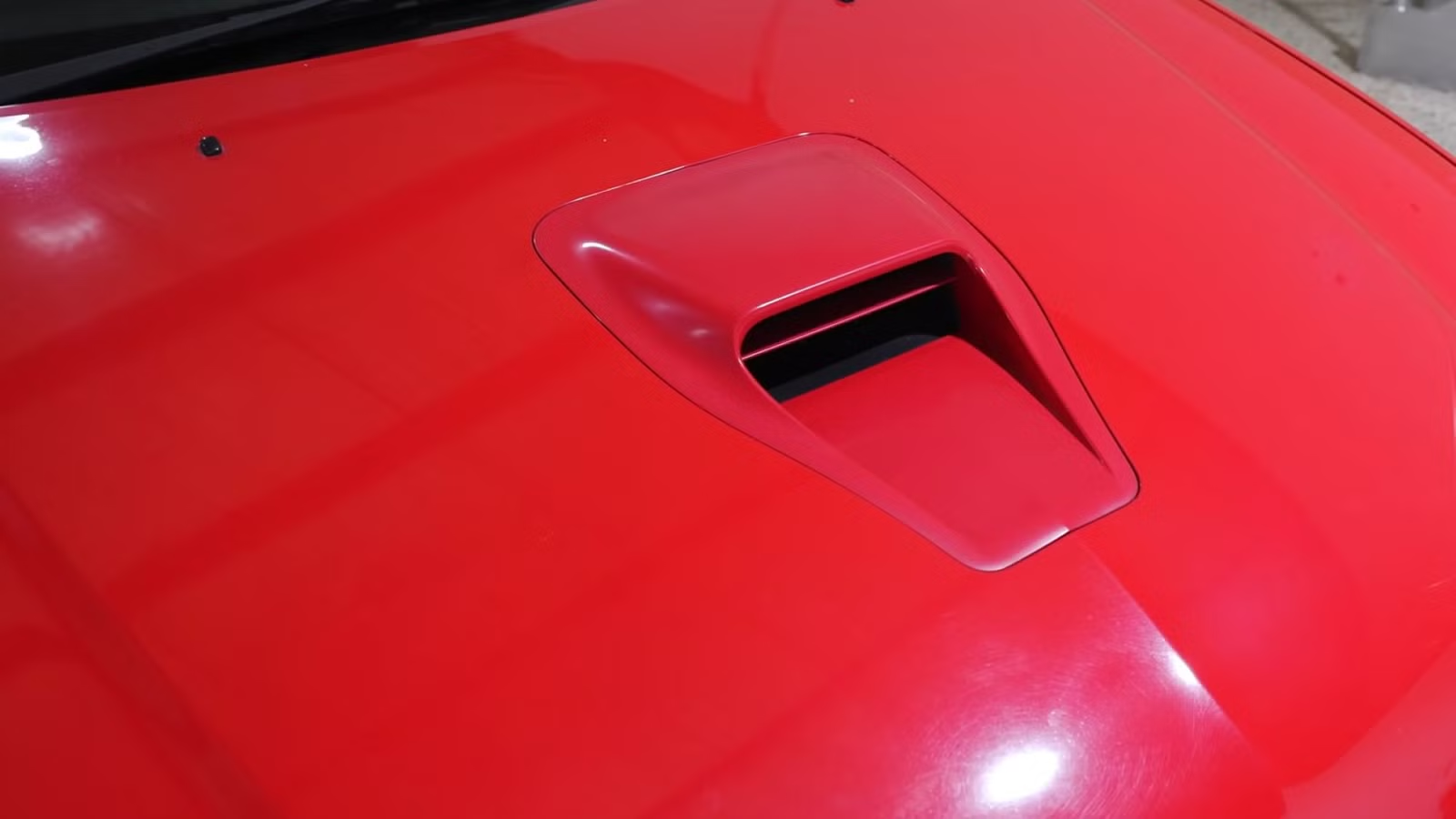
The Mitsubishi Airtrek launched in Japan in 2001 and two years later in the US as the Outlander. The American model was pretty unoffensive, with a naturally aspirated engine and crossover practicality. In Japan, however, Mitsu decided to launch a sports version in 2002 called the Airtrek Turbo R. On went a hood scoop and 16-inch alloys, but most importantly, the Turbo R received a large slug of power.
The Turbo R Is An Evo-Engined Sleeper

Under that new hood, Mitsubishi fitted a detuned version of the Lancer Evolution VII’s legendary 4G63T engine. In doing so, the company created one of the first true hot crossovers. Consider this, the Turbo R’s engine has 237 hp and 253 lb-ft of torque at just 2,500rpm, allowing it to reach 60 mph in 6.5 seconds. That might not seem like ridiculous speed these days, but it was fast 25 years ago. The much loved Honda S2000 drop-top sports car, with its 8,900 rpm red line, would be slower (at least according to one test) reaching 60 mph in 6.8 seconds. But the Airtrek Turbo R wasn’t just about straight line speed.
The Turbo R Can Tackle More Than The School Run

The JDM Turbo R came equipped with a full-time AWD system that utilizes a viscous coupling center differential. The engine is mated to a 5-speed automatic transmission featuring Tiptronic steering wheel paddle shifters. Testers found that, despite the size (3,351 pounds) and unassuming shape, the Turbo R had an astonishing turn of speed over twisty back roads. “Despite its size and comparatively lofty ride height, turn-in is sharp with little body roll,” noted Top Gear. “Mid-corner grip levels would shame some hot hatches and with sure-footed traction on the exit of corners you really do forget the Airtrek’s size.” There was an export Outlander Turbo version for European markets, which did come with a 5-speed manual transmission, although the engine only managed 202 hp.
Mitsubishi Lancer Evolution: Complete Guide To Every Generation And Buying One Today
It became a legend by dominating one era, embarrassing bigger rivals, and turning into one of the most wanted performance bargains left.
The Mitsubishi Airtrek Turbo R Is Coming To The USA
Since the Airtrek Turbo R launched in Japan in 2002, from next year it will be eligible for import under the 25-year rule. This allows car fans to legally source vehicles from abroad that are at least 25 years old, bypassing certain federal safety and emissions standards. The good news is that the Turbo R never gained the notoriety of its Evo cousin, and even in Europe, previously imported cars rarely sell for more than around $10,000. The cost of importing a car from somewhere like Germany to the US is from $2750, says West Coast Shipping, with classics paying 2.5% duty and modern vehicles from 27.5%. So finding and importing an Airtrek Turbo R shouldn’t break the bank — but there are a few things to watch out for, including not mistaking a genuine Turbo R for a lower-powered European Turbo model.
Make Sure You Do Your Homework When Buying Any Performance JDM Import

As with any used car purchase, it is important to do your homework, but if you are buying it sight unseen and shipping it across an ocean, extra care is needed. ReDriven has done a good review on what to look out for in Airtrek Turbo Rs, starting with the failure of the window regulators, a known problem area. Then check for paint degradation — particularly peeling and flaking on the hood scoop — as well as rust under the trunk. Another good tip is to be aware of bits of innocent-looking trim that are damaged or missing. This may not be an issue with a Mustang, but parts are harder to come by on a rare JDM car.
The 4G63T is a solid engine, but make sure it has been properly serviced and maintained, and watch out for oil leaks. Also check that the transmission fluid has been regularly changed. As with most JDM cars of this era, if looked after, the Airtrek Turbo R should be a sturdy and reliable workhorse. It makes for an interesting alternative to an Evo, too.
Sources: Redriven.com, TopGear, Mitsubishi, West Coast Shipping

Related posts



Latest Post


No Comments