
The Largest Displacement V8 Ever Put In An American Car
In an era when automakers are chasing efficiency with turbocharged four-cylinders and hybrid powertrains, it’s worth pausing to appreciate just how gloriously excessive American engines once were. Displacement was king, and the bigger the cubic inches, the better — because for a naturally aspirated engine, there is no substitute for sheer size when it comes to making power. Forced induction can compensate with boost, but a big-lunged air-breather lives and dies by how much fuel and air it can swallow in a single stroke.

During the classic muscle car era from the mid-1960s to the early 1970s, American automakers were involved in a sort of arms race to make faster cars and bigger engines. Chrysler led the way with the legendary 426 Street Hemi and the 440ci Six-Pack. Ford actually had a winner in the 425-horsepower 427, but curiously replaced it with the 428 and 429, both of which had less power. GM, on the other hand, not only kept their mighty 427 alive for the Corvette, they rewarded the rest of their lineup with massive 454 and 455 cubic-inch engines.
As remarkable as it seems, those humongous V-8s aren’t even close to the largest displacement engine ever factory-installed in a car. Big engines still exist today, mostly in trucks, but the largest displacement available in a current production car is a far cry from the giants of the past — and positively puny compared to the largest displacement V-8 ever fitted to a regular-production American automobile.
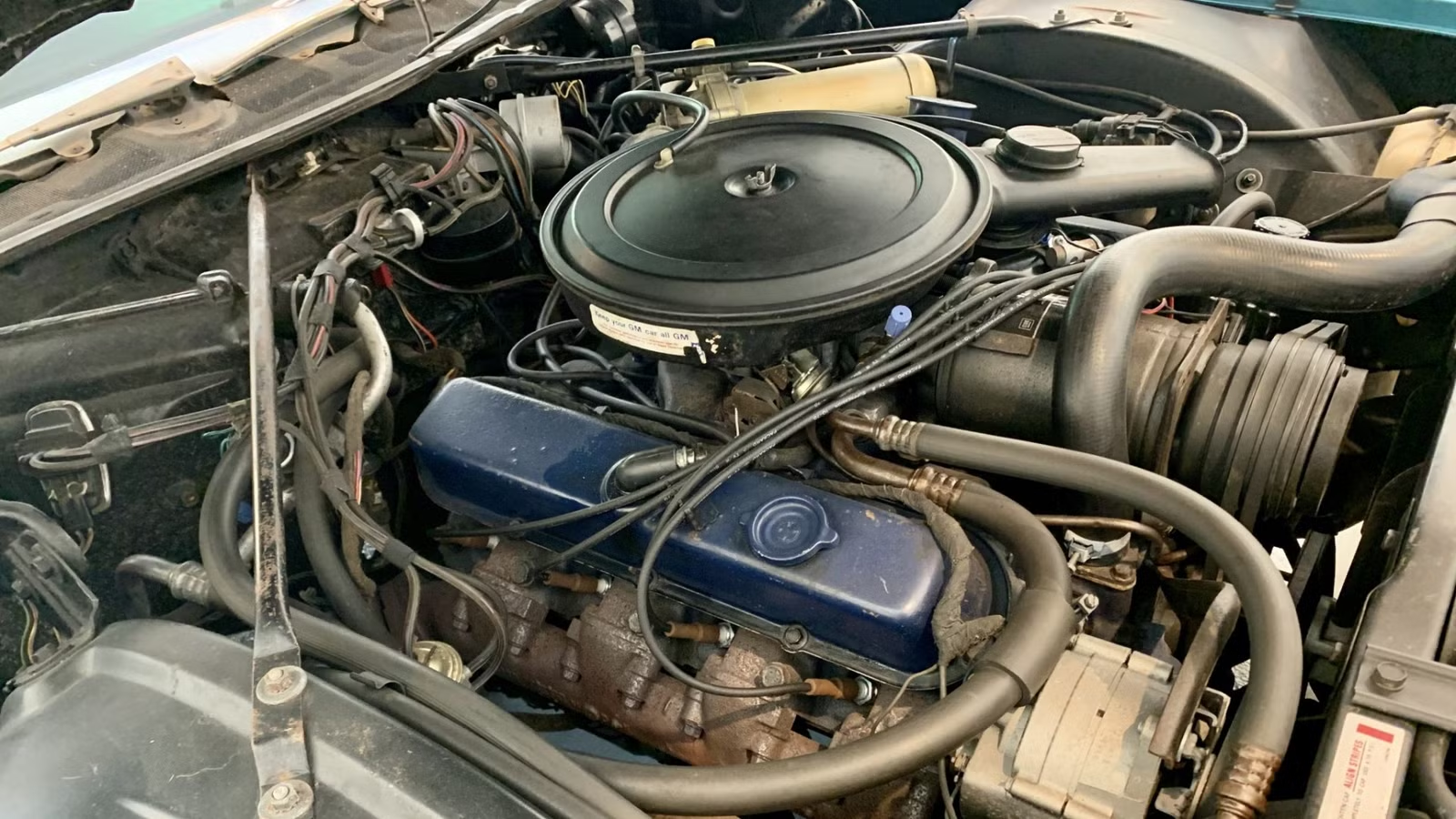
Cadillac 500 V-8 Engine

For most of the 1960s, General Motors had a peculiar big-engine ban that kept V-8s with displacements larger than 400 cubic inches out of their divisions’ mid-sized cars. The Corvette was exempt, but this certainly hampered Chevy’s muscle car performance until the ban was lifted for the 1970 model year. For GM’s full-size rides, however, big engines weren’t just allowed — they were necessary, especially for the Cadillacs. The Eldorado went through five generations in the ’60s, and with each new entry it grew in size, requiring increasingly large engines to move it.
1970 Cadillac Eldorado Power and Performance
|
Engine |
500ci V-8 |
|---|---|
|
Horsepower |
400 HP |
|
Torque |
550 pound-feet |
|
Transmission |
Three-speed automatic |
|
0-60 Time |
8.8 seconds |
|
Quarter-mile |
16.37 seconds |
|
Top Speed |
126 MPH |
Introduced for the 1970 model year, the Cadillac 500 V-8 engine was, as the name suggests, 500 gas-guzzling cubic inches of American excess. Exclusive to the Eldorado until 1976, the 500 was derived from the Cadillac 472ci engine, with an increased stroke to generate the additional displacement. Rated at 400 horsepower, it wasn’t quite as dynamic as many performance engines of the day, but its 550 pound-feet of torque made it the undisputed rotational-force champion. This engine didn’t transform the Eldorado into a factory drag car, but it did keep the massive luxury cruiser from feeling like a slug.
Rise And Fall Of The 500
The fourth-generation Eldorado, built from 1959–1960, and the fifth generation from 1961–1962 came standard with a 390ci V-8 that produced 325 horsepower. For the sixth and seventh generations (1963–1966), a 340-horsepower 429ci V-8 was the top option. In 1968, Cadillac decided the Eldorado needed more muscle and introduced a 472ci V-8 generating 375 horsepower. Two years later, in 1970, even that was deemed insufficient, and the 400-horsepower 500ci V-8 became available.
A 1970 Cadillac Eldorado, equipped with the 500 engine, returned around 9 MPG combined — and that’s essentially why the engine began an almost immediate decline. The fuel crisis of the 1970s and tightening government regulations forced automakers to improve fleet fuel economy across the board. In 1971, the 500 engine was detuned to 365 horsepower, and in 1972 it shed another 30 ponies. By 1976, this once-mighty engine mustered only 190 horsepower — a figure that seems barely adequate to motivate a 5,000-pound Cadillac.
The 400-Plus Displacement Club
All Big Three American automakers had V-8 engines with displacements over 400 cubic inches for years, but they were reserved for full-size car and truck use. Once the 1964 Pontiac GTO made it cool to drop big-block V-8s into mid-size platforms, the displacement and horsepower wars began in earnest. That fight was essentially settled by 1966 with the introduction of the Chrysler 426 Street Hemi. Cranking out 425 ponies and 490 pound-feet of torque, it was the highest-performance engine of the classic muscle car era.
420-Friendly Engines
|
Engine |
Horsepower |
Torque |
|---|---|---|
|
426ci Hemi V-8 |
425 HP |
490 pound-feet |
|
427ci FE V-8 |
425 HP |
480 pound-feet |
|
427ci L88 Tri-Power V-8 |
435 HP |
460 pound-feet |
|
428ci Cobra Jet V-8 |
335HP |
420 pound-feet |
|
429ci 390-Series V-8 |
340 HP |
480 pound-feet |
|
429ci Cobra Jet V-8 |
375 HP |
450 pound-feet |
|
440ci Magnum V-8 |
390 HP |
490 pound-feet |
|
454ci LS-6 V-8 |
450 HP |
500 pound-feet |
|
455ci Big Block V-8 |
360 HP |
510 pound-feet |
|
460ci 385-Series V-8 |
365 HP |
500 pound-feet |
|
472ci 472-Series V-8 |
375 HP |
525 pound-feet |
|
500ci 472-Series V-8 |
400 HP |
550 pound-feet |
Ford had the 335-horsepower 429ci Cobra Jet V-8, which many claim was underrated, but the 14- and 15-second quarter-mile times of cars equipped with it tell a different story. Over at Chevy, the C2 and C3 Corvettes had the 425-horsepower 427ci V-8 available, but no other mid-size production car had access to it. Finally, in 1970, when GM’s arbitrary big-engine ban ended, the 390-horsepower 454ci V-8 was unleashed, giving the Chevelle a fighting chance against Mopar muscle cars.
454 Horsepower King

While the Cadillac 500 wears the torque crown for massive V-8s in regular production cars, it’s the Chevy Big Block 454 that is the King of the Ponies. Introduced in 1970, the 454ci V-8 came in two variants. The LS-5 version produced 390 horsepower and 500 pound-feet of torque, which is impressive until it’s compared to the 450 horsepower of the LS-6. This engine was most famous for powering the 1970 Chevelle SS and the 1971 C3 Corvette ZR2, both of which are extremely rare classics today.
Quickest Massive Engine Cars
The Cadillac Eldorado has always been a full-size luxury cruiser, and its 500ci V-8 was never intended to make it a performance vehicle. With other massive engines, however, the goal was winning red-light challenges and earning bragging rights at the drag strip. As is often the case, more displacement doesn’t automatically equal more horsepower, and high cubic inches aren’t synonymous with low quarter-mile times.
Big V-8 Drag Race
|
Car |
Engine |
Quarter-mile Time |
|---|---|---|
|
1970 Cadillac Eldorado |
500ci 472-Series V-8 |
16.37 seconds |
|
1968 Lincoln Continental Mark III |
460ci 385-Series V-8 |
16.0 seconds |
|
1969 Ford Mustang Boss 429 |
429ci 385-Series V-8 |
14.09 seconds |
|
1970 Dodge Challenger R/T SE |
440ci Magnum V-8 |
14.0 seconds |
|
1969 Ford Mustang Mach 1 |
428ci Cobra Jet V-8 |
13.9 seconds |
|
1970 Chevrolet Chevelle SS |
454ci LS-6 V-8 |
13.8 seconds |
|
1970 Buick GSX Stage 1 |
455ci Big Block V-8 |
13.3 seconds |
|
1967 Chevrolet Corvette Sting Ray |
427ci L88 Tri-Power V-8 |
13.3 seconds |
|
1970 Plymouth Hemi ‘Cuda |
426ci Hemi V-8 |
13.1 seconds |
The Eldorado Got Bitten By A Viper

The Cadillac Eldorado, which was first fitted with the 500ci V-8 in 1970, held the record for the largest displacement engine in an American production car for 33 years, until Dodge reared up and bit it on the back end. Introduced for the 1992 model year, the Viper sports car featured an 8.0-liter V-10 engine, but that only equaled 488 cubic inches, so the Eldorado was still the King of Displacement. In 2003, however, Dodge unleashed the second-generation Viper with an 8.3-liter V-10, which works out to 506.5 cubic inches.
Dodge Viper Engines
|
Generation |
Engine |
Horsepower |
|---|---|---|
|
First (1992-2002) |
8.0-liter Viper V-10 |
400-460 HP |
|
Second (2003-2006) |
8.3-liter Viper V-10 |
500-510 HP |
|
Second (2008-2010) |
8.4-liter Viper V-10 |
600-640 HP |
|
Third (2013-2017) |
8.4-liter Viper V-10 |
640-645 HP |
Dodge wasn’t quite done in the displacement race, fitting the third-generation Viper with an 8.4-liter V-10 — a whopping 512.5 cubic inches. The Viper holds the record for the largest displacement engine ever put into an American production vehicle, but there is a caveat that allows the Cadillac to retain some prestige. The Viper needed two extra cylinders to claim the top spot, so the Cadillac Eldorado remains the champion when it comes to V-8 engines specifically. Given the industry’s ongoing shift toward turbocharged V-6s, electrification, and hybrids, it seems unlikely that any American car will ever out-displace the 500ci V-8.
The Cadillac 500 V-8 Could Have Been A Legend

The fact that the Cadillac 500 is the largest displacement V-8 ever put in an American car is a bit like Spinal Tap guitarist Nigel Tufnel bragging that his amplifier “goes to 11” when all others only reach 10. Yes, the 500ci is bigger than any other production car V-8, but it isn’t more powerful or faster — it’s just a number that sounds enormous. The 1970 Cadillac Eldorado is a timeless classic, but it was never a street machine. The real shame is that, if not for some unfortunate timing, the Caddy 500 could have been one of the most legendary engines ever created.
Debuting in 1970, it arrived just as government emissions regulations tightened and consumer demand for better fuel economy surged — which meant there was never any appetite to develop a performance version of the Cadillac 500. With upgraded cylinder heads, a dual-four-barrel carburetor setup, and a more aggressive compression ratio, it’s not beyond the realm of possibility that this engine could have cracked 500 horsepower with torque figures pushing into the high 600s pound-feet. Imagining something like that under the hood of a Chevelle SS remains every muscle car fan’s greatest what-if fantasy.
Sources: Cadillac, Dodge, and Chevrolet

Related posts
Latest Post


No Comments