
The Custom Exhaust That Makes American V8s Sound Like F1 Cars (or a Vacuum Cleaner)
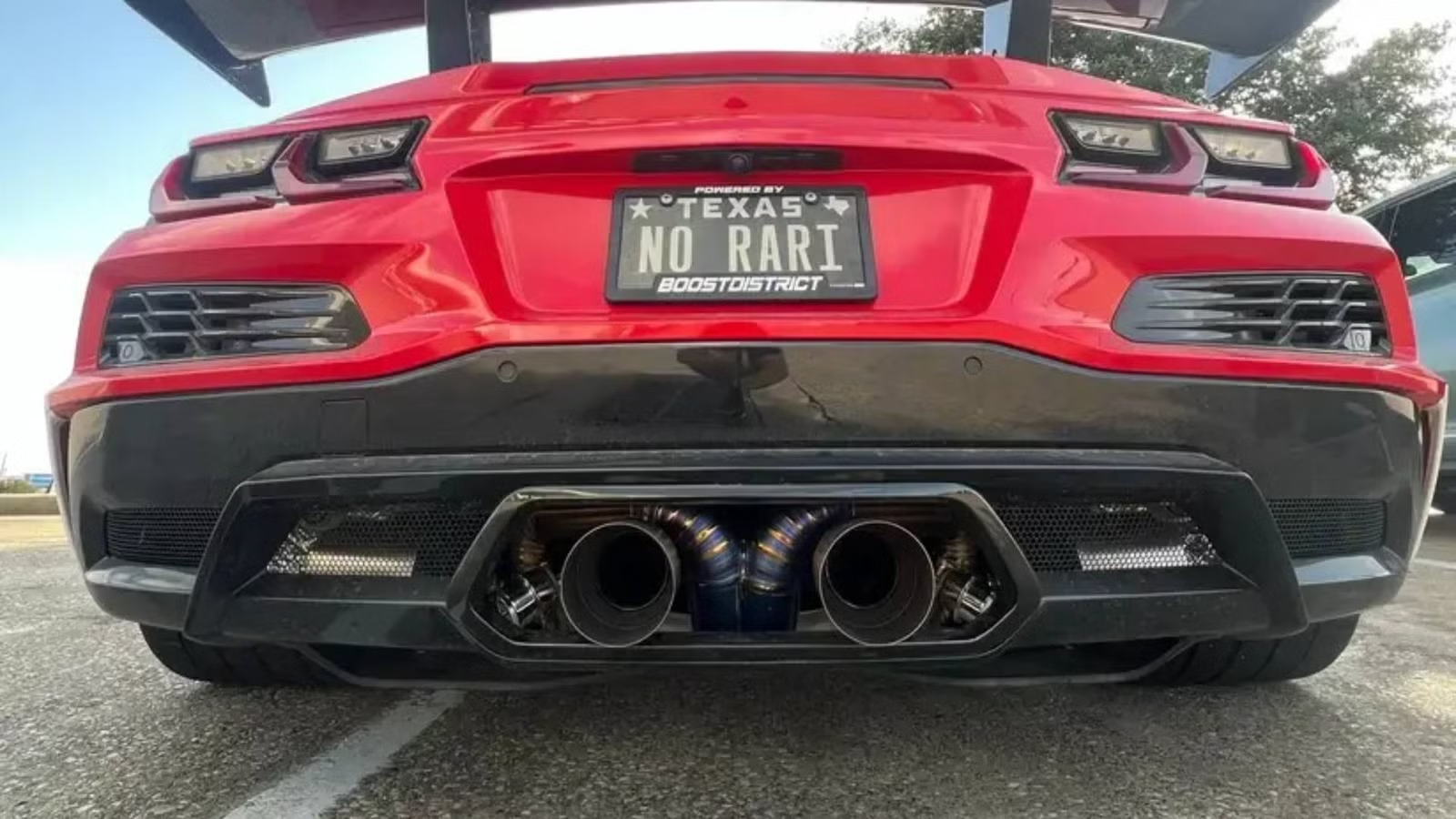
It used to be so easy to tell an American V8 apart from a European or Japanese engine just by the way it sounded from a distance. That deep, burbly roar just didn’t come from engines elsewhere, and if you’re really slick, you can discern between an LS, a Coyote, or a Hemi, from listening to the noise from your bedroom window without even looking outside. Well, nowadays, some want their American sports car V8s to sound like an F1 car, for better or for worse, depending on your opinion.
Why American V8s Sound so Unique

It’d be easy to say that American V8s are huge and stone-age, while European V8s are comparatively light and sophisticated, and call it a day. The reality is not nearly that straightforward, and the key differentiator comes from the crankshaft design and the firing order. Aside from a few exceptions like high-end Corvettes and Mustangs, American V8s often use a cross-plane crankshaft, where the crank pins are set at 90-degree angles to each other.
This layout needs heavy counterweights to balance inherent secondary vibrations that prematurely stress engine parts, and it has the added side effect of creating an uneven firing order across both banks of cylinders. Because two cylinders on the same bank fire back-to-back, pulses of exhaust gas hit the manifold in rapid succession, producing a distinct burble inherent to older muscle cars and even newer pushrod engines.

On the other hand, European and Japanese sports car V8s typically use flat-plane crankshafts with crank pins set at 180-degree angles, almost behaving like two inline-four engines joined together. The arrangement makes cylinders on either bank fire alternately and evenly while exhaust exits the manifold from each cylinder without interference. This is the mechanism that makes supercars like the Ferrari 458 and McLaren 720S, as well as F1 cars, sound so high-pitched and melodic when you push the throttle. Well, turns out that some people want that same sound out of their LTs and Coyotes.

Changing Exhaust Harmonics: Turning American V8s Into F1 Cosplayers
Changing the pitch of a cross-plane V8 requires more than just bolting on a set of wide-open mufflers or cutting out your catalytic converters with a reciprocating saw. Standard four-into-one manifolds simply collect exhaust gases from four cylinders on the same side of the engine, preserving that signature unequal pulse interval that gives American V8s their distinct burble. Changing that frequency demands an entirely re-engineered exhaust layout that crosses cylinder bank streams to artificially replicate even firing cylinders.
By tuning every primary runner to equal lengths and uniting opposing cylinder pulses into unified collectors, custom builders force cross-plane exhaust gases to exit in a synchronized, harmonious rhythm. When executed correctly, this setup can artificially mimic the acoustics of a flat-plane crankshaft without modifying the engine’s internal components. Even so, this alone isn’t guaranteed to give you the result you’re after.

If tube diameters, lengths, or collector angles are even slightly off, the high-pitched exotic roar you’re after collapses into a flat, monotone buzz that sounds less like an F1 car and more like a malfunctioning household appliance. It takes an especially skilled and experienced exhaust fabricator to achieve the desired result. Even then, the results are mixed, to say the least.

That exact challenge is where the 8-4-1 header configuration comes into play, at least in theory, anyway. By snaking eight precise, equal-length primary tubes through four secondary merges before feeding into a single, central crossover collector, 8-4-1s force cross-plane exhaust to enter the manifold in a synchronized, uninterrupted sequence. Instead of back-to-back pulses clashing on one bank of the engine, it’s all one high-frequency salvo.
A relative newcomer to the aftermarket tuning scene, specialty exhaust manufacturers like Concept 841, based in Lodi, California, have pioneered these bespoke setups specifically for modern American performance platforms. Most notably, these include iconic platforms like C5 through C8 Corvettes and S550/S650 Mustangs, but it comes at a tremendous engineering cost. Executing an 8-4-1 setup requires massive physical real estate, which is why traditional front-engine cars almost never even attempt it.

As for the mid-engine C8 Corvette, the most popular application of 8-4-1 headers thus far, that problem’s null and void. With its 6.2-liter LT2 V8, fabricators finally had the rear-chassis packaging space needed to route eight long primary runners of equal length into a unified central collector behind the powertrain. On paper, it turned a traditional American pushrod V8 into an exotic screamer above 4,000 RPM while keeping the factory ECU and catalytic converter locations exactly the same. In practice, the results were quite controversial.
Hypercar Exhaust Note, or Annoying Drivel?

Proponents of 8-4-1 headers swear the high-frequency scream above 4,000 RPM turns a domestic pushrod engine into a budget Ferrari. Meanwhile, critics argue that stripping away a cross-plane V8’s low-end rumble ruins its fundamental character for a jarring, high-pitched squeal, even at lower speeds.
If you’re firmly in the skeptic camp, adapting 8-4-1 headers to traditional front-engine platforms like an S550 Mustang or older Corvettes only makes the problem worse. In those applications, tight frame clearances, custom floor pan cuts, and severe cabin heat management leave owners paying thousands in fabrication fees for a sound that often drones endlessly during daily commutes. But what are your thoughts? Do you think 8-4-1 headers make an LFA out of a Mustang, or does it turn a C8 Stingray into an overpriced noise machine? Let us know in the comments below.
Source: Concept 841, ENG Motorsport

Related posts






Latest Post


No Comments