
The Kawasaki That Quietly Became A Future Classic
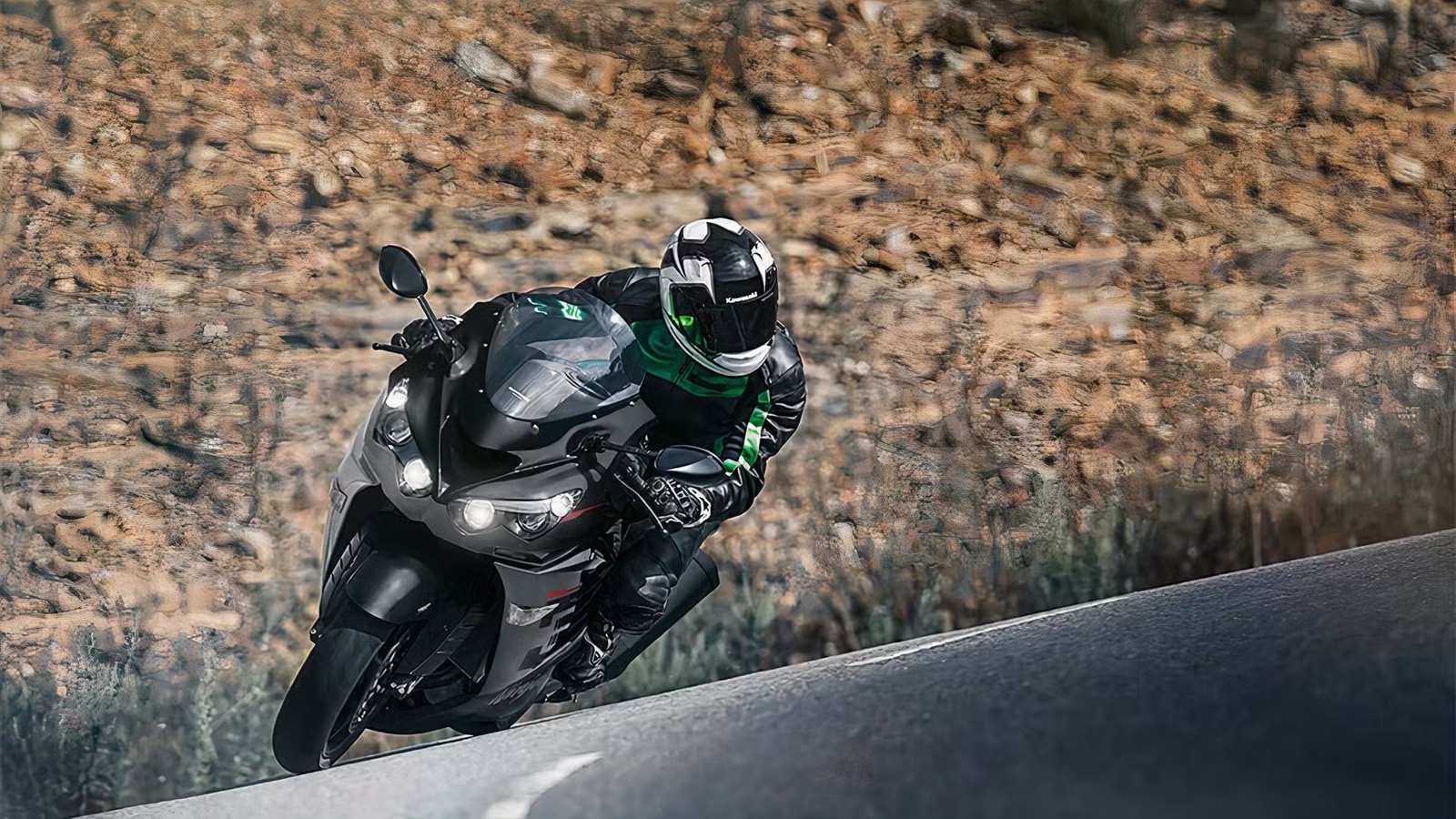
Most motorcycles don’t just disappear. When a manufacturer kills off a model, there’s usually a going-away party first — a final edition in a moody paint scheme, a press release thanking loyal owners, maybe a limited run with a numbered plaque on the triple clamp. It’s a send-off, and it works. Then there’s the other way a bike leaves the world: it just stops showing up on the list. No statement or a farewell colorway. One year it’s there, and the next year’s announcement simply forgets to mention it. Then, over the years, it becomes a future classic and starts growing in value. One of Kawasaki’s largest sports bikes might be going down that road soon.
Kawasaki Has Made Some Brilliant And Iconic Machines

Long before it was a brute force to reckon with, Kawasaki had already built a reputation around one simple philosophy: if it could go faster, it probably should. The 1984 GPZ900R kicked the whole thing off as the original Ninja, a bike quick enough to headline “Top Gun” and outrun anything else on sale. The ZX-11, sold as the ZZR1100 outside North America, held the “fastest production motorcycle title” for six straight years starting in 1990. Then came the ZX-12R in 2000, radical enough to debut Kawasaki’s first mass-produced aluminum monocoque frame.

None of that happened in isolation from Kawasaki’s smaller bikes, either. Sharpening the ZX-6R and ZX-10R for showroom shootouts and world championship grids handed Kawasaki’s engineers a deep well of aerodynamic and chassis data, the kind of knowledge that doesn’t come cheap and doesn’t come fast. Over time, almost all of these have become future classics and fetch decent money in the used market. And this we can foresee happening for the largest Ninja ever, too. This over-1,400cc behemoth is in its final years, being discontinued in most international markets.
The Kawasaki Ninja ZX-14R Has Quietly Become A Future Classic
Base Price: $17,599


The entire category of massive, naturally aspirated hyperbikes has been quietly shown the door across the industry. Europe’s Euro 5 emissions rules already forced Kawasaki to pull the ZX-14R from that market at the end of 2020, and manufacturers everywhere have shifted their flagship ambitions toward lighter chassis, forced induction, and, increasingly, electrification. A 1,441cc inline-four with a cable throttle and no ride-by-wire isn’t where the industry’s money or attention is going anymore. That’s precisely the kind of dead-end lineage that tends to age into something collectible — not because it was rare when new, but because nothing quite like it gets built again.

Here, in September 2025, Kawasaki laid out its 2026 sport and supersport lineup for the U.S. market. The Ninja 500, Ninja 650, ZX-4R, and ZX-6R all made the cut. The Ninja ZX-14R didn’t get a mention — not confirmed, not killed off. New units sitting on dealer floors right now are 2025 leftovers, and at $17,599 before destination charges, they’re still moving. It’s just sitting there, technically for sale, with nobody at Kawasaki saying whether that’s still true a year from now.
Twenty Years On The Same Basic Recipe

The current bike’s story starts in 2006, when the original ZX-14 replaced the ZX-12R with a 1,352cc engine and the same monocoque philosophy. Kawasaki bumped displacement to 1,441cc and added the “R” badge in 2012, and that’s essentially where the story stopped. Colors have shuffled, a slipper clutch and traction control arrived along the way, but the bike riding out of showrooms today is mechanically the same animal that debuted well over a decade ago.
A Monocoque Masterpiece Hidden Under The Plastics

Instead of a conventional perimeter frame wrapping around the engine, Kawasaki uses an aluminum monocoque structure that arches over the top of it, a layout the brand pioneered on the ZX-12R and carried forward here. The payoff is a chassis that’s narrower between the rider’s knees than the bike’s overall bulk would suggest, along with the kind of unshakable stability at triple-digit speeds that a wider, boxier frame would struggle to match.
Analog Soul Meets Just Enough Safety Net

There’s no ride-by-wire throttle here, no cruise control, no TFT dashboard streaming data at you. What the ZX-14R does have is Kawasaki Traction Control with three selectable settings and two power modes, enough of a net to keep an inexperienced right wrist out of the ditch without filtering out the mechanical feel that makes a bike like this worth riding in the first place. It’s a rider aid philosophy that splits the difference — modern enough to be safe, old-school enough to still feel like you’re doing the work.
Powered By Kawasaki’s Largest Inline-Four Ever

The engine is still the headline. At 1,441cc, it’s the biggest inline-four Kawasaki has ever put in a production motorcycle, built around an 84.0mm bore and 65.0mm stroke with a 12.3:1 compression ratio. Digital fuel injection runs through four 44mm Mikuni throttle bodies, TCBI ignition handles spark timing, and power reaches the rear wheel through a six-speed transmission and a back-torque-limiting slipper clutch. Kawasaki rates it at 197 horsepower and 116.5 pound-feet of torque at 7,500 rpm, numbers that still give modern liter bikes a run for their money.
What makes it interesting isn’t just the peak figures, though. Rather than the peaky, top-end rush you’d get from a highly strung 1,000cc superbike engine or the sudden shove of a turbocharged bike, the ZX-14R leans on enormous low-end torque. It pulls hard from barely off idle and just keeps building, which is exactly why Kawasaki markets it as the “King of the Quarter Mile” and why the factory claims a 9.77-second run down the strip.
The ZX-14R Can Take Interstates With Ease
There’s a reason the U.S. is the last place you can still walk into a dealership and buy a new Kawasaki Ninja ZX-14R. European emissions regulations — particularly Euro 5 — have effectively ended the motorcycle’s availability across much of Europe. America’s vast interstate network, looser emissions framework, and enduring appetite for big, straight-line power have kept the door open here in a way it’s closed almost everywhere else. The ZX-14R didn’t survive by accident — it survived because this happens to be the one market still built for a bike like it.
Sofa Comfort At Mach Speeds

Swing a leg over one, and it doesn’t feel like a stretched-out superbike, because it isn’t trying to be one. The ZX-14R has a long wheelbase, a wide and genuinely plush seat, and a rider triangle that keeps your wrists and knees far happier than anything wearing full race bodywork has any business doing. Riders have long nicknamed it an “intercontinental ballistic missile” for good reason — point it down an interstate, and it’ll happily eat a few hundred miles before anyone on board starts complaining.
That combination — a genuinely comfortable, capable sport-tourer wrapped around one of the biggest, most characterful engines Kawasaki has ever built — isn’t coming back once this generation is gone. Nobody’s going to announce the funeral. It’ll just quietly stop appearing on the list one year, the same way it quietly stopped mentioning this one. The smart move is buying it while it’s still just an ordinary trip to the dealership.
Source: Kawasaki

Related posts
Latest Post


No Comments