
The Forgotten Chrysler-Powered Grand Tourer Rarer Than Most Coachbuilt Ferraris
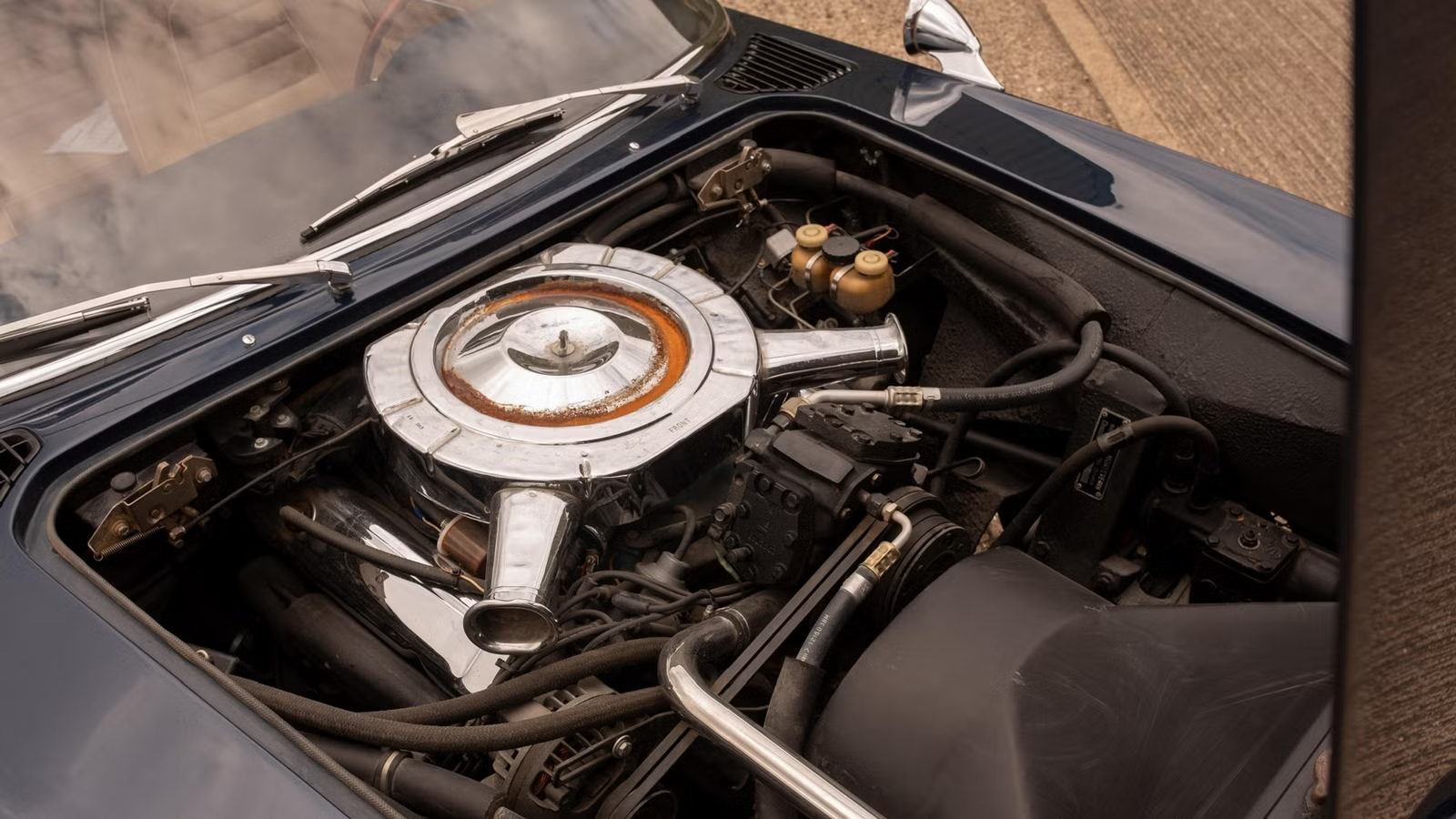
When you think of Chrysler-powered cars, you’ll typically think of the classic American muscle cars. The imagery of loud, brash, NASCAR-influenced monsters appears right away. This Chrysler-engined car, however, is very different from those performance monsters. While it’s still very powerful, that big-block performance is packaged inside a much more genteel image. It’s also incredibly rare—some variants of it are rarer even than coachbuilt specials.
Several Automakers Have Tried To Combine European Style With American Power

The idea of combining the best of both worlds of European and American Cars has been very appealing for a long time. American engines are powerful and reliable, and during the mid-20th century they were the cheapest and easiest way to get the kind of power that could rival the European giants. Combine that with European styling and craftsmanship, and (in theory) you’re onto a winner. Several European automakers have tried to make that theory work, to varying degrees of success. Bristol, Jensen, and Facel Vega, among others, managed to create great but niche Sports Cars using it.
One of the European automakers that entered into this niche that was emerging during the mid-20th century is one of the oddest of them all. Coming from a country that you wouldn’t associate at all with making cars, it was the brainchild of an eccentric figurehead who wasn’t afraid of burning a few bridges to get things done his way.

The First Production Car To Break 300 Horsepower
The 1955 Chrysler C-300 became the first mass-produced car to officially breach the 300 horsepower barrier.
One Brand That Specialized In These Kinds Of Cars Came From An Unlikely Country
Out of all the automakers that tried to capitalize on this “best of both worlds” idea between European aesthetics and craftsmanship and American power, one of the most unusual was Monteverdi. Peter Monteverdi (the company’s founder) was based in Switzerland, and he’d been in the automotive industry for some time before building his own cars. He started off as a car dealer, before branching out into building (and racing) Grand Prix cars. On the dealership side of his business, he sold cars from multiple brands. This included Ferrari. His relationship with Ferrari wouldn’t last forever, though. When it ended, Monteverdi got tempted to follow that European-American hybrid idea to create a genuine competitor to Enzo Ferrari’s juggernaut.
The Forgotten Big-Block Monster That Deserved More Fame
It beat the Road Runner in period testing, won Motor Trend Car of the Year, and costs a fraction of what a Chevelle SS 454 commands today.
The Monteverdi High Speed 375 Is A Luxurious, Chrysler-Powered Grand Tourer That Was Built Out Of Spite

|
Engine |
Transmission |
Drivetrain |
Power |
Torque |
|
7.2-liter V8 |
4-speed manual, 3-speed automatic |
Rear-wheel drive |
375 bhp |
480 lb-ft |
Peter Monteverdi’s most well-known creation has to be the High Speed 375. This big, luxurious grand tourer was produced from 1967 to 1976, and it has a very interesting history. That’s because a lot of that history centers around Mr. Monteverdi having disputes with people. The big dispute that started it all off was one with Enzo Ferrari. Peter Monteverdi and Enzo Ferrari had a falling-out in 1963. Ferrari demanded that Monteverdi pay for 100 cars upfront, but Monteverdi refused to. This led to Ferrari no longer supplying new cars from the factory to Monteverdi’s dealerships. Instead of switching to selling another high-end sports car brand, Monteverdi decided to compete with Ferrari directly and build his own car instead. That resulted in what you see here.
When it came to the High Speed 375’s American heart, it had one of the coolest choices you could have got off the shelf at that time. That’s Chrysler’s 440 cubic-inch (7.2-liter) Magnum V8. This is the same engine that was standard issue on a lot of Mopar’s most famous muscle cars, including the Dodge Charger R/T, Dodge Charger Daytona and Plymouth Superbird. In the Monteverdi, it was advertised as producing 375 hp (hence the “375” in the name). It’s also got 480 lb-ft of torque, making it the torquiest European car that was produced during the 1960s. That was enough to put it on par with other big grand tourers of its era. It also made it a direct competitor to other European grand tourers powered by big-block American engines, like the Jensen Interceptor.
Ferrari Wasn’t The Only Company Peter Monteverdi Upset

As we just mentioned, Ferrari wasn’t the only company that Peter Monteverdi upset with his decisions. Another one was the coachbuilder Frua. Initially, Frua worked closely with Monteverdi on the design and manufacturing of the High Speed 375. The original plan was that Frua would manufacture the High Speed 375 in Italy, at a low volume (20 cars per year). This didn’t end up sitting well with Monteverdi. That’s because demand for the High Speed 375 started outstripping what Frua was able to accommodate on their production line. Instead of keeping the relationship with Frua good, Peter Monteverdi went behind Frua’s back. He proposed a new coachbuilding deal with Carrozzeria Fissore. Fissore had the facilities to increase production to match demand. That deal was completed in 1969, after Frua had already built 12 cars.
Understandably, Frua wasn’t happy with this. Frua had suggested that the production be outsourced to Carrozzeria Maggiore, which would have kept Frua involved with the car. Peter Monteverdi clearly didn’t mind burning bridges in his business, though. Not only did he completely remove Frua from being involved in the car, but he also took Frua’s design with him without paying royalties to his former coachbuilder. This led Frua to file a court order against Monteverdi, prohibiting him from using the original design with another coachbuilder. That meant that the car had to be redesigned.
It Was Developed Into Multiple Body Styles

Most people who have seen the Monteverdi High Speed 375 will have likely seen it as a coupe. But that coupe body style wasn’t the only form it came in. Peter Monteverdi saw a lot of potential in the High Speed 375’s platform for it to be made into multiple different variants. As part of that, he wanted to cash in on the appeal of luxury 4-door sedans in the Middle Eastern market. The High Speed 375 ended up being made into a 2-seater coupe, a 2+2 coupe, a convertible, and a 4-door sedan. That 4-door sedan is known as the High Speed 375/4, and (just as Peter Monteverdi predicted) it became popular with Middle Eastern royalty. It also gains a lot of historical significance, as it’s a high-performance sedan that pre-dated that kind of car becoming popular.
The Story Behind Swizerland’s Failed Supercar, The Monteverdi Hai 450 SS
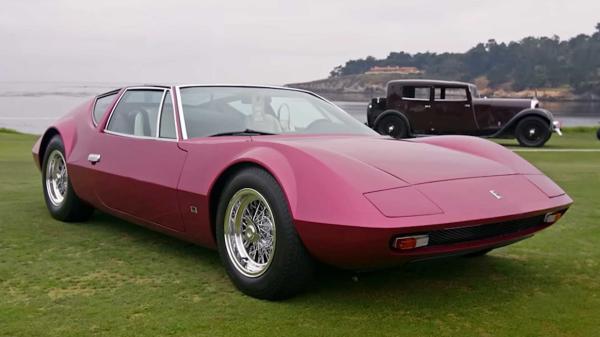
Monteverdi’s supercar could have been an automotive Swiss army knife, combining an Italian body with one of the best engines from the U.S.: a Hemi V8.
It’s Gaining Traction In The World Of High-End Collectors

Thanks to its niche appeal and the fact that it was produced in tiny numbers (only 28-35 examples of the 4-door 375/4 are estimated to have ever been built), the Monteverdi High Speed 375 is starting to get real traction in the upper echelons of the classic car market. A 1971 High Speed 375/L Coupe built by Fissore sold for £156,800 (around $206,883) in 2016. Another 375/L sold for the equivalent of around $330,000 last year, and a 375/4 also generated a bid for the equivalent of $400,500. A High Speed 375 also won best in show at the 2018 Goodwood Cartier Style et Luxe Concours d’Elegance. Clearly, the demand for these ultra-rare cars is on the up. It might not be long before examples regularly go for over half a million dollars at auction.
Sources: Bring A Trailer, Goodwood Road & Racing, Monteverdi, RM Sotheby’s

Related posts



Latest Post


No Comments