
Honda’s Homologation Special Won World Superbike Twice And Vanished
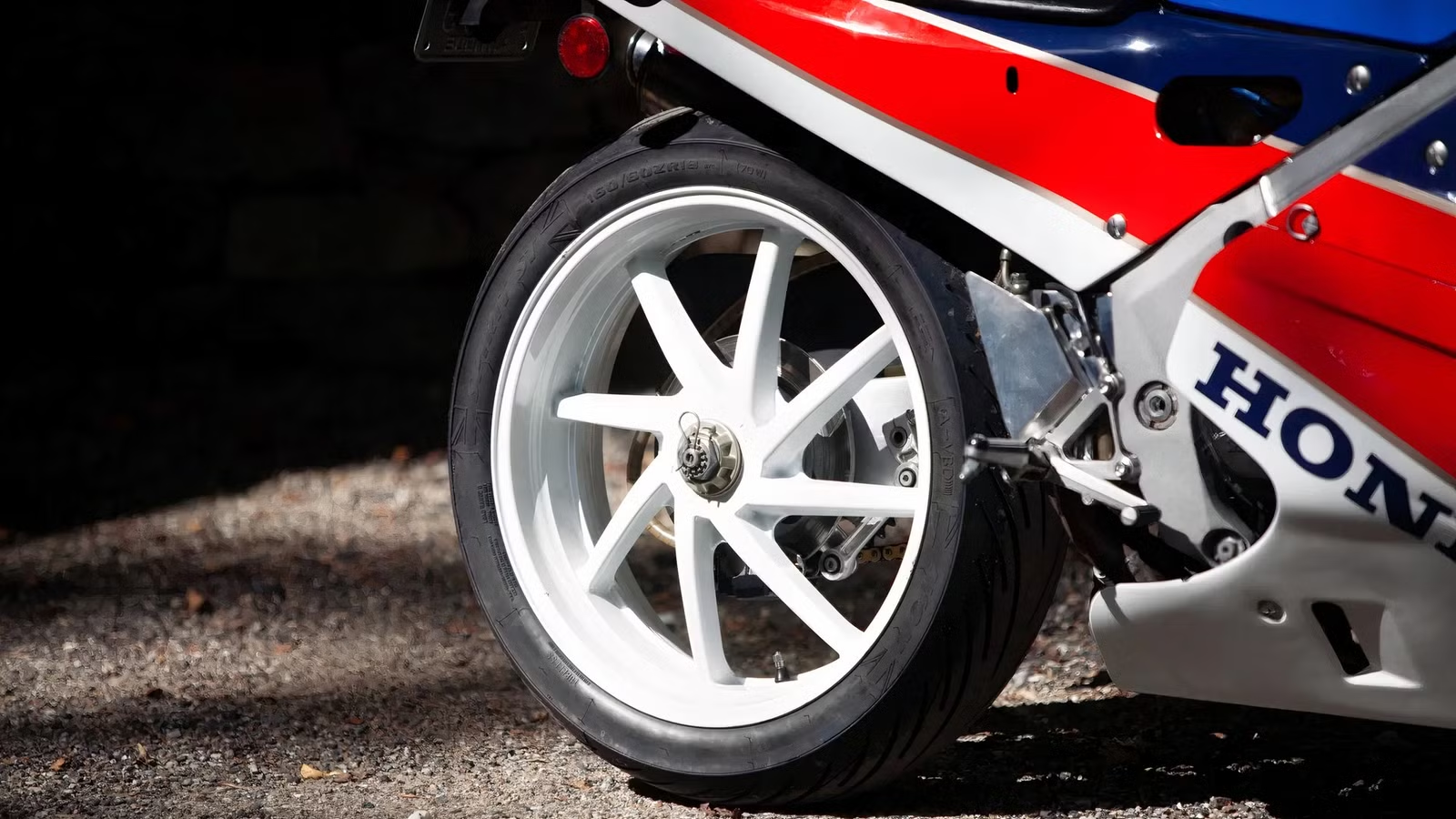
By the late 1980s, motorcycle racing had a strict rule: if you wanted to win on Sunday, you had to sell the same machine in showrooms on Monday. That single requirement forced manufacturers to build some of the most extreme road bikes ever produced, road-legal only in the loosest sense of the word. Honda took that rule further than anyone expected, and the result became the standard every rival was measured against, right up until it wasn’t.
The Homologation Rule That Built Race Bikes for the Street

When the Superbike World Championship launched in 1988, its organizers wrote a rule that shaped the entire era. Unlike prototype racing series, where machines bore only a passing resemblance to anything a customer could buy, Superbike racing required that competing motorcycles start life as genuine production models. A manufacturer had to build and sell a minimum number of road-going units before its race bike could even line up on the grid.
That single rule created an arms race nobody had planned for. Factories that wanted to win were suddenly forced to sell the closest thing to a factory racer that money could buy, complete with exotic materials, race-derived suspension, and engines that had almost nothing left in common with anything mass-produced. For manufacturers with the ambition and the budget, it was an opportunity to prove something. For everyone else, it was an expensive new cost of doing business.
The Bike That Beat Everyone and Then Disappeared


One factory answered that challenge more aggressively than any of its rivals. It built a machine with technology borrowed directly from its endurance racing program, priced it at roughly double what a normal sport bike cost, and sold every example almost as fast as dealers could unload the crates. Riders who managed to get their hands on one owned something closer to a grand prix bike with license plates than a conventional motorcycle.
The results on track were immediate and emphatic. The bike won races from its very first season and carried its rider to the sport’s biggest prize not once, but twice in a row. It was, by any measure, the machine every other manufacturer had to beat. Then, almost as suddenly as it had arrived, the factory walked away from it, and the bike that had defined an era quietly vanished from production for good.
Meet the Honda RC30

The bike behind that reputation was the Honda RC30, badged the VFR750R in most markets, and built by Honda Racing Corporation specifically to win the new Superbike World Championship. At its heart sat a 748cc, 90-degree V4 engine, developed from the architecture of Honda’s VFR750F but re-engineered almost entirely inside, with gear-driven double overhead camshafts, titanium connecting rods, and a close-ratio six-speed gearbox with a slipper clutch. In its unrestricted, international specification, the V4 produced roughly 118 horsepower at 11,000 rpm and torque in the mid-50 lb-ft range, enough to push the RC30 to a top speed just over 150 mph while carrying a dry weight close to 400 pounds. Against the mass-produced 750s and 900s that had ruled sport bikes only a few years earlier, the RC30 was built on an entirely different level.
The V4 and Single-Sided Swingarm That Set It Apart

What made the RC30 remarkable wasn’t just the engine; it was the hardware wrapped around it. The chassis used an aluminum twin-spar beam frame that placed the engine low and central for a lower center of gravity, paired with fully adjustable Showa suspension front and rear. The rear wheel rode on a single-sided Pro-Arm swingarm, a design borrowed from Honda’s endurance racers, that allowed the wheel to be swapped in seconds during a pit stop rather than minutes. Quick-release axles and fork-mounted brake calipers carried the same endurance racing logic to the front end.
The RC30’s credentials weren’t theoretical. American rider Fred Merkel piloted the bike to victory in the inaugural Superbike World Championship in 1988 for Team Rumi Honda, then defended the title in 1989 aboard the same machine. Merkel’s two consecutive championships made the RC30 the defining bike of the series’ first era, and its reputation only grew from there, with wins at the Isle of Man TT and in endurance racing adding to its résumé. No other Japanese four-cylinder motorcycle would match that level of World Superbike success for years.
Why Honda Walked Away at the Peak

Despite the winning record, the RC30 was never meant to be a volume product. Honda built roughly 3,000 examples worldwide between 1987 and 1990, starting with a Japanese-market release in 1987, followed by Europe in 1988. The United States didn’t see the RC30 until 1990, the bike’s final production year, and only a vanishingly small allocation ever made it into American dealerships. For a bike this significant, that combination of low production and delayed timing meant most enthusiasts never had a real chance to buy one new.
The bigger reason the RC30 disappeared, though, was a change to the rulebook that had created it in the first place. In 2003, the FIM rewrote Superbike regulations to allow four-cylinder machines up to 1,000cc, rather than capping them at 750cc. That single change meant manufacturers no longer needed to hand-build expensive, low-volume 750cc specials to stay competitive, since their standard-production liter-class sport bikes could now race as they were. The homologation special, as a concept, stopped making financial sense almost overnight, and the RC30 was never replaced with anything built to the same extreme.
The Collector’s Ghost

What the RC30 lost in availability, it gained in mystique. A 1990 example crossed the block at a recent Mecum auction result for $51,700, a figure that reflects where clean, well-documented examples sit in today’s market. At the top end, a 1988 example with barely any recorded mileage brought $121,000 at a separate Mecum auction sale, among the highest prices ever recorded for the model.
Compare that to the bikes the RC30 was built to beat: the Kawasaki GPZ900R, which briefly held the title of fastest production motorcycle in the world with 115 hp, and the Suzuki GSX-R750 slabside, which redefined the 750 class with roughly 106 hp in a chassis over 100 pounds lighter than the GPZ900R, were both built in far greater numbers and now trade for a fraction of what a clean RC30 commands. That gap is the clearest evidence of what homologation scarcity actually does to a bike’s legacy. If you’re hunting for an RC30 today, originality and documented history matter more than raw mileage, since so few genuinely unmolested examples remain.
Sources: Mecum, Honda

Related posts

Latest Post


No Comments