
The Kawasaki Riders Secretly Recommend To Their Friends
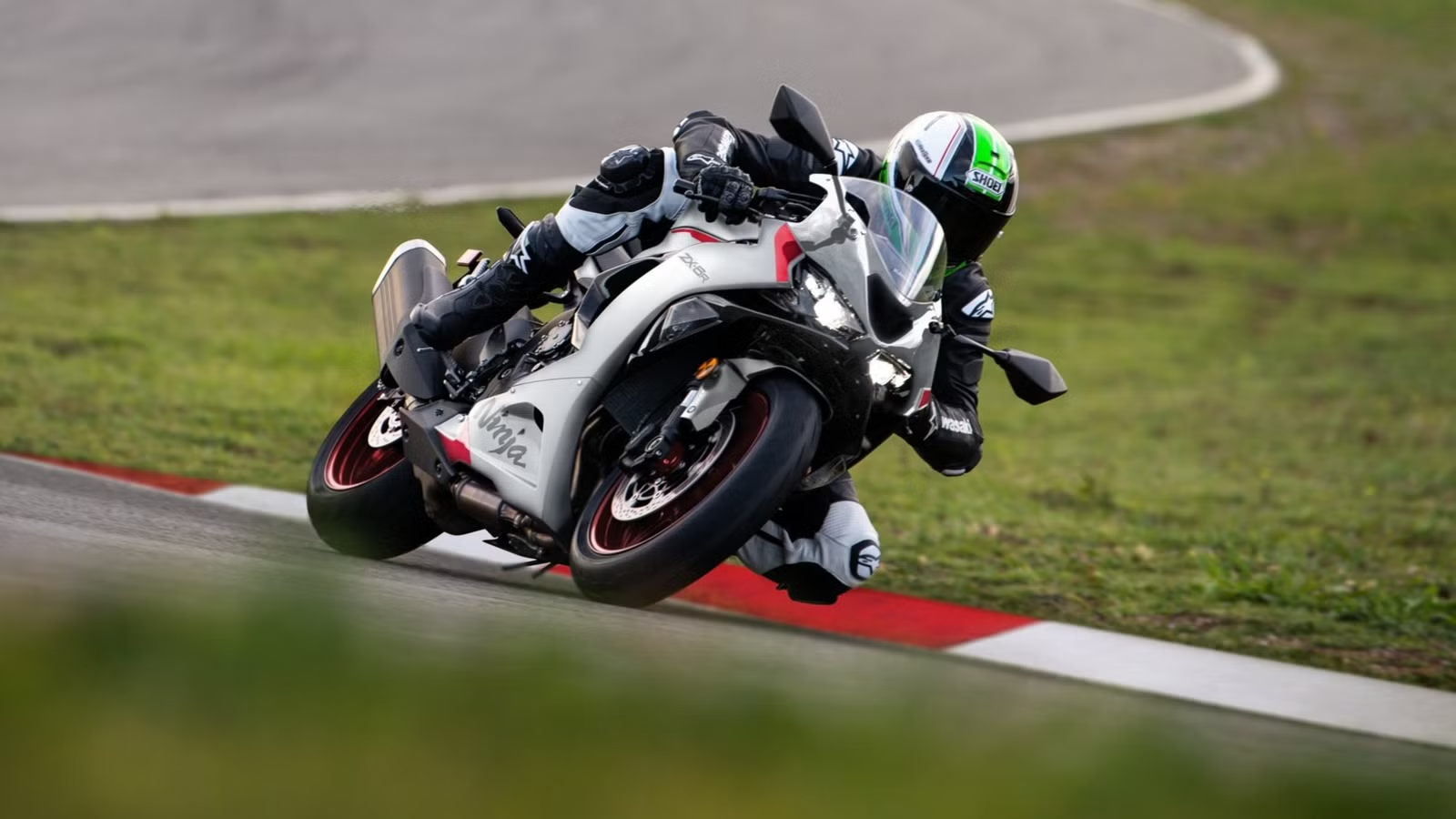
The motorcycle spec sheet tells only half the story. The other half purely depends on the riding and ownership experience. That is also why there’s an exciting lineup of underrated motorcycles today. Japanese motorcycles top this secret list. These bikes impress experienced riders and mechanics with bulletproof reliability, incredible versatility, and value. Most of this underrated bunch includes daily-ridable ADVs, roadsters, cruisers, and dual-sports. However, a few high-performance exceptions balance grin-worthy riding appeal with practicality. We highlight one such Kawasaki sports bike that is keeping the essence of the OG inline-four middleweights alive and kicking in 2026.
The Dwindling World Of Inline-Four Middleweight Sportbikes

There was a time when the supersport world was defined by screaming four-cylinder middleweight sport bikes. But today, the motorcycle world is paying a heavy price for stricter emission norms with downsized engines. Four-cylinder engines were once popular even among quarter-liter sportbikes. Examples from the 1980s and 1990s include the Honda CBR250RR (MC22), the Kawasaki ZXR400, and the Suzuki GSX-R400.

Bigger, more iconic, and newer examples include middleweights like the Yamaha YZF-R6 and the Honda CBR600RR. The former has been discontinued, and the latter has not been updated in ages. Middleweight four-cylinder sport bikes were once the sharp edge of the performance class, even questioning the existence of liter-class superbikes. Today, most middleweight sport bikes are sadly shifting to safer parallel-twin engines.
Japanese Brands Are Keeping The Spirit Alive

Today, only three middleweight four-cylinder sport bikes remain, and all are Japanese. Honda, Suzuki, and Kawasaki are keeping the spirit of yesteryear alive. Among them, the Suzuki GSX-R600 and the Honda CBR600RR are quite dated and nearing the end of their life cycles. That leaves us with Kawasaki being bolder with the ZX-6R, offering a much more modern, exciting option. That is why it is a constant recommendation by enthusiasts to enthusiasts.

Keep The Friends That Recommend The Kawasaki Ninja ZX-6R Closer

The 2026 Kawasaki Ninja ZX-6R is one of the last true 600 cc supersports you can buy new today. What makes the ZX-6R special and an instant recommendation from riders is its unique engine, which provides more mid-range torque that helps it have improved everyday street usability without compromising on-track performance. A short-ratio gearbox and a standard quickshifter further complement it. The combination of a lightweight chassis and sharp track-oriented suspension tuning helps it flick through sharp corners with conviction. While modern rivals like the Yamaha R7 and the Aprilia RS 660 are impressive, their twin cylinders can never match the Ninja ZX-6R’s aura of a balanced, more versatile inline-four engine.
This $11,599 Sport Bike Dominates The Segment

The specialty of the 600 cc supersport class is no compromise on performance or track-going aggression. In fact, most 600 cc bikes in this segment are defined by racing series. The best solution has always been to pack an inline-four engine with a displacement of just under 600 cc. Hence, we saw the same format across manufacturers.

But the problem with this race-derived formula was that these supersports were not very good road bikes. Kawasaki understood this hurdle earlier, and that’s how the ZX-6R’s displacement was bumped up to 636 cc in 2002. The result is an engine that delivers better torque in real-world use. This displacement bump helps it quietly dominate the segment and edge out the equally enticing Suzuki GSX-R600 and Honda CBR600RR.
Packs A Screaming Inline-Four With A Practical Side

An aggressive 636 cc inline-four mill powers the ZX-6R, and Kawasaki claims the additional 37 cc displacement over a traditional 600 cc supersport improves power delivery. It produces 127 horsepower at 13,000 RPM and 52.1 pound-feet of torque at 10,800 RPM, while being able to rev all the way to the 15,000 RPM redline. A cable throttle and individual throttle bodies offer a more rooted rider–bike connection.
The latter are coupled with a second set of oval throttle bodies, controlled by the ECU to smooth out the power delivery. All this trickery under the skin helps the ZX-6R deliver relatively linear performance across the rev range, aiding its adaptability on city streets, racetracks, and winding canyon roads. Power is sent to the rear wheel via a six-speed manual gearbox with an assist and slipper clutch.
A Surprisingly Reliable Mill

Its reliability comes from longevity. The ZX-6R’s 636 cc mill has been around since 2003. Kawasaki has refined this mill for over two decades, addressing every possible niggle along the way. It was discontinued in 2007 but returned in 2013 with no major upgrades. In 2019, Kawasaki also updated it to improve emissions compliance. The refinement levels this engine has achieved over its long tenure also help explain its reliability.
Track-Ready Underpinnings Mean Razor-Sharp Handling
The ZX-6R sits on an old-school yet well-balanced aluminum perimeter frame for sharp, stable handling. The main frame pairs an aluminum swingarm and subframe, mimicking a liter-class sport bike layout. This extensive use of aluminum helps keep it light—the ZX-6R ABS version tips the scale at just 436.6 pounds.
Adding to its grin-worthy dynamics is fully adjustable Showa suspension hardware. It comprises 41 mm Showa Separate Function Fork-Big Piston (SFF-BP) forks up front with 4.7 inches of travel. The rear gets a Bottom-link Uni-Trak monoshock with 5.9 inches of travel. Kawasaki claims this suspension setup offers predictable yet sharp handling characteristics to help improve riding confidence.

Braking duties are taken care of by dual semi-floating 310 mm discs coupled to dual radial-mounted monobloc four-piston calipers up front. The rear gets a 220 mm petal disc coupled to a single-piston caliper. Grip duties are courtesy of sticky Pirelli Diablo Rosso IV tires wrapped around lightweight 17-inch wheels at both ends.
Comfort Takes A Back Seat, Though

Being a supersport, the ergonomics are designed for aggression. While the 32.7-inch seat height is approachable for most riders, the rider triangle is quite aggressive with low-mounted clip-ons, rear-set footpegs, and thin seat cushioning. The focus is more on a commanding riding posture to ace technical courses. Its compact dimensions support this, with a 55.1-inch wheelbase, 5.1 inches of ground clearance, and a 23.5-degree rake angle.
Packs Ample Technology To Make It Daily Ridable

This is where the ZX-6R makes its arch-rivals look outdated. It packs a healthy dose of riding assistance and safety technology. Features like Kawasaki Quick Shift, four riding modes (Sport, Rain, Road, and Manual), and Low and Full power modes help tame its aggressive mill. Assistive features like three levels of traction control and intelligent ABS are also there. A crisp TFT screen controls all its technology and also offers smartphone connectivity.
This Is The Most Balanced Supersport For The Streets

This Kawasaki motorcycle stands out for being one of the most livable supersports. Inherently, supersports sacrifice comfort and daily ridability for outright track-going appeal. But the ZX-6R strikes a balance between commitment and comfort. The redline and aggressive ergonomics aren’t the only key factors that define this Ninja. Its street cred comes largely from the modest bump in engine displacement over a traditional 600 cc supersport.
Source: Kawasaki

Related posts

Latest Post


No Comments