
13 Influential Motorcycle Engines Ever Made
It’s hard to overestimate the role an engine plays in a motorcycle. If it were to be likened to the human body, is it its heart? Its thought-defining brain? The very blood that allows the body to function in the first place? Regardless of how one might try to place it, what’s not in doubt is that without the engine, we’d just be pedaling to places on bicycles.

And still, despite how important an engine is, there are some that have pushed the boundaries of what was thought possible. These engines have proved ground-breaking, maybe because of a technological breakthrough or what they would mean for future generations of motorcycles from the brand. This list, which captures everything from the exotic minds of Ducati to the precision-driven minds of Suzuki, Yamaha, and Honda, brings together the engines we feel have made a sizable impact. Or, to put it differently, the list of the most important motorcycle engines ever made.
13
Ducati Pantah L-Twin Engine
Production Years: 1980-1986
The Pantah has a very special place in the hearts of all Ducati fans. It was the first modern belt-driven V-twin, making it the forebear of all modern Ducati engines. It was never particularly reliable and certainly not the most powerful. Still, it was born out of a time of great adversity for Ducati as a brand and exceeded all expectations. Not only that, but it was competitive on the racetrack, too, defying the odds.
Ducati 500SL Pantah Engine Specs
 22 autotech Displacement |
499cc |
|
Configuration |
L-Twin |
|
Power |
45 hp |
|
Torque |
N/A |
|
Top Speed |
121.8 mph |
All specs sourced from Motorcycle Specs
12
Yamaha CP2 Engine
Production Years: 2015-Present

Designed from the ground up to meet specific emissions and power targets, the CP2 has proven to be one of the most versatile engines ever made. Yamaha has been able to put this in anything from a middleweight sportbike to their ground-breaking Tenere 700. In every platform, it has proven to be reliable. Statistically speaking, it’s the most reliable engine in the industry.
2022 Yamaha MT-07 CP2 Engine Specs
|
Displacement |
689cc |
|
Configuration |
Parallel-Twin |
|
Power |
75 hp |
|
Torque |
50 lb-ft |
|
Top Speed |
129 mph |
Specs sourced from Motorcycle Specs; Top Speed referenced from FastestLaps
11
Ducati 851 L-Twin Engine
Production Years: 1987-1992

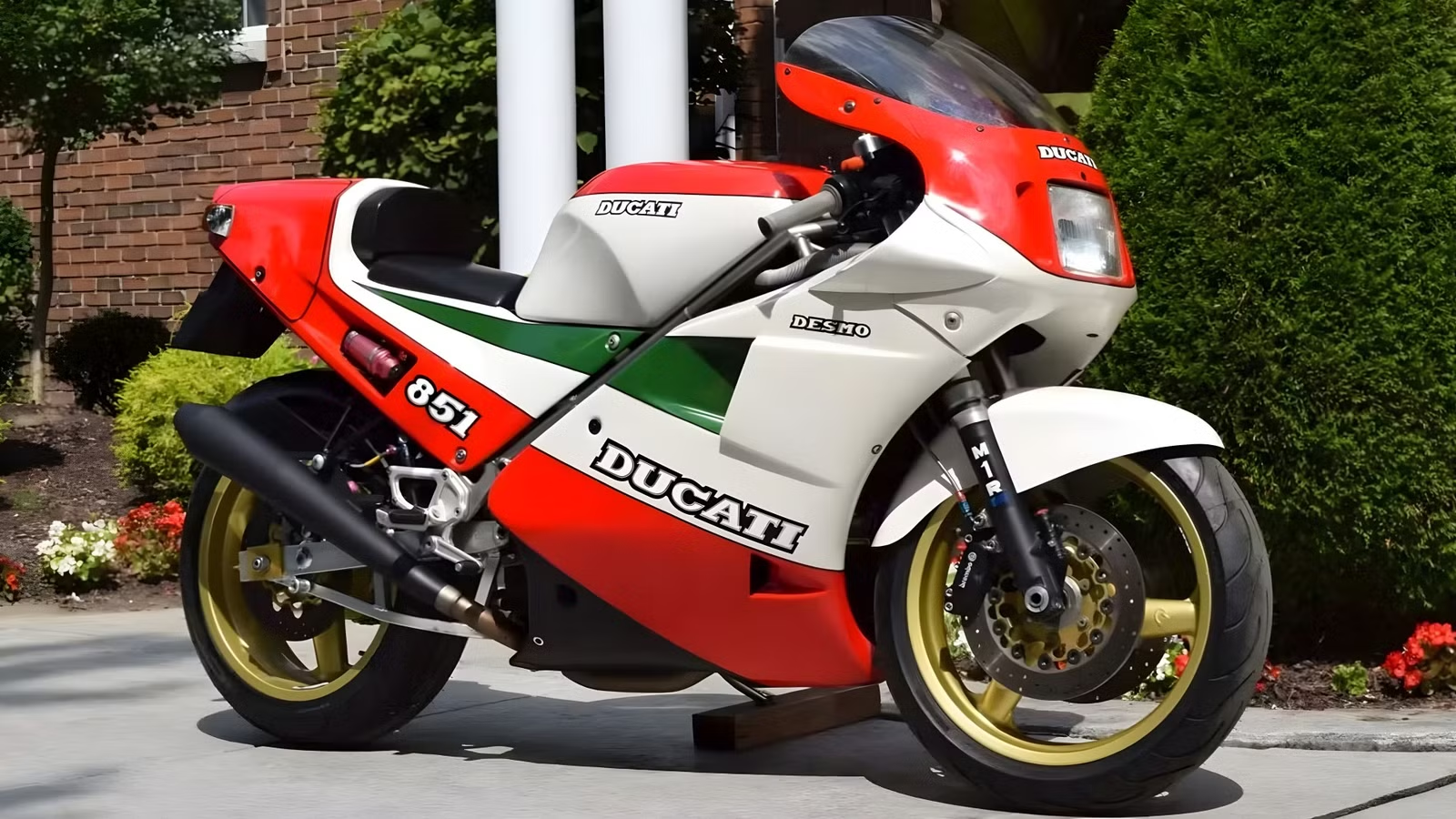
It says a lot about Ducati’s confidence in the 851 to name the entire motorcycle after it. Back when it first saw the light of day, the fuel-injected, liquid-cooled V-twin was a big jump ahead in performance compared to anything before it.
The 851 was met with immediate success. It made an impressive 102 horsepower and powered the Ducati to its first World Superbike title. As we mentioned earlier, this was one of those engines that paved the way for future Ducati motors to follow, as variations of the 851 engine will be used in multiple upcoming Ducatis.
Ducati 851 Engine Specs
|
Displacement |
851cc |
|
Configuration |
L-Twin |
|
Power |
102 hp |
|
Torque |
52.5 lb-ft |
|
Top Speed |
148 mph |
Specs sourced from Motorcycle Specs; Top Speed referenced from FastestLaps
10
Honda NR750 V4 Engine
Production Year: 1992

Occasionally, Honda will shake off their “boring” tag and create something uniquely special. In the case of this V4, it was the oval pistons. Explicitly developed for racing, this engine in the Honda NR750 is technically a pseudo V8 and costs them a small fortune to produce. It never quite acquitted itself on track, so the technology got abandoned. However, these incredible engines are still an engineering marvel.
Honda NR750 V4 Engine Specs
|
Displacement |
747.7cc |
|
Configuration |
V4 oval cylinder |
|
Power |
125 hp |
|
Torque |
48.6 lb-ft |
|
Top Speed |
159.8 mph |
All specs sourced from Motorcycle Specs
9
Yamaha CP4 Engine
Production Years: 1998-2001

After initially using a 20-valve head, the Yamaha R1 pivoted dramatically from that complex, ineffective technology to something simpler. Giving their flagship the cross-plane crank from their race bike, an option that Valentino Rossi famously preferred over the multi-valve engine on track. It also worked on the road, and as a fortunate byproduct, it sounds more like a burly V8 than a highly strung sport bike.
1998 Yamaha R1 CP4 Engine Specs
|
Displacement |
998cc |
|
Configuration |
Transverse 4-cylinder |
|
Power |
148.8 hp |
|
Torque |
79.8 lb-ft |
|
Top Speed |
172.2 mph |
All specs sourced from Motorcycle Specs
8
Honda CB750 Inline-4 Engine
Production Years: 1969-2003

The CB750 marked a landmark moment not just for Honda but also for motorcycles in general. It rocked up in 1969 and gave the world the first mass-produced 4-cylinder engine.
This was a 736cc unit that featured a single overhead cam and two valves per cylinder, and its power output allowed it to breach 100 mph with ease. This was unheard of at the time. It was also claimed to be smooth, quiet, and, typical of Hondas now, reliable. The bike itself wasn’t anything extraordinary, but the engine more than made up for it.
Honda CB750 Engine Specs
|
Displacement |
736cc |
|
Configuration |
Transverse 4-cylinder |
|
Power |
67 hp |
|
Torque |
44 lb-ft |
|
Top Speed |
123.2 mph |
All specs sourced from Motorcycle Specs
7
Honda C90 Single-Cylinder Engine
Production Years: 1967-2002

Undeniably, it is the most ubiquitous engine in the history of the world. In its various sizes, from 50cc all the way up to 125cc, these engines quite literally power the world (most notably in the Honda Super Cub).
It isn’t just Honda that makes them either; Honda themselves licensed production out to other manufacturers, and they, too, shared the designs. Today, there are as many Chinese-made copies of this incredible little lump as there are originals.
Honda C90 (Super Cub) Engine Specs
|
Displacement |
89.5cc |
|
Configuration |
Single-cylinder |
|
Power |
8 hp |
|
Torque |
4.8 lb-ft |
|
Top Speed |
55 mph |
Specs sourced from Motorcycle Specs; Top Speed referenced from MCN
6
Yamaha R6 Inline-4 Engine
Production Years: 1999-2020

As the supersport arms race was hotting up, a clear fan favorite emerged: the Yamaha R6. It was more powerful and more reliable than the competition, simple as that.
Nothing could touch it for a time, and after a few years, other manufacturers found ways to make more power but could never match the Yamaha for reliability on track. It is still the most popular track platform to this day.
1999 Yamaha R6 Engine Specs
|
Displacement |
998cc |
|
Configuration |
Forward-inclined parallel 4-cylinder |
|
Power |
148 hp |
|
Torque |
79.8 lb-ft |
|
Top Speed |
161.5 hp |
Specs sourced from Yamaha; Top Speed sourced from Motorcycle Specs
5
Ducati Desmoquattro L-Twin Engine
Production Years: 1985- Present

After the Pantah, came the Desmoquattro. It incorporated its desmodromic system and gave it the Desmo name. The system’s genius is in its relative simplicity. By using the camshaft to both open and close the valves, they eliminate the need for valve springs.
This allowed it to reduce complexity, weight, and components. It also effectively improves performance because the system eliminates the momentary delay you will find in any spring (otherwise known as valve float).
1994 Ducati 916 Engine Specs
|
Displacement |
916cc |
|
Configuration |
L-Twin |
|
Power |
114 hp |
|
Torque |
66.3 lb-ft |
|
Top Speed |
158.5 mph |
All specs sourced from Motorcycle Specs
4
Suzuki GSX-R1100 Inline-4 Engine
Production Years: 1986-1998

Suzuki’s incredible GSX-R750 of the ’80s was the predecessor to the mighty GSX-R1100. The latter featured a 1,052cc 4-cylinder oil-cooled DOHC unit with an impressive 125 horsepower at 8,500 rpm.
This particular engine was a standout for Suzuki because it reportedly had a very good mid-range grunt and was tremendously robust. This gave way to plenty of mod potential that bumped the power output to scarcely believable levels.
1986 Suzuki GSX-R1100 Engine Specs
|
Displacement |
1,052cc |
|
Configuration |
Inline-4 |
|
Power |
125 hp |
|
Torque |
76 lb-ft |
|
Top Speed |
155 mph |
All specs sourced from Motorcycle Specs

Related posts



Latest Post


No Comments