
The Kawasaki Naked Bike That Feels Tailor-Made For Everyday Riding
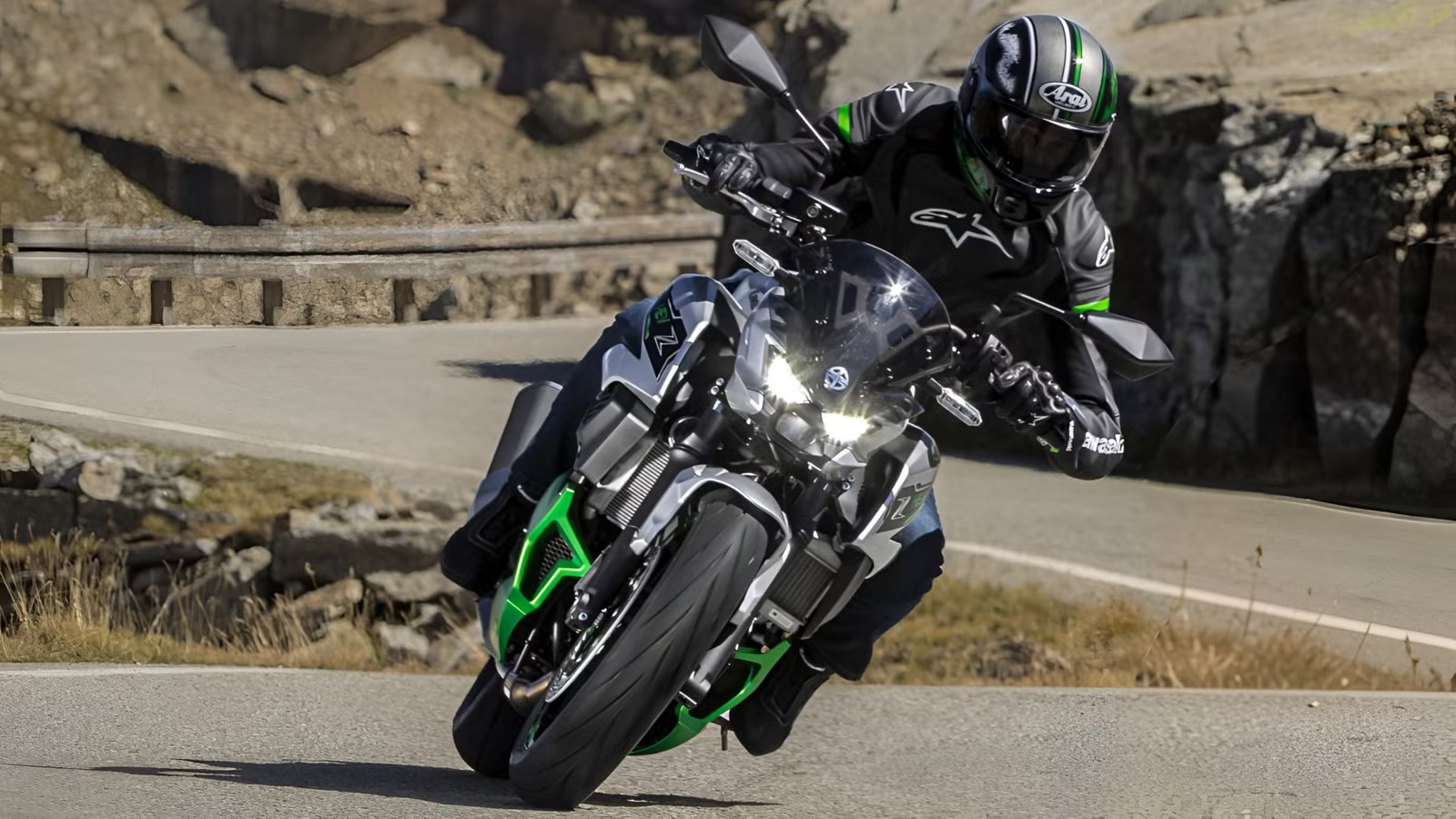
There are plenty of daily-rideable naked bikes in 2026. But not all offer a tailor-made experience where the performance profile, hardware, technology, and even reliability come into play. Out of all the companies, the big four Japanese bike makers nail the well-rounded formula with the added advantage of being super reliable. Among them, Kawasaki has a bold and controversial naked bike that makes for an underrated everyday riding machine. It is their first-ever production hybrid naked bike that fuses the best of both worlds, and also the drawbacks. It is a bit too practical for a sporty naked bike, and therein lies its identity crisis.
Kawasaki Has A Varied Line-Up Of Naked Motorcycles

Kawasaki offers one of the most vibrant lineups of naked bikes with its Z series. Kickstarting things is the tiny Z125 Pro, a humble city-only minimoto that redefines fun without focusing only on performance or exotic components. Then there is the Z500, which shares underpinnings and engine with the popular Ninja 500 sportbike.

The Z650 is also a very popular naked bike that shares components with the Ninja 650 sports bike. The Z900 and the liter-class Z1100 also follow a similar formula of sharing bits with their twin sports bike counterparts. Kawasaki also offers two retro-vibing naked roadsters with the Z650RS and the Z900RS. The wildest naked motorcycle from Kawasaki is the Z H2, the world’s only production supercharged naked bike.

Standing out profoundly, however, is the new duo of electrified naked bikes—the Z E-1 and the Z7 Hybrid. Frankly, the Z E-1 is lackluster even as a commuter. But the Z7 Hybrid is unique in that it fuses a sporty side (thanks to components shared with the Ninja 500 sports bike) with a very frugal and practical side (its electric motor and battery, plus a clever suite of electronics).

The Kawasaki Z7 Hybrid Stands Out As The Most Suitable Everyday Motorcycle
Price: $12,499

Let’s address the elephant in the room first—its pricing. The Kawasaki Z7 Hybrid is priced at an eye-watering $12,499. This is due to the utilization of first-time technology features, including a hybrid motorcycle powertrain. From a value perspective, the Z7 Hybrid makes little sense, as similarly priced or more affordable pure-ICE rivals offer much more bang-for-buck. Examples include the $10,999 Honda CB1000 Hornet SP, the $11,149 Suzuki GSX-8TT, the $11,989 Suzuki GSX-S1000, and the $10,899 Yamaha MT-09, to name some.

The USP here is its everyday utility. Relaxed ergonomics, never-before-seen efficiency ratings, and clever technology that makes daily riding a no-frills affair. The design is cool, the hardware is great, and clever features like an automated gearbox with paddle shifters make for an involving yet simplified riding experience. All of this helps make the Z7 Hybrid a naked bike that promises to do it all.
Powered By A Hybrid Parallel-Twin Engine

The Kawasaki Z7 Hybrid’s party trick is its dual powertrain setup. It gets a familiar 451 cc parallel-twin engine that works in tandem with a 9 kW electric motor. The hybrid setup gives this Kawa naked bike the flexibility to run on gas, electricity, or a mix of both. The engine is rated at 58.3 horsepower. When combined with the electric motor, the peak output comes to 68.5 horsepower and 44.2 pound-feet of torque.
Note that the peak power rating of 68.5 horsepower is achieved when the electric motor is using its e-boost feature. The advantage of the electric part of this powertrain is the instant torque available from the get-go. This is also how this otherwise entry-level naked bike manages 0–60 mph in 4.3 seconds.
Its Automated Manual Transmission Makes Daily Riding A Breezy Affair

Power is sent to the rear wheel via a unique six-speed gearbox. This is an electronically actuated hydraulic automated manual transmission that offers manual and automatic operation; available functions depend on the selected powertrain mode. There is no need to use a physical clutch here, as the rider can shift simply by pressing buttons (like paddle shifters) on the handlebar. There are four ride modes here—Sport, Sport-Hybrid, Eco-Hybrid, and EV —where “Sport” mode has no electric motor intervention and “EV” mode has no ICE intervention. The other two modes utilize both sides of the powertrain in different ratios.
Frugality Adds To The Practicality

The biggest advantage of a hybrid powertrain is its superior fuel efficiency, as the heavy lifting is shared between two power sources. Furthermore, the ICE engine helps recharge the battery pack while on the run. Conversely, the electric motor’s instant torque helps relieve the stress of the initial torque pull. This also helps improve the ICE engine’s efficiency in the long run.
Kawasaki claims that the Z7 Hybrid naked bike returns up to 64 MPG in Eco-Hybrid mode. This mode focuses solely on conserving fuel and maximizing battery regeneration. This is made possible by a linear performance tune, conservative shifting, and activating the ICE only after reaching around the 2,000 RPM mark. The electric motor handles the launch.

In the Sport-Hybrid mode, it offers 58.8 MPG. As the name suggests, this mode leans more towards a sporty side by unleashing the full potential of the 451 cc engine and the electric motor. The shifting is strictly manual, and the idling stop function, which uses the electric motor alone for launches, is disabled. Instead, both power sources work in tandem from the get-go. Furthermore, the E-Boost function is present in this mode, offering a five-second burst of maximum acceleration.
Nimble Dynamics Courtesy Of Proven Underpinnings

Underpinning the Z7 Hybrid is a high-tensile steel trellis frame suspended on 41 mm telescopic forks up front, with 4.7 inches of travel. The rear gets a Uni-Trak gas-charged monoshock with adjustable preload and 4.5 inches of travel. Braking duties are taken care of by dual 300 mm discs coupled to 2-piston calipers up front. The rear gets a single 220 mm disc coupled to a single-piston caliper. Grip duties are courtesy of 120-section front and 160-section rear tubeless tires wrapped around 17-inch wheels.

Despite the added heft of the electric motor and battery pack, the Z7 Hybrid weighs a commendably light 498.3 pounds. Furthermore, it’s compact, with a wheelbase of 60.4 inches, a length of 84.4 inches, and a width of 31.7 inches. Its seat height is also accessible at 31.3 inches. These attributes make this hybrid naked bike a comfortable, easy-to-ride daily motorcycle.
Backed By A Wholesome Electronic Suite

The cockpit is adorned with a color TFT screen that gets smartphone connectivity via Bluetooth and the Rideology app. The electric part of the powertrain adds a Walk mode that assists with maneuvering the motorcycle in tight parking spots. When engaged, opening the throttle moves the bike forward at walking speed. Closing the throttle past the neutral point also puts the bike into reverse. It also has a regenerative function to help recharge the battery pack while on the go.
The Kawasaki Z7 Hybrid Is An Underrated Bike That Is Struggling To Make A Mark

The Kawasaki Z7 Hybrid is a very practical naked bike, and that’s where the problem lies. The ICE part of this motorcycle is derived from the Z500, which in turn shares the underpinnings with the Ninja 500 sports bike. Hence, we expect the Z7 to have an elevated sporty side. But when we add the hybrid powertrain to the mix, things take a different turn. The added weight and complex layout make the Z7 Hybrid rather muted compared to what a pure-ICE version of the same would have been.

But the advantages include a simpler riding experience and superior MPG ratings. The final nail in the coffin is its premium price tag, which is the cost of an all-new generation of powertrain technology. But credit where it’s due, Kawasaki has strayed where no other motorcycle maker has. Every feature of the Z7 Hybrid is designed to make it a solid everyday motorcycle. For now, it is struggling to make a mark, but future iterations could refine the package. Until then, it is an underrated naked bike that will appeal to a select few riders.
Source: Kawasaki

Related posts
Latest Post


No Comments