
McMurtry’s Fan-Powered EV Supercar Is Going Production

McMurtry Automotive confirmed this week that a production-ready version of the Spéirling is imminent, with a full reveal coming soon after years of development rooted in one of motorsport’s most jaw-dropping moments. The Bristol-based startup’s fan-powered EV hypercar didn’t just set a record at the Goodwood Festival of Speed — it obliterated the hillclimb benchmark so convincingly that it forced a rethink of what a supercar without a combustion engine can actually do.

The Spéirling PURE, as the production variant is being called, carries forward the core concept of the prototype: a powerful electric drivetrain paired with an active underbody fan system that generates massive mechanical downforce without a single traditional wing. Getting that system from a purpose-built demonstrator to a car real buyers can own has been the engineering challenge McMurtry has been quietly solving — and the tease ahead of the reveal suggests they believe they’ve cracked it.
Why the Goodwood Record Still Matters
The Goodwood Festival of Speed isn’t a sanctioned racing series, but within the enthusiast world it carries enormous weight. The 1.16-mile hillclimb through the grounds of Goodwood House draws factory-backed hypercars, Formula 1 machinery, and purpose-built record attempts every summer, and the outright record is a genuine benchmark of raw performance. When the Spéirling prototype ran the course in 39.08 seconds — besting the previous record held by the Volkswagen ID.R — it did so without the elaborate aerodynamic bodywork that most record-chasers rely on. No swan-neck rear wing, no massive front splitter. Just a flat-bottomed car with a fan pulling it into the tarmac from underneath.

That distinction matters because it reframes what the Spéirling actually is. Most EV performance claims hinge on straight-line acceleration — impressive torque figures that translate into quarter-mile times. The Goodwood record is a corners-and-crests test, a measure of how hard a car can be pushed through a real road course. Winning there with fan-generated downforce rather than passive aerodynamics was a statement about the entire engineering philosophy behind the car.
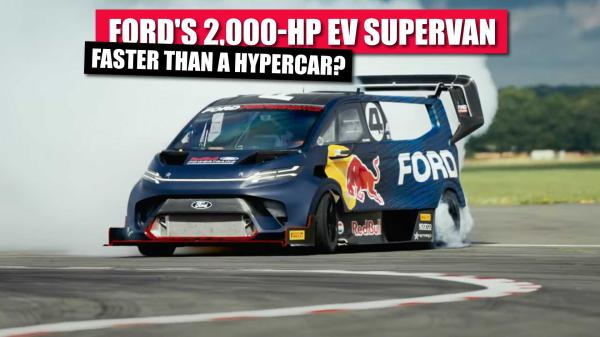
Watch Ford’s 2,000-HP Electric SuperVan Lap The Top Gear Track Faster Than A Hypercar
The high-performance Transit van vies for the all-time record set by a Renault F1 car way back in 2004.
How Fan Downforce Works — And Why It’s So Different

Traditional aerodynamic downforce depends on airflow over and under the car’s body. Go fast enough and shaped surfaces — wings, diffusers, dive planes — push the car into the road. The problem is that passive aero is speed-dependent: at low speeds, you have very little of it. The Spéirling’s approach borrows from ground-effect racing concepts and the Gordon Murray-designed Brabham BT46B fan car of 1978, using an electric fan to actively extract air from a sealed skirt around the car’s underfloor. The result is a low-pressure zone beneath the car that generates downforce regardless of road speed.
McMurtry’s system reportedly produces over 2,000 kilograms of downforce — more than the car’s own weight — which means it could theoretically drive upside down on a ceiling at sufficient fan speed. In practice, it means the Spéirling corners with mechanical grip levels that no passive-aero road car can match at normal speeds, making it one of the fastest cars at Goodwood. The challenge in moving to production has been making that fan system reliable, thermally managed, and manufacturable at the small volumes a boutique hypercar demands.

Why Naturally Aspirated Engines Are Making A Comeback
Car brands are turning back to naturally aspirated engines for hypercars with clever engineering solutions to help meet emission targets.
What ‘Production-Ready’ Actually Means for the Spéirling
The gap between a record-breaking demonstrator and a car a customer can take delivery of is substantial for any manufacturer, but it’s especially demanding when the core technology is as novel as active fan downforce. McMurtry’s tease of the Spéirling PURE signals that the company has addressed the durability and cooling requirements that a prototype built for a single hillclimb run doesn’t need to worry about. The fan system has to survive track days, road use, and the thermal load of repeated high-downforce cornering without degrading.
Production constraints also shape what the final car looks like relative to the prototype. Manufacturing a sealed underbody skirt system consistently across multiple cars — ensuring the ground-effect seal works correctly on each unit — is a precision engineering problem. McMurtry hasn’t published full production specifications ahead of the reveal, but the PURE designation suggests a focused, stripped approach: maximum performance, minimal concession to comfort. Expected production numbers remain very limited, keeping the Spéirling firmly in halo-hypercar territory rather than anything approaching volume production.

The Goodwood Hill Climb: Everything You Need To Know
The diverse array of cars gunning it around the hairpin turns of Lord March’s steep driveway will likely thrill most automotive enthusiasts.
The Bigger Picture: EV Performance on Enthusiasts’ Terms

For gearheads who remain skeptical about electric performance cars, the Spéirling makes a different kind of argument than a Rimac Nevera or a Lucid Air. Those cars win on acceleration metrics that are genuinely staggering but feel disconnected from traditional performance culture. The Spéirling won at Goodwood — a hillclimb with heritage stretching back decades, beloved by the same crowd that turns out for classic car concours and Group B reunion runs. That context is deliberate. McMurtry’s team understood that breaking a record at a track-day event carries more cultural weight with enthusiasts than any 0–60 figure.
The production reveal, expected imminently following the June 25 announcement, will be the moment McMurtry has to prove the concept survives contact with commercial reality. If the PURE delivers on the prototype’s promise, it won’t just be a win for one small British startup — it’ll be a legitimate data point that EV supercars can compete on driver’s-car terms, not just in a straight line. That’s the argument enthusiasts have been waiting for someone to make convincingly.
The reveal is coming. After everything the Spéirling prototype proved at Goodwood, enthusiasts deserve to see what McMurtry has built for the road.
Source: McMurtry Automotive, Road&Track

Related posts
Latest Post


No Comments