
The Time Indian Built A Motorcycle With An Upside-Down Four-Cylinder
Indian Motorcycle‘s coolest motorcycle had the smoothness of a luxury car and the road presence of a locomotive. Sadly, though, it was beginning to accelerate like one pulling freight.

The engineers, however, found an ingenious way to release more power and manage trapped heat. The engine benefited, but the rider’s leg was about to get cooked.
Indian Turned A Thoroughbred Four Into A Heavyweight
It should be noted that Indian didn’t create America’s great longitudinal four-cylinder motorcycle from scratch. The bloodline ran through Ace and William Henderson, whose designs established the American inline-four as a smooth alternative to the V-twins filling roads across the USA. When Ace’s finances collapsed, Indian acquired its patents and remaining stock in early 1927, gaining the flagship it wanted for its rivalry with Harley-Davidson.

The early Indian-owned machine kept much of the Ace formula, but the company soon began changing it. An Ace engine went into a frame based on the Indian 101 Scout in 1928, only for excessive vibration to expose the mismatch. Indian answered with a double-downtube frame that calmed the machine down, though the stronger structure added weight and dulled some of the original bike’s eagerness.
Durability kept winning arguments inside the engineering department. In 1929, the Ace’s three-bearing crankshaft gave way to a heavier five-bearing chrome-nickel unit intended to survive police service. The Four became sturdy and beautifully smooth, but it also became a 515-pound motorcycle whose acceleration could be embarrassed by Indian’s lighter Sport Scout. In essence, the thoroughbred had been trained for patrol duty and fed accordingly.
Better Cooling Became An Engineering Emergency

In all honesty, that tradeoff might’ve worked in an easier market. The Great Depression made an expensive four-cylinder luxury motorcycle harder to justify, especially when Indian entered the 1930s carrying financial problems of its own. Customers who could afford a premium bike expected something impressive, and “very refined once it eventually gets there” wasn’t the strongest showroom pitch in America, as you’d imagine.
By 1935, Indian decided the Four needed a serious rethink. Its engineers were working with imperfect lubricants and metal alloys that didn’t manage heat as effectively as later materials. Top-end lubrication was another concern, so controlling cylinder-head temperature became more than an academic exercise. A hot engine could damage its oil and turn a long ride into utter destruction.
No Easy Route

On top of that, competition sharpened the problem. Harley-Davidson’s overhead-valve Knucklehead arrived for 1936 with performance and styling that would help define the American motorcycle. Indian’s flagship remained smoother than most rivals but lacked the acceleration of smaller machinery. A grand four-cylinder that couldn’t convincingly outrun the company’s own V-twin had the makings of an expensive inside joke.
Indian wanted better airflow around the exhaust valves, more power, and a wider usable rev range. The problem was where the hottest hardware would go after the engineers rearranged it. Motorcycle packaging has always been a discipline in which every brilliant idea eventually meets somebody’s knee.
The Indian Model 436 Put Its Exhaust On Top

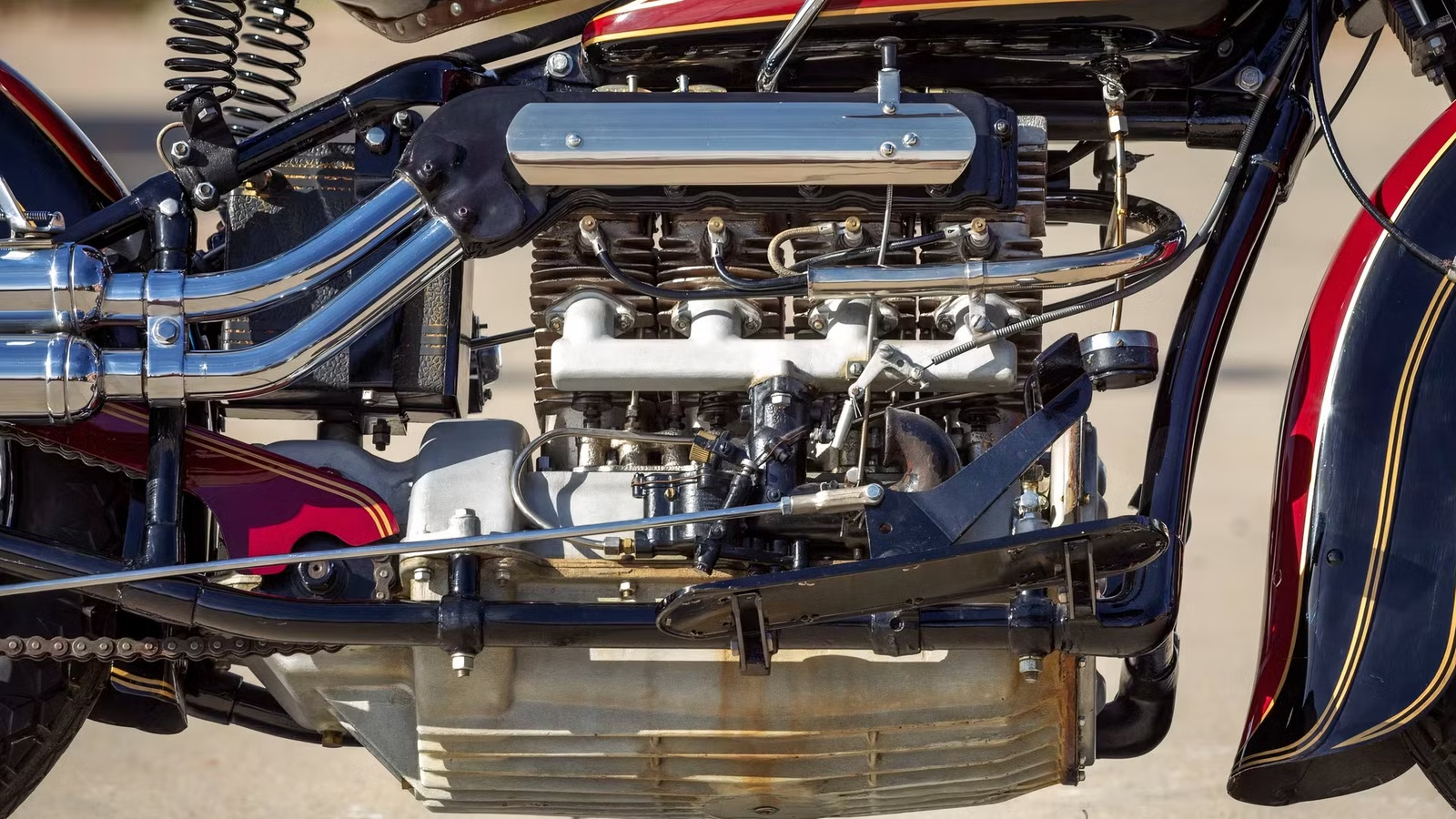
Indian’s solution was the 1936 Model 436, better remembered as the Upside-Down Four. Its 77.1ci engine reversed the valve arrangement used by earlier Indian Fours. Instead of placing the intake valves above the exhaust valves, Indian positioned the exhaust valves and pipes on top, while the intake system ran below the cylinder head.
Technically, the Model 436 used an exhaust-over-inlet layout. Visually, it looked as though somebody had assembled the top half of the engine after reading the blueprint in a mirror. The carburetor sat low, the exhaust hardware occupied prime real estate beside the rider, and Harley riders were reportedly delighted to repeat the new motorcycle’s nickname.
The engineering logic, however, held together better than the jokes suggested. Exposing the exhaust-valve area to cooling air helped the engine shed heat, while output rose to around 35 horsepower. Its usable range stretched to roughly 3,500 to 3,600 rpm, compared with about 2,800 to 3,000 rpm before the redesign. Indian promoted it as the fastest motorcycle it had built, and riders familiar with American fours found the 1936 and 1937 versions noticeably stronger than their predecessors.
The rest of the Model 436 remained unmistakably prewar Indian. It used a three-speed hand-shifted transmission with a foot clutch, while a leaf-spring fork managed the front end. Drum brakes handled stopping duty, and chain drive sent power rearward. The right-hand shifter and left-hand throttle also opposed Harley-Davidson’s arrangement, because America’s great motorcycle rivalry apparently needed to continue whenever riders reached for a control.
More Power Came With A Built-In Leg Roaster

Moving the exhaust valves upward improved cooling around the engine, but it placed four very hot valves and the header pipe close to the rider’s leg which, as you can imagine, wasn’t ideal. Early 1936 motorcycles used exposed exhaust-valve gear with a small heat shield. That protection proved inadequate, so Indian enclosed the mechanism and enlarged the shield before the model year was over. The engine could breathe, while its owner considered asbestos trousers.
In reality, the bigger cover reduced the risk of a burn, though it couldn’t make the heat disappear. Rear-cylinder airflow remained less effective, and police riders complained about the temperature during long days in the saddle. The machine had gained the performance Indian wanted, then turned its rider into part of the cooling system. That might’ve felt thoughtful on a cold morning, but summer traffic offered a harsher review.
Smooth Operator

Then, carburetion brought another complication. The 1936 Model 436 used a Marvel updraft carburetor that could be delicate when incorrectly adjusted. Indian adopted twin Zenith carburetors with separate aluminum manifolds for 1937, but the extra hardware brought no clear increase in outright power or speed. Even so, the Upside-Down Four remained exceptionally smooth, and its low center of gravity gave it pretty respectable handling.
Indian Abandoned The Layout, But Not The Four

Indian understood the market’s verdict quickly. By 1939, used examples of the 1936 and 1937 Upside-Down Four could be worth the same as, or less than, a Sport Scout from the corresponding year. Even if math isn’t your thing, it’s easy to see that this was brutal depreciation for a range-topping American motorcycle. People understandably had decided that four cylinders, top-notch styling, and a complimentary calf warmer didn’t add up to irresistible value.
For 1938, Indian returned the Four to a conventional F-head arrangement. The intake valves went back on top, while the exhaust valves moved to the side and the manifold returned to the lower part of the engine. The company kept developing its four-cylinder flagship, and later machines earned admiration for their durability, speed, and elegant proportions.
Proving Its Worth

That reversal has made the Model 436 easy to dismiss as one of Indian Motorcycle’s worst ideas. If you think about it, the engineers improved exhaust-valve cooling, raised horsepower, and widened the engine’s useful operating range. The failure came from placing the solution too close to a human being, a packaging mistake that feels obvious only after somebody rides through July with a glowing manifold beside their shin. All in all, viewed through a different lens, the Model 436 was a rare machine with real performance beneath its awkward reputation. Don’t believe us? All these years later, try scoring one in impeccable condition for less than $100,000.
Sources: Audrain Automobile Museum, Motorcycle Classics, Hagerty, Indian Motorcycles

Related posts



Latest Post



No Comments