
The Long-Lost Yamaha GP Bike That Seeded 18 Straight 500cc Titles
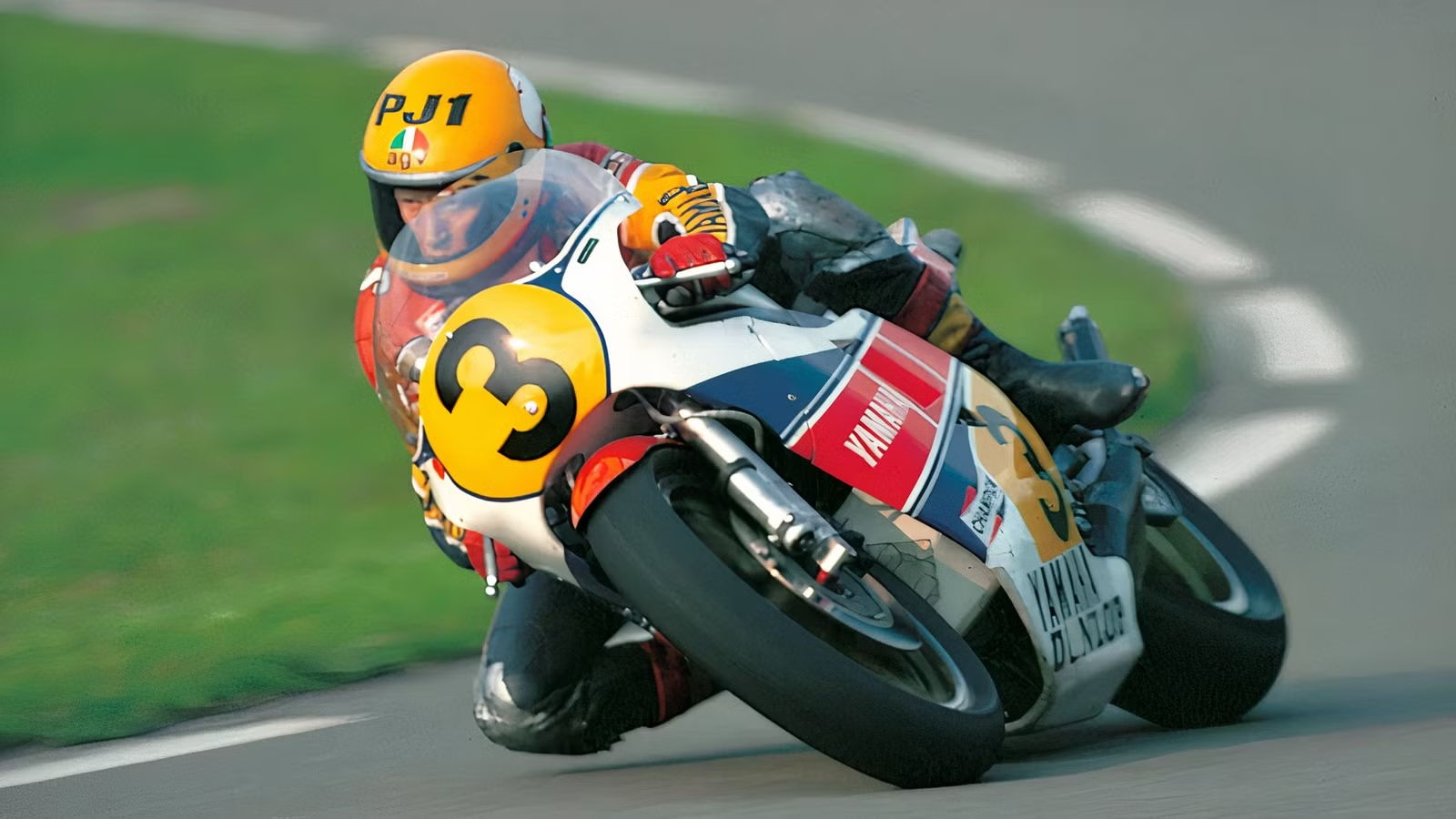
In life, failures are necessary stepping stones on the path to success, and things aren’t all that different when it comes to motorcycle development. Just about every manufacturer has its flops along with all the achievements we remember so fondly, because you can’t get it right one hundred percent of the time no matter how hard you try. And although we normally like to focus on the great machines that drove technology forward over the years, today we’re here to talk about a short-lived Yamaha race bike that didn’t quite serve its purpose as intended. But despite this, it was still an important step in the right direction for the company and motorcycle tech as a whole.
The Rise Of V4 Engines In Motorcycle Racing

Before the V4 layout became popular in Grand Prix racing during the eighties, inline-fours were the engines most commonly found out there on the track. Two-strokes had gained serious ground in the seventies, a decade that saw Yamaha’s YZR500 putting out some impressive performances in the 500cc GP class. The YZR went through several iterations over the years, one of them being the 0W23 which helped Giacomo Agostini win the Rider’s Championship in 1975 and gave Yamaha its very first 500cc title. Then there was the 0W45, ridden to yet another championship victory by the legendary Kenny Roberts in ‘79. But these variants of the YZR were both inline-fours, and it wasn’t until the eighties that V4s finally found some traction.
 55 autotech
The First Mass-Produced Motorcycle To Use A Factory V4 Engine
This engine almost killed the V4 layout entirely, until it was reworked to perfection.
Where It All Began

Even if Yamaha is the focal point of our discussion today, we must give credit where it’s due and acknowledge Honda’s NR500 from 1979 as the first Grand Prix racer to employ a V4 configuration. The 499cc engine was a four-stroke, though, featuring oval pistons, eight valves per cylinder, and a peak output of around 100 horsepower at 16,000 rpm. Meanwhile, Yamaha was having a go at the square-four engine layout with the 0W54 and 0W60, but it ultimately joined the V4 camp in 1982. Technically speaking, though, Yamaha’s powerhouse was in fact a W4 due to its twin crankshafts, yet it still passes as a V4 in public consciousness. So which version of the YZR500 was the one to get this fresh tech?
The 0W61 Marks The Start Of Yamaha’s V4 Ambitions

|
Displacement |
Horsepower |
Torque |
|
498.5cc |
128 HP |
81 LB-FT |
Unleashed in 1982, the 0W61 became the first motorcycle with a two-stroke V4 mill to compete in GP racing. It sadly didn’t become anywhere near as successful as Yamaha would’ve hoped, but it did sow the seeds for something much greater to take root later on. The Japanese manufacturer was under a great deal of pressure that season, with King Kenny having won three consecutive titles from 1978 until 1980 but only managing a third-place finish in ’81 behind Suzuki riders Randy Mamola and Marco Lucchinelli. Yamaha and Roberts were eager to get ahead yet again the following season, hoping the 0W61 would be the bike to make that happen. Now then, let’s have a closer look at what the motorcycle’s two-stroke V4 was all about.
Yamaha never released any data on its power output figures, but the bike is believed to have produced something in the region of 120 hp. That four-cylinder mill came with rotary disc valves, YPVS technology and liquid cooling, as well as the twin-crank arrangement we’ve mentioned earlier. It was considerably narrower than the 0W60’s square-four, and Yamaha’s engineers managed to squeeze the carburetors between the cylinder banks for even tighter proportions. The bike weighed less than 300 pounds wet, so its power-to-weight ratio would be absolutely wild even by today’s standards. It also featured an innovative frame design that would later evolve into the famous Deltabox, and the rear shock was mounted horizontally via linkages for improved mass centralization and packaging efficiency.
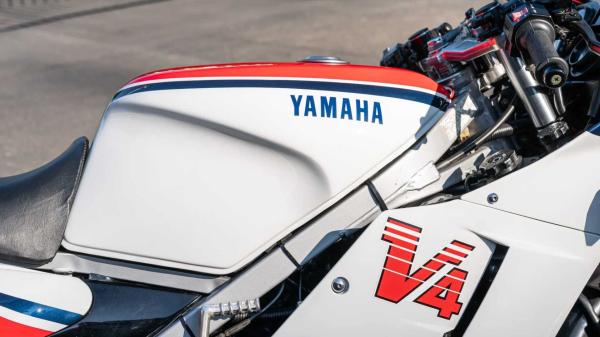
Yamaha Built A V4 Two-Stroke That Shook The World To Its Core
This Yamaha exploded onto the motorcycling scene and changed bikes forever
How Did The 0W61 Fare On The Racetrack?

The 1982 season seemed to be off to a great start for Yamaha’s factory team. Kenny Roberts won the opening round in Argentina, while his teammate and British racing legend Barry Sheene took second place. They were both riding 0W60s at the time, though, and it wasn’t until the next round at Austria’s Salzburgring that the V4-powered 0W61 made its debut. Roberts managed a respectable third-place finish but was outpaced by Sheene, who came second and was still riding the older square-four 0W60. The new V4 got its chance to shine at the fourth round in Spain, when King Kenny scored his second race win of the season aboard it. This might’ve gotten people’s hopes up for the 0W61, but they were in for a pretty harsh reality check further down the road.
Roberts crashed at a very rainy Dutch TT after starting on pole and leading the pack for a good chunk of the race. Then, at Silverstone, Sheene’s first outing on the 0W61 during free practice ended with a career-threatening crash, and Roberts suffered a similar fate on race day, resulting in an injury that took him out for the rest of the season. He ultimately finished the championship in fourth place, just ahead of Sheene, while Suzuki rider Franco Uncini took the title that year. Both of Yamaha’s factory riders were forced to miss the last four rounds, turning what was already a difficult 1982 season into an absolute disaster. Not only that, but test rider Ikujiro Takai had tragically lost his life while testing the 0W61 at Sugo. So the more superstitious observers might have assumed the bike was cursed. But why did it end up causing its riders so much trouble?
On the one hand, the engine’s powerband was extremely narrow and explosive, delivering a brutal surge of force at high revs but feeling almost tame lower down the rpm range. Its crankshafts were excessively light, too, causing the revs to spike when the rear tire lost traction and further hampering the bike’s grip. This combined with the rudimentary tire technology from the early eighties was a calamity waiting to happen, and the chassis didn’t make things any better. Because although the frame and rear suspension were innovative, they left a lot to be desired since their development was still very much in its infancy. Despite sounding like an absolute nightmare, though, the 0W61 still occupies an important place in Grand Prix racing history.
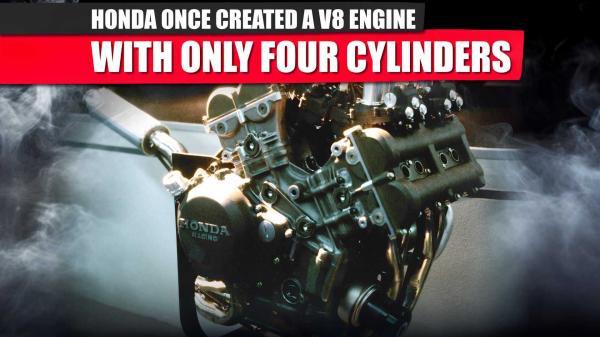
Honda Once Created A V8 Engine With Only Four Cylinders
It was a weird engineering solution to a problem that plagued Honda for years.
Why The YZR500 0W61 Is Still Relevant

The two-stroke, V4-bearing Yamaha racer might have been flawed, but it did spawn the powertrain formula that went on to dominate the premier 500cc class for the last 18 years of its existence. And as far as Yamaha was concerned, it pioneered technologies that would pay dividends once they became more refined, such as the Deltabox-style frame or its engine configuration. Subsequent YZR500 models won six more GP titles for Yamaha in the eighties and nineties, with Eddie Lawson and Wayne Rainey snatching three each. Kenny Roberts came close to a championship victory with the 0W70 in ‘83, but he ended up losing by just two points after an epic duel with Honda’s Freddie Spencer. Either way, it was clear that Yamaha had learned from its mistakes, and the 0W61 basically walked so future YZRs could run. It wasn’t a bad bike by any means; just temperamental and a bit too rough around the edges.
Sources: Yamaha, Australian Motorcycle News, Motorsport Magazine, Bennetts, Honda

Related posts


Latest Post


No Comments