
Toyota’s Wild Mid-Engine Sports Car Put A 450-HP Racing Engine Behind The Driver In 1970
For most enthusiasts, Toyota’s mid-engine sports car legacy was started by the Midship Runabout 2, or simply the “MR”. 2 After all, the MR2 was the first ever mass-produced 2-door mid-engined sports car from the Japanese automaker, launched in 1984.

However, the MR2’s significance goes beyond the engine layout. Coming from the house of Toyota, it wasn’t temperamental or overly exotic, nor was it just reserved for those with deep pockets. The MR2 actually democratized the mid-engine sports car category, and without the headaches that usually come with high-performance machinery. Interestingly, Toyota’s mid-engine sports car obsession wasn’t new. Hidden in its archives was a forgotten 2-door prototype that may have laid groundwork for some of the brand’s future icons, yet never saw the light of a showroom.
Toyota Wanted To Build A World-Class Sports Car In The 1960s
It all traces back to Toyota’s racing heritage in the FIA’s Group 7 races during the 1960s. If you aren’t familiar with the Group 7 competition, it was a motorsport category that allowed purpose-built two-seater race cars to have no limits on the engine output. While Porsche ruled the grid, the likes of Ferrari, Nissan, Isuzu, and Toyota were all determined to challenge them. Toyota, however, wasn’t there just to compete or make up the numbers. The Japanese automaker wanted to dominate the competition and claim victories, and that ambition demanded a world-class sports car.

That’s when Toyota kickstarted its racecar project in 1967, codenamed 415S. But it wasn’t a solo effort. Yamaha also came on as a collaborator, contributing heavily to the chassis of a machine capable of winning the Japanese Grand Prix. By 1968, the 415S (or the first Toyota 7, as it came to be known) was ready to hit the track with a 3-liter V8 engine pumping out 300 horsepower.
However, it didn’t live up to the expectations, forcing Toyota to go back to the drawing board. The project for the new Toyota 7 was codenamed 474S internally. This time, it had a new steel pipe space frame chassis, and a 5.0-liter V8 that churned out 530 hp and 383 lb-ft of torque. On paper, Toyota finally had a serious contender. But the racetrack told a different story. The Toyota 7 was outpaced by the Nissan R382, which used a V12 engine.
But Toyota wasn’t ready to throw in the towel. Instead, it doubled down, developing the third and most powerful iteration of its race car, the 578A. In 1970, Toyota had finally created the monster it had been chasing. Built on a lighter aluminum space frame chassis, the Toyota 7 was powered by a twin-turbo 91E V8 engine producing a whopping 800 hp and 535 lb-ft of torque — numbers that were almost unheard of at the time. It looked ready to dominate the 1970 Japanese Grand Prix. But before the car could prove itself on the track, circumstances beyond Toyota’s control brought the entire campaign to a halt. The race was canceled after new emissions-related regulations came into effect, and with rival manufacturers like Nissan also pulling out, Toyota had no choice but to abandon its plans.
Toyota’s 24 Hours Of Le Mans Dream Too Ended In Tragedy

However, the cancellation of the Japanese Grand Prix wasn’t the final blow for the Toyota 7 program. It was followed by two tragic accidents — two fatalities, to be precise. The first came in 1969, when Toyota driver Sachio Fukuzawa was testing a Toyota 7 with a 3-liter engine on a closed circuit. As per reports, he lost control over the car and ended up crashing. The impact resulted in fire and, sadly, Fukuzawa’s death. Tragedy struck again in 1970 when newly assigned Toyota driver Minoru Kawai was behind the wheel of a Toyota 7 that lost control and suffered a violent crash at theSuzuka Circuit. The impact was catastrophic, throwing Kawai out of the car, resulting in fatal injuries.
Toyota’s Group 7 ambitions for the 24 Hours of Le Mans came to an end, but the engineering behind the Toyota 7 wasn’t forgotten. It became the foundation for a road-legal, mid-engine two-door sports car prototype.
The EX-7 Was Born From Toyota’s Canceled Group 7 Race Car

The Toyota EX-7 concept made its debut at the Tokyo Motor Show in 1970, carrying the same DNA as the Toyota 7. It was based on Yamaha’s 578A aluminum frame chassis and featured only two seats, hinting at what a road-going performance machine from Toyota could look like.

The front end was sharply raked with wide wraparound rectangular headlights, while the nose of the EX-7 concept followed the same angle as the large windshield, creating a seamless visual flow from front to cabin. It also featured large side windows, while the small glass sections on either side of the T-bar roof added to its distinctive appearance. The EX-7’s rear end carried its own visual drama, with horizontally stacked slats cleverly concealing the vertical rear windshield and lending the concept an unmistakably exotic silhouette. Complementing the yellow bodywork, the black-painted nose and rear section added a sharp contrast.
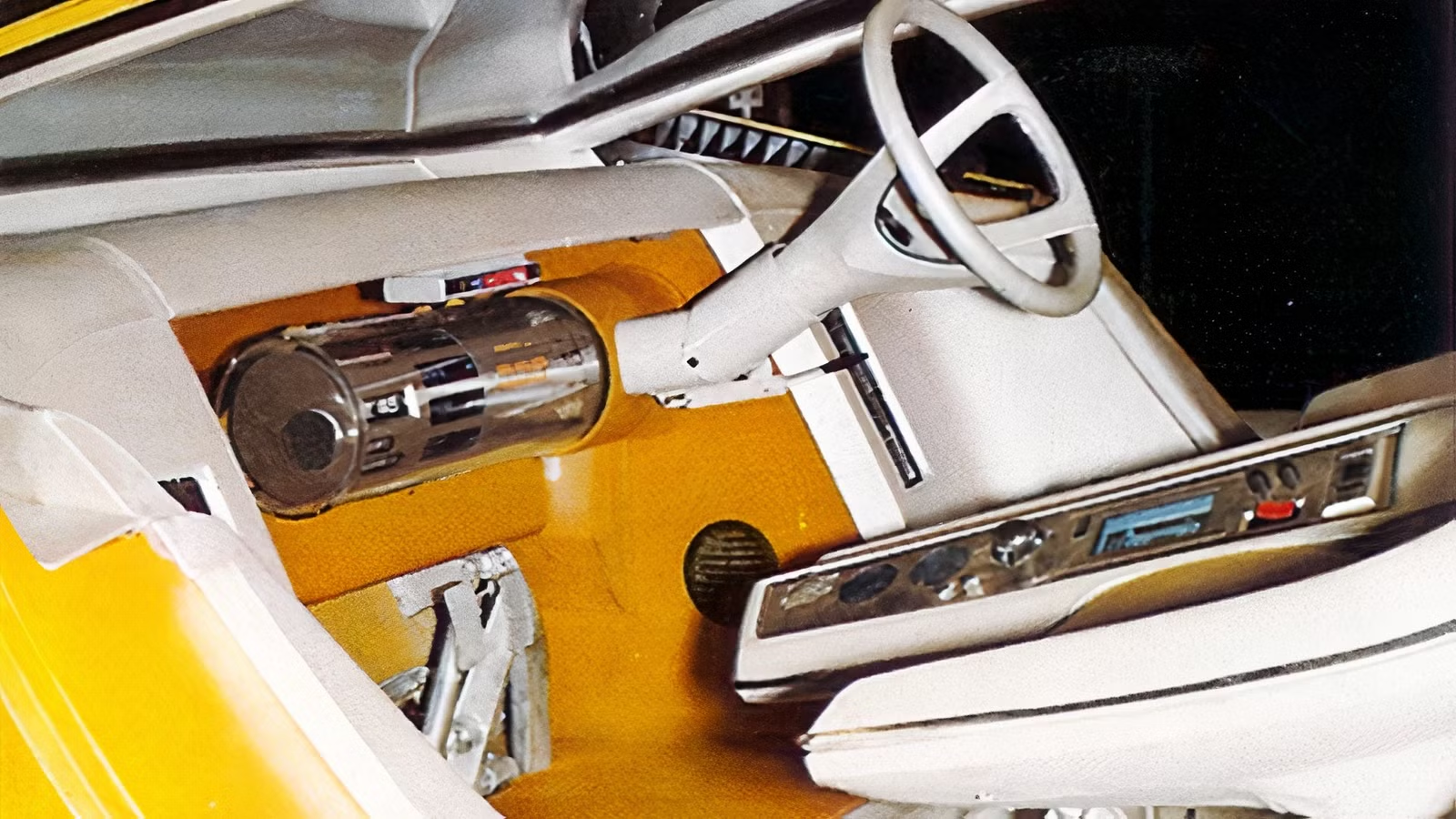
The cabin featured striking light grey and yellow dual-tone upholstery, along with an unconventional cylindrical dashboard. The front seats could rise upward (by around 6 inches) for easier ingress. It was a clever touch that sounds perfectly normal in modern luxury cars but was incredibly forward-thinking in 1970.
The Mid-Engine Roots Of The EX-7

It wasn’t just the chassis that the EX-7 shared with the Toyota 7; it also inherited the same mid-engine layout and even the 5.0-liter V8 engine. But there was one major difference. Since the EX-7 was envisioned as a road-legal concept, Toyota removed the twin turbochargers from the Toyota 7’s engine, resulting in a reduced output of around 442 hp. The engine was paired with a 5-speed manual transmission, sending power to the rear wheels.
Although Toyota never revealed the official acceleration or top-speed numbers for the EX-7, some sources suggest that this futuristic concept could sprint from 0 to 60 mph in around 5 seconds and reach a top speed of 180 mph. That was still seriously quick for the 1970s, and it would not feel slow even by today’s standards.
The EX-7 Project Ended Before It Could Reach Showrooms

The saddest part of the EX-7’s story is that Toyota never gave it a chance to reach production. After all the time, money, and engineering effort Toyota poured into the Toyota 7 program, the cancellation of the Japanese Grand Prix was already a major setback. But things became even worse when Toyota lost two drivers, Sachio Fukuzawa and Minoru Saito, in separate testing accidents. With the racing program eventually coming to an end, the EX-7 became Toyota’s vision of what a road-going version of its wild race car could have looked like.
But the EX-7 remained one of its kind. Part of the reason was that it was always more of an experiment than a realistic production car. The design was avant-garde, but turning it into a road-ready machine would have been extremely difficult, especially with regard to safety and homologation requirements.
How The EX-7 Set The Stage For The MR2

The EX-7 was gone, and with it, Toyota’s mid-engine dream seemed to have died as well. But great ideas rarely disappear. In 1984, Toyota embraced the same mid-engine philosophy with the launch of the MR2, this time as a sports car that enthusiasts could easily afford.

Its sharp, wedge-shaped nose somewhat echoed the EX-7’s front end. Yet Toyota went in a completely different direction with the powertrain. It was not some exotic big-block V8. The MR2 shared a humble 1.6-liter engine with the Corolla. That decision helped keep the price within reach of everyday enthusiasts while offering the reliability Toyota was already known for. The MR2 lived on through three generations until 2007, quietly fulfilling the promise the EX-7 never had the chance to keep.
Sources: Toyota Automobile Museum

Related posts



Latest Post


No Comments