
The Japanese V-Twin Engineered To Outlive Its Owner
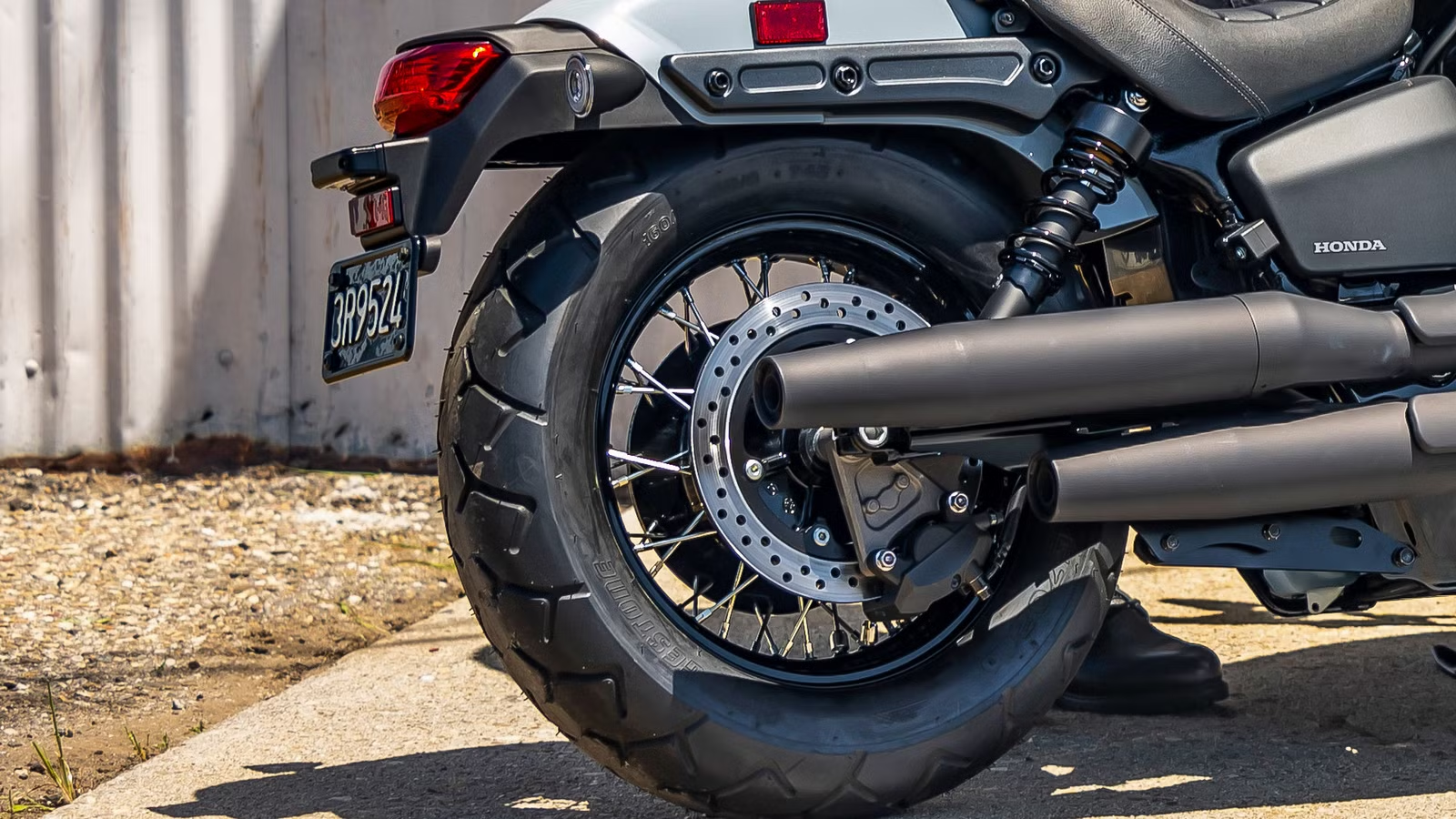
A V-twin engine holds a very distinctive place in motorcycling history. American cruiser bikes are defined by their rumbling V-twin engines. The Ducati Panigale V2, the Aprilia RSV Mille, and the KTM RC8 are sportbikes that showcase the wild side of V-twin engines. Although more complex than a parallel-twin engine, V-twins (in existence since 1902) have shown notable refinement and durability.

Who better to highlight these features than Japanese motorcycle makers, known for precision engineering? As a result, many Far East V-twin engines are designed to last much longer than their counterparts. The engine that interests us is a modern V-twin that has been around since 1983 and currently powers a timeless Honda cruiser bike.
Some Of The Most Reliable V-Twin Engines Are Japanese
This is because Japanese motorcycle makers combine precision manufacturing tolerances, conservative engine tuning, and the philosophy of Kaizen (continuous refinement) in their engineering. The result is a relatively concise yet long-lasting lineup of V-twin-powered motorcycles. A V-twin engine is more adaptive than a comparable parallel-twin mill.


They offer a narrower frontal profile, stronger low-end torque, and a lower center of gravity. This is why a V-twin engine works well on low-slung cruisers and nimble, urban-ready streetfighters. Beyond reliability, V-twins also add drama with a distinctive sound and visually pleasing design.
Japan’s Oldest V-Twin Cruiser Engines: How Long They’ve Really Lasted

Japanese V-twin engines, especially the long-standing ones, offer a balance of traditional and modern features that help them stay relevant for longer. Most V-twin engines in the Japanese portfolio are 20-plus years old and from Suzuki. The Boulevard C50 V-twin is 25 years old, the SV650 V-twin is 27 years old, and the mighty M109R power cruiser’s V-twin is 20 years old.

Interestingly, the youngest V-twin Japanese cruiser bike engine is the Yamaha Bolt R-Spec’s 13-year-old 942 cc air-cooled mill. These long-lasting engines have stayed relevant for so long thanks to the manufacturer’s formula of subtly updating them over the years with the necessary components. The most common upgrade is swapping carburetors for fuel injection. This adds a much-needed refresh without hampering reliability or refinement. Among the timeless bunch, the Honda Shadow Phantom stands out because its V-twin engine is a core design that is over 40 years old and has yet to show its age.
The Honda Shadow Packs One Of The Longest-Surviving Japanese V-Twin Cruiser Engine Designs

The Honda Shadow V-twin engine’s origin story dates back to the 1980s. Honda launched the 1983 VT750C with a liquid-cooled 45-degree SOHC V-twin. It had a displacement of roughly 749 cc, three valves per cylinder, and a six-speed manual gearbox with a final shaft drive. Then, due to US import tariffs imposed in 1984 on motorcycles over 701 cc, Honda temporarily downsized this engine to 700 cc on the VT700C.
The next evolution came in 1998 with the return of the 750 cc V-twin on the Shadow ACE. Honda also changed the V-twin angle to 52 degrees for better balance. This engine has soldiered on without any major updates to date. The 750 cc V-twin is based on the 600 cc Shadow VLX 52-degree mill and was enlarged to 750 cc by increasing the bore by 4 mm and the stroke by 10 mm.

Reliability is well catered for here with a simple engineering design featuring a SOHC layout, three valves per cylinder, and a low compression ratio. Add a low-stress performance tune to the mix, and we have an engine that can virtually go on forever with timely maintenance and preventive care. Honda also helps keep this mill relevant to 2026 standards with fuel injection that boosts refinement and helps meet modern emission standards.
The latest iteration of this 745 cc liquid-cooled V-twin produces 44.9 horsepower at 5,500 RPM and 47.9 pound-feet of torque at 3,500 RPM. It has a 9.6:1 compression ratio, and the power curve is linear yet meaty at the lower end. Power goes to the rear wheel through a five-speed manual gearbox and a final shaft drive system.
American-Inspired Timeless Styling Complements Its Near-Immortal V-Twin

The Shadow Phantom doesn’t look outdated in 2026 because of its custom touches. This ten-year-old design still looks sharp thanks to blacked-out elements on almost every component. Honda seems to have taken a lot of inspiration from the 1950s Indian Chief.
Notable cues include the low-slung, muscular design, a minimal headlamp enclosure, and the padded, scooped solo seat. Its dual-tone paint job on the teardrop fuel tank adds more visual drama. It also gets bobber-inspired chopped fenders that give those chunky tires a more dynamic presence.
Rivals Can’t Match The Shadow Phantom’s Balance Of Style, Function, And Value

This design approach also helps the Shadow Phantom age better than its rivals. Its closest counterpart is the cool-looking Kawasaki Vulcan 900 Custom that fuses chopper styling with Japanese longevity. It also has a larger, long-standing 903 cc V-twin and cuts an attractive figure. But the Vulcan 900 is larger and heavier, making it better suited to the highway. The Shadow Phantom edges ahead for urban duties. Also, the Kawasaki costs more at $9,999.
Then there’s the Suzuki Boulevard C50, which leans more towards the classic side with lots of chrome and full-sized fenders. However, it’s a bit too traditional, and features like pulled-back handlebars and floorboards make it more comfortable on highways only. While the Boulevard C50 is priced the same as the Honda Shadow Phantom ($9,299), it falls behind because Suzuki discontinued it for 2026.
Accessible Dimensions Help It Be A Relaxing Daily Ride

Despite staying true to the quintessential low-slung, stretched-out cruiser stance, the Honda Shadow Phantom is still relatively compact. It has a 64.5-inch wheelbase and a low seat height of 25.6 inches. The low seat height and five-inch ground clearance lower the center of gravity, aiding stability.
The rider sits low and relaxed, with slightly forward-set footpegs and tall, wide handlebars. It also weighs a manageable 553 pounds, making it a comfortable daily runabout. The seat is well-scooped and padded to support long rides.
Simple Underpinnings Are Sturdy And Long-Lasting

Sturdy and proven underpinnings complement its near-immortal V-twin. The Shadow Phantom sits on a simple double-cradle steel frame that cocoons the V-twin. It is suspended by 41 mm forks up front with 5.5 inches of travel. The rear gets preload-adjustable twin shocks with 3.5 inches of travel.

Braking is handled by a 296 mm disc coupled to a two-piston caliper up front. The rear gets a 276 mm disc coupled to a single-piston caliper. Fairly chunky 120/80 front and 160/80 rear tires, mounted on 17-inch front and 15-inch rear laced wheels, help the bike handle highway speeds and winding roads with confidence.
The Honda Shadow Phantom Is Beginner-Friendly With Minimal Technology

There are no complex electronics here. This not only helps the Shadow Phantom stay timeless but also helps it be a comfortable first motorcycle for newbies. The onboard features are very basic, with the only notable feature being dual-channel ABS.

Its instrument cluster is as simple as it gets: a large analog speedometer with a tiny bottom-mounted LCD to display data, including trip details. The absence of TFT screens and extensive driver-assist features keeps the overall build simple, too. This makes it easier and more affordable to repair.
Source: Honda Powersports

Related posts


Latest Post


No Comments