
Volvo Is Killing Its Wagons For Good—And The 2027 SUV Lineup Is The Proof
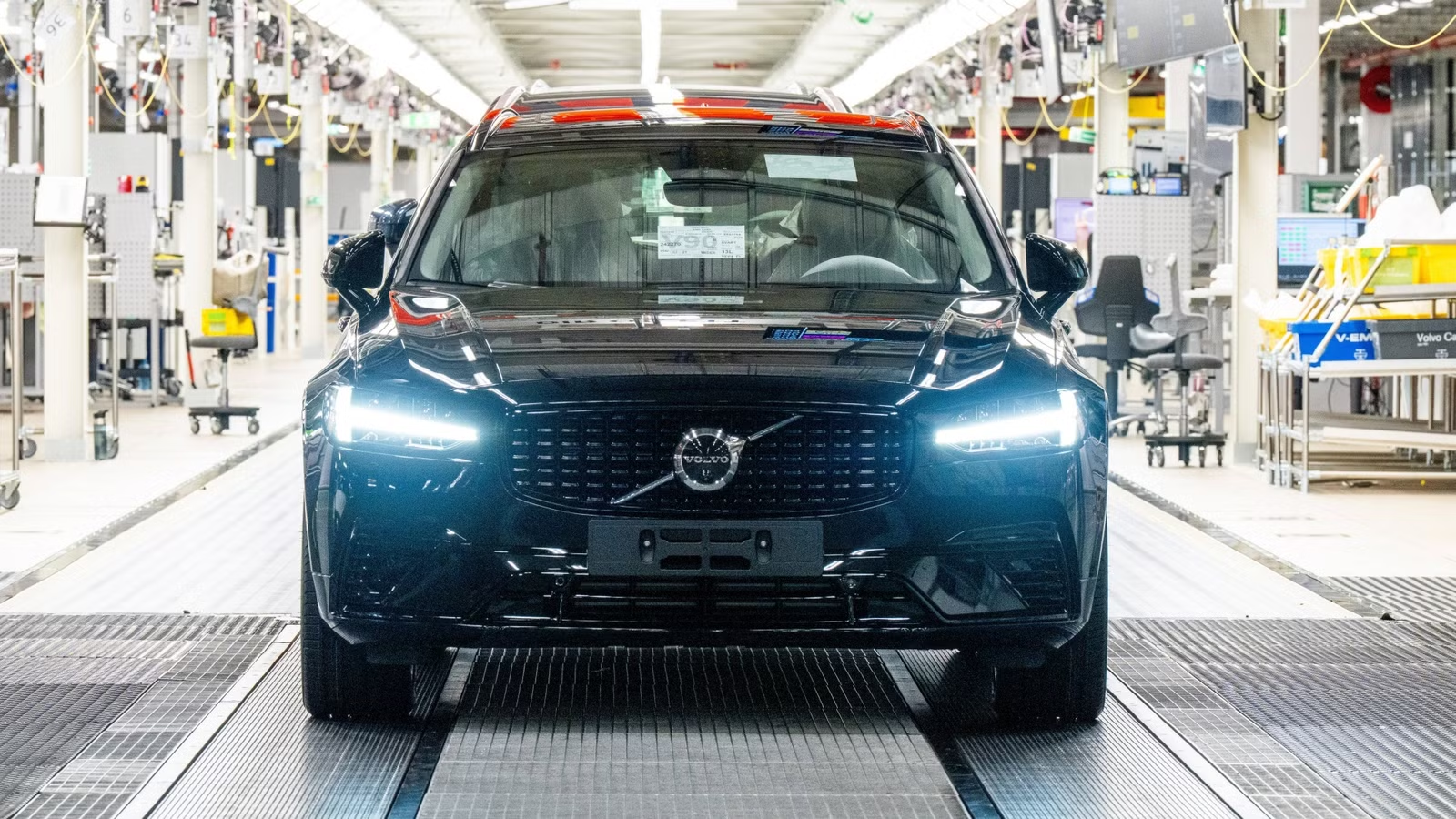
Volvo’s 2027 lineup announcement, confirmed this week, removes the V60 and V90 wagons from the US market entirely. No carryover trims, no limited-run farewell edition—just an SUV-only portfolio going forward, anchored by electric crossovers like the EX60. For a specific and passionate group of buyers, this is the closing of a chapter that was already running short on pages.

The V60 and V90 weren’t just wagons. They were among the last European-engineered, long-roof performance cars you could walk into a US dealership and buy new. That distinction is rarer than it sounds, and Volvo’s exit makes it rarer still.
What Volvo Is Replacing The Wagons With
The 2027 Volvo lineup pivots fully to SUVs and crossovers, with the EX60 serving as the brand’s new centerpiece for North America. First drives of the EX60 have drawn broadly positive coverage—it’s a capable, refined electric SUV with Volvo’s characteristic Scandinavian restraint—but it occupies a fundamentally different space than the cars it’s effectively replacing. A wagon buyer choosing a V90 Cross Country wasn’t just after cargo room. They were after a driving experience that sits lower, handles more precisely, and feels more connected than any SUV at the same price point.

Volvo has also signaled a sub-$40,000 EV for the US market in 2027, aimed at volume rather than enthusiast credentials. The brand’s direction is clear: broader appeal, higher volume, electric powertrains. The wagons don’t fit that roadmap.
Why The V60 And V90 Were Worth Mourning

The case for the V60 and V90 was always straightforward if you were the right kind of buyer. Both cars offered genuine cargo utility—the V90 in particular could swallow luggage, gear, or a weekend’s worth of life without the ride-height penalty of an SUV. They handled with a composure that crossovers at similar price points still struggle to match. And they looked right: long, low, purposeful.
The performance argument was real, too. The V60 Polestar Engineered variant—with tuned suspension, Öhlins dampers, and 415 horsepower from a twin-charged inline-six—made a genuine case for the sport wagon as a driver’s car. It was never a volume seller, but it validated the entire lineup’s performance credibility. Buyers who chose the standard T6 or T8 plug-in hybrid variants were getting the same platform, the same chassis tuning philosophy, and a car that rewarded attention to the road in ways that an XC60 simply doesn’t.
The Broader Wagon Extinction—And Where Volvo Fits

Volvo isn’t alone in this. The wagon’s retreat from the US market has been steady and largely one-directional for two decades. Hyundai is also discontinuing its remaining wagon body style, according to recent reporting, citing the same forces: SUV demand, profitability math, and the cost of maintaining a niche body style through an expensive platform transition.
On the performance end, Porsche confirmed this month that the Taycan Sport Turismo and Cross Turismo wagon variants won’t return for the 2027 model year in America—another significant exit for buyers who valued the long-roof form in a high-performance context. The list of new wagons available in the US is now genuinely short. Volvo’s departure doesn’t just thin the herd; it removes one of the most accessible and well-rounded options in the segment.
What This Means For Used V60 And V90 Values

When a model line ends without a direct successor, the used market tends to notice—eventually. The V60 and V90 will likely follow a pattern familiar to enthusiasts who’ve watched other niche-but-beloved platforms disappear: a period of soft prices as the news settles, followed by gradual appreciation as the supply of well-maintained examples shrinks, and the buyer pool recognizes what’s gone.
The Polestar Engineered variants are the obvious collector targets, but even well-optioned T6 and T8 Cross Country examples deserve attention. These are complex cars—Volvo’s plug-in hybrid systems require some diligence in ownership—but buyers who do their homework on service history and battery condition will find genuine value. The window where these cars are still affordable and still plentiful won’t stay open indefinitely.
Volvo’s CEO has suggested, somewhat cryptically, that wagons could return to the lineup within five years. That’s a long horizon, and it’s conditional on market signals that aren’t currently pointing in that direction. For now, the 2027 announcement is what it is: a definitive end to the V60 and V90 as new-car options in America.
Volvo built some of the most convincing arguments for the wagon in the modern era. The V60 and V90 proved that practical and performance-oriented don’t have to be in conflict. Losing them from US showrooms isn’t a market footnote—it’s a real subtraction for buyers who knew exactly what they were getting.
Sources: Yahoo Autos, Carscoops, Road & Track

Related posts





Latest Post


No Comments