The Japanese Sports Sedan That Gives The Germans A Taste Of Their Own Medicine
9 minutes reading
Friday, 2 Oct 2026 12:00 0 47 autotech
When it comes to choosing sports sedans, German brands like BMW, Audi, Porsche, and Mercedes-Benz are the obvious choice. You tend to get a lot of power, oodles of athletic-looking interior detailing, track-worthy DNA, and a badge on the front that carries a bit of weight.
However, if you are looking for something a bit more old-school, but with still plenty of power, high rates of reliability, and lots of calm luxury inside, there isn’t much that gets in the way of this Japanese sedan.
German Sedans Have Dominated The Performance Market For Decades
Front 3/4 shot of BMW M5 (F90) parkedBring A Trailer
The formula has been around for generations, but German marques have spent decades refining fast sedans. The 1998 M5 proved a family sedan could have a proper performance engine, while the 1996 Mercedes-AMG E 50 showed the same idea could work, just with more luxury . Audi eventually joined the fun in 2000 with the S6 and its V8, and since, German sedans have become very hard to ignore.
What changed was the sheer amount of performance these models can deliver without giving up their everyday manners, and by 2010, a fast German sedan could be just as comfortable cruising to work as it was terrifyingly fast on a back road.
BMW, Mercedes-Benz, And Audi Set The Benchmark For Fast Luxury Sedans
Front 3/4 shot of 2026 Audi RS7 parkedAudi
Take the 2026 BMW M5; it gets a 4.4-liter bi-turbo V8 paired with an electric motor good for 717 horsepower, while an eight-speed automatic transmission and xDrive AWD help it get to 60 mph in as little as 3.4 seconds. All that while still being comfortable enough sitting in traffic or covering highway miles.
The very mention of Mercedes-AMG conjures up images of luxury meeting on-road performance, and the new E 53 Hybrid is proof that German brands know what they’re doing. Its 3.0-liter plug-in inline-six kicks out 577 horsepower and pushes the E 53 to 60 in less than four seconds, all while offering you 41.7 inches of front legroom. Modern German sports sedans are exceptionally fast and refined, but they are becoming increasingly technology-laden, which leaves room for a more traditional alternative.
The Lexus IS 500 Brings A Very Different Formula
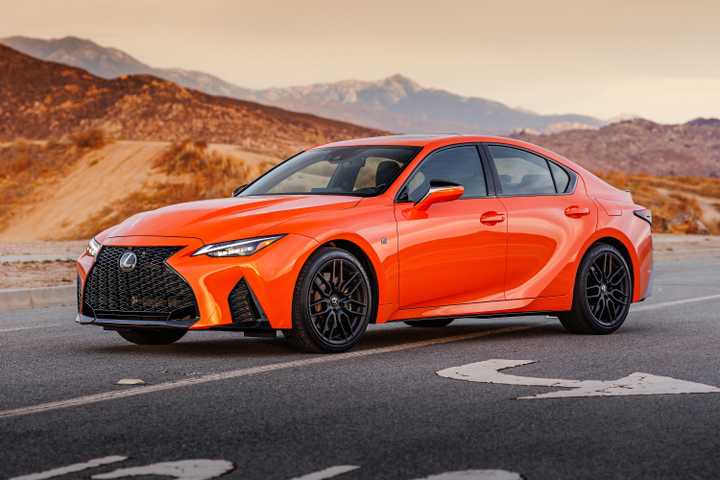
2025 Lexus IS 500 front end close-up parked on ridgeGarret Donahue | TopSpeed
The final model year of the legendary Lexus IS 500 was 2025, but there is something about it that not only delivers what you want from a luxury sports sedan but also makes a compelling case for long-term ownership.
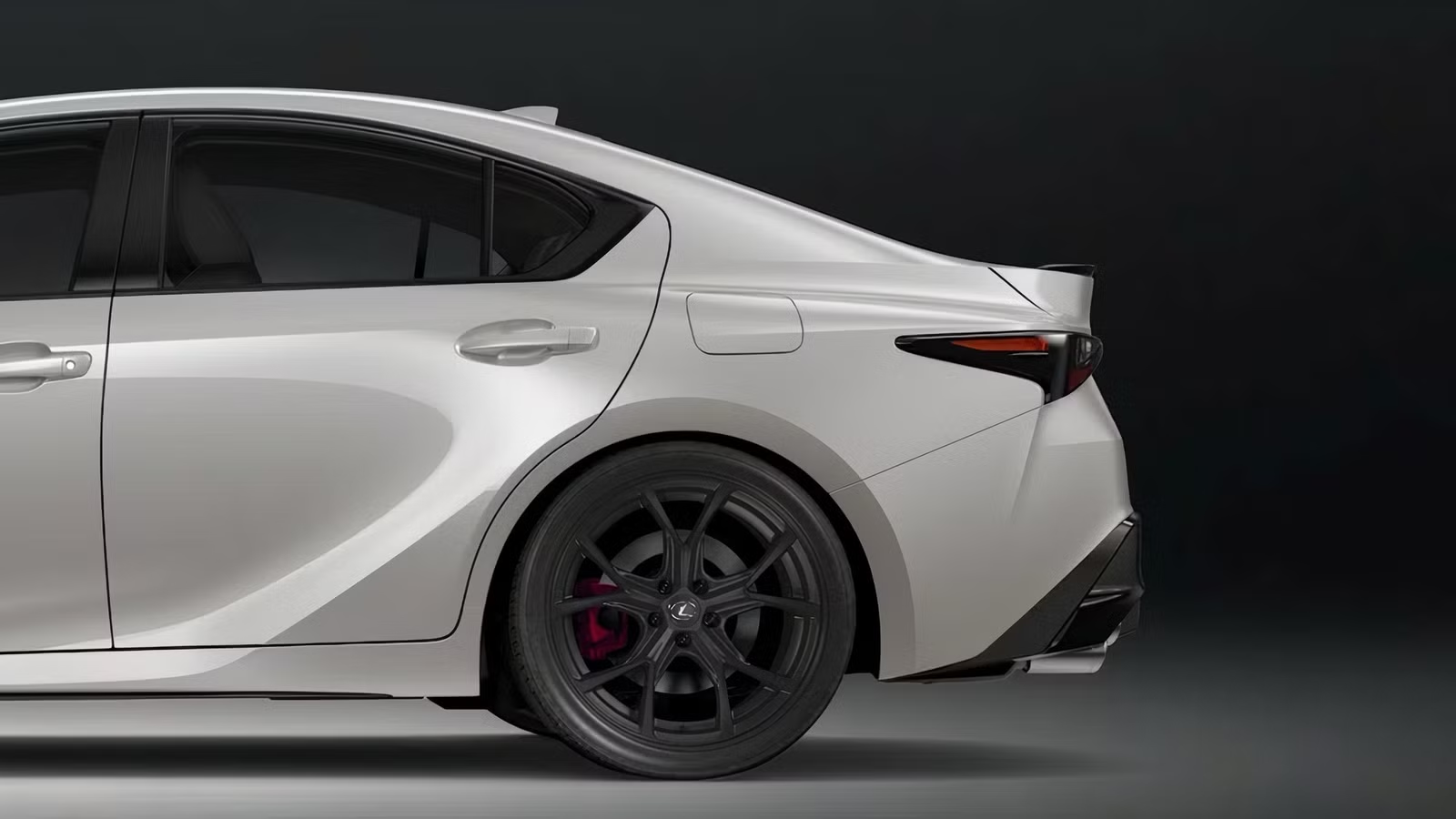
There are three trims of the 2025 Lexus IS 500: the F SPORT PERFORMANCE, the F SPORT PERFORMANCE Premium, and a limited run of the Ultimate Edition. All have four doors, seating for five people, 10.8 cubic feet of trunk space, and a sporty yet classy look.
Its Naturally Aspirated 5.0-Liter V8 Makes Over 450 Horsepower
Close-up shot of 2025 Lexus IS 500 engine bayLexus
The defining characteristic that makes the IS 500 such a compelling sports sedan is the engine under the hood. It is equipped with a 5.0-liter naturally aspirated 90-degree 2UR-GSE V8 rated for 472 horsepower at 7,100 rpm and 395 pound-foot of torque at 4,800 rpm.
0–60 mph times are respectable at around 4.5 seconds, and a top speed of 149 mph is not to be dismissed. While a lot of high-end German sports sedans are quicker, most of them have followed the evolution of turbo tech to get results. The IS 500 uses an old-school NA V8. That means no turbo lag, linear power delivery, a mechanical feel, a deep growl from the exhaust, a rev-happy character, and a direct throttle response.
Rear-Wheel Drive And A Traditional Automatic Keep The Driving Experience Real
Rear 3/4 shot of 2025 Lexus IS 500 in yellow parked on roadGarret Donahue | TopSpeed
Power is sent straight to the rear wheels through an eight-speed Direct-Shift automatic, with no all-wheel drive system trying to manage every last pound-foot. Why does that matter? Because the IS 500 still feels like a car where the drivetrain is doing its job, rather than constantly trying to second-guess what you want from it.
The transmission also gives the relatively large V8 room to work. It holds gears when pushed, delivers clean shifts, and keeps the rear axle involved when you are leaning on the throttle. There is no electric motor filling in the gaps or turbocharger waiting to spool up—just a conventional powertrain doing things the old-fashioned way.
Owners of the last model year of the IS 500 seem to appreciate this kind of setup, with owner ratings on Kelley Blue Book at 4.5 out of 5 for performance and 81 out of 100 for driving experience on J.D. Power. Despite a general lack of nannies, one owner said the following about their IS 500.
Beautiful design, plenty of pep, handles unbelievably well. You feel planted when you are cornering, and it corners really well.
IS 500 Delivers V8 Performance Without German Complexity
When we say the IS 500 gives German sedans a taste of their own medicine, we mean that it takes the general formula of what makes a good sports sedan and brings something different. The V8 under the hood is one thing, but then there is the way in which Lexus brings its own flavor of class and rock-solid quality to the table.
Proven Lexus Engineering Can Make Long-Term Ownership Easier
Side action shot of red 2025 Lexus IS 500 driving on roadLexus
On J.D. Power, the final model year of the IS 500 is rated 91 out of 100 for reliability. While a study of the IS 500 isn’t recorded by iSeeCars, they do say that the wider IS family has a lifespan of between 180,000 and 200,000 miles. The IS 500 was only released in 2022, so we haven’t seen a huge number of high-mileage models yet, but one owner has already claimed to have put 85,000 miles on the clock with nothing needed but simple maintenance.
Thanks to how Lexus builds its cars, the IS 500 is sporty and stylish, but also very dependable. The 2UR-GSE V8 under the hood is a famously stout piece of engineering, and the rest of the IS 500 follows the same kind of conservative philosophy.
View of the engine bay of the 2025 Lexus IS500Garret Donahue | TopSpeed
The suspension uses conventional coil springs and Yamaha rear performance dampers rather than air suspension, while the steel body and relatively straightforward cabin avoid some of the expensive complexity found in 2026 German sedans.
Even the brakes (two-piece aluminum units with 14-inch front and 12.7-inch rear rotors), the Torsen limited-slip differential, the cooling system, and the electrical architecture are based on well-established Lexus hardware. It is this kind of design thinking that has made Lexus such a reliability powerhouse: it doesn’t constantly chase the newest thing.
A Cabin Built Around Buttons And Materials, Not Screens And Software
High-angle side shot of 2025 Lexus IS 500 interior showing front cabinLexus
The IS 500’s cabin is also a welcome antidote to the modern obsession with turning a car interior into a nightclub. There is plenty of tech in there, but Lexus hasn’t forgotten that buttons, proper controls, and decent materials mean more, especially as it ages.
The F SPORT Performance gets exclusive satin-finish interior trim, F SPORT seats, and a leather-wrapped steering wheel, while the standard NuLuxe upholstery can be found in Black, Glazed Camel, or Rioja Red. That means a classy cabin that isn’t shouty.
Close-up shot of 2025 Lexus IS 500 interior showing seat detailLexus
There is also a decent amount of equipment. An eight-inch touchscreen is standard fare, while the Navigation/Mark Levinson package brings a larger 10.3-inch display with navigation. Apple CarPlay and Android Auto are standard, and the originally optional Mark Levinson audio rig comes with 17 speakers and 7.1-channel Quantum Sound Logic Surround.
You also get heated and ventilated front seats and dual-zone climate control, while an originally available power moonroof adds a touch of everyday luxury. In short, you get the old-school engine feel mixed with elegant, nearly timeless interior quality.
The IS 500 Makes The Most Sense For A V8 Sedan Before They Disappear For Good
Front 3/4 action shot of 2025 Lexus IS 500 F Sport Performance driving on roadChris Chin | TopSpeed
You could follow the J.D. Power overall rating of 86 out of 100, or the 83 percent owner recommendation rate on Kelley Blue Book to come to the conclusion that the last model year of the IS 500 is a good idea. But, there is a compelling argument: V8s in sedans are very rapidly disappearing from the U.S. market, and this one is attached to a sedan that still offers 44.8 inches of front legroom, a lot of quiet quality inside, and a lot of V8 noise on the outside.
Starting prices for the 2025 IS 500 F SPORT Performance and F SPORT Performance Premium were between $60,345 and $64,485 last year. Today, Classic.com says the average auction price of an IS 500 is $59,974. The IS 500 Ultimate Edition had only 500 units built and a starting price of $71,495. While there are no recorded sales of the Ultimate Edition on the used market yet, it is worth noting that the highest price paid for a ’25 IS 500 is just under $80,000, and that was a base trim.
Front 3/4 action shot of 2025 Lexus IS 500 driving through tunnelLexus
Lexus models hold their value well, and as these are the last of the IS 500 models, we could see them become collector’s items in the future, especially well-kept examples. The 2UR-GSE V8 is also being discontinued, along with the LC 500 lineup this year, and while there are V8s in German sedans in 2026, there are no naturally aspirated ones.
The IS 500 was never about winning any numbers games, and it doesn’t need to. It is about doing what the increasingly complicated sports-sedan market has forgotten: giving you a real sense of occasion every time you get in it, without making ownership feel like a burden. There is no denying that modern German sedans are special, but the final model year of the IS 500 is a proper old-school sports sedan, and that makes it very difficult to dismiss.
Base Trim Engine
5L V-8 ICE
Base Trim Transmission
8-speed automatic
Base Trim Drivetrain
Rear-Wheel Drive
Base Trim Horsepower
472 HP @7100 RPM
Base Trim Torque
395 lb.-ft. @ 4800 RPM
Base Trim Fuel Economy (city/highway/combined)
17/25/20 MPG
Base Trim Battery Type
Lead acid battery
Make
Lexus
Model
IS 500
Sources: Lexus, Classic.com, iSeeCars, J.D. Power, and Kelley Blue Book.












No Comments