The Sports Car That Refuses To Sacrifice Reliability
7 minutes reading
Wednesday, 26 Aug 2026 22:00 0 32 autotech
For years, sports cars have come with an unwritten compromise. If you wanted something engaging to drive, you often had to accept higher maintenance costs, expensive repairs, or questionable reliability. Plenty of cars delivered performance, but not many inspired confidence once the warranty expired. However, one Japanese sports car has spent more than three decades proving that excitement and dependability don’t have to be mutually exclusive. Before we dive deeper into this sports car that encourages you to take the long way home, it is worth acknowledging how timeless this two-seater roadster has become.
Modern rivals have largely moved in the opposite direction. Cars such as the Nissan Z, Toyota GR 86, and even the Ford Mustang offer substantially more punch in the power department, but they’ve also grown larger and heavier. They remain top choices, yet many enthusiasts argue that simplicity has disappeared over the years.
2027 Toyota GR86 side shotToyota
It’s true. Road & Track echoes that sentiment, noting that modern sports cars have become “heavier, more complex, and less engaging.” While some enthusiasts still believe more cylinders automatically mean more excitement, one lightweight roadster continues to prove otherwise. It isn’t perfect, but few sports cars connect driver and machine quite like it. This roadster has been doing exactly that for decades.
Now in its fourth generation (ND), the MX-5 has stayed true to the formula that made the original a success back in 1989. While it has evolved over the years, Mazda made a conscious effort to return to its roots after the larger, heavier NC.
The result was a lighter, more compact roadster that once again prioritized simplicity and driver engagement. The original NA and second-generation NB became favorites for exactly that reason, and today’s ND builds on the same philosophy while adding modern styling, improved technology, and better refinement without losing what made the Miata special in the first place.
Fast-forward to today, and the ND3 brings a series of small but worthwhile updates, including revised headlights and taillights, a recalibrated limited-slip differential, suspension tweaks, and an updated infotainment system. Mazda also increased output from 155 horsepower to 181 horsepower in 2019. While the MX-5 has evolved throughout its ten-year production run, it has never strayed from the lightweight, driver-focused formula that made it a success.
Driving And Handling Leaves An Impression On Anyone Who Gets Behind The Wheel
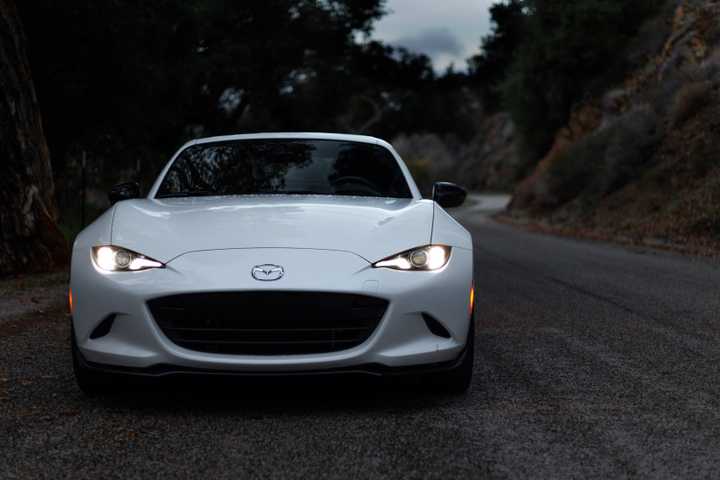
Front shot of 2026 Mazda MX-5 Miata RF in white parkedIan Wright | CarBuzz | Valnet
Under the hood sits a naturally aspirated 2.0-liter Skyactiv-G four-cylinder producing 181 horsepower and 151 pound-feet of torque. Buyers can pair it with a six-speed manual or a six-speed automatic, with most enthusiasts favoring the manual.
It’s a rear-wheel-drive setup, and with a curb weight of just 2,350 pounds, the MX-5 doesn’t need huge power figures to be exciting. On paper, 181 horsepower doesn’t sound like much, but remember, there’s very little weight for it to move around. Road & Track noted that the Miata feels at its best when it’s being worked hard, praising its friendly, responsive chassis and the way it communicates as you approach its limits.
Action shot of 2021 Mazda MX-5 Miata RF going around a trackIsaac Atienza | TopSpeed
Throw in the near 50:50 weight distribution, compact dimensions, and low seating position, and it’s easy to see why the MX-5 has become the benchmark for lightweight sports cars. Car and Driver also praised its “direct, responsive steering” and “athletic chassis,” proving that driving enjoyment isn’t always about chasing bigger horsepower numbers.
Mazda’s Cabin Ethos Is Simple
Eschewing flashy tech and oversized screens, the 2026 MX-5 keeps things focused: low-slung seats, a tight cockpit, and well-placed controls serve up a true sports-car vibe. The new 8.8-inch infotainment screen with wireless Apple CarPlay and Android Auto adds a subtle touch of modernity, but old-school buttons and dials ensure the spotlight stays on driving—not on swiping through menus. As Top Gear put it, the MX-5 is “a pleasing antidote to modern cars.”
Lightweight Engineering Still Wins
It Doesn’t Need Huge Power To Put A Smile On Your Face
2026 Mazda MX-5 Miata Front EndMazda
To further illustrate how the narrative has shifted, look at the Nissan Z and Toyota GR86. Both are excellent sports cars, and both produce considerably more power than the MX-5, but they’ve also become heavier. The Toyota GR86 weighs around 2,800 pounds, while the Nissan Z tips the scales at more than 3,500 pounds.
2027 Toyota GR86 front shotToyota
By comparison, the Miata weighs just 2,350 pounds. That lower weight allows it to change direction more eagerly, brake later, and carry more speed through corners. Road & Track summed it up well, saying the Miata’s compact dimensions and low weight create “a world-class driving experience,” adding that its balance of ride and handling rivals “the best sports cars of old.”
2026 Mazda MX-5 Miata Making A TurnMazda
That’s where the MX-5 separates itself. The GR86 offers more cabin space and the practicality of a fixed roof, while the Nissan Z delivers more straight-line performance. The Miata, however, stays true to the lightweight formula, showing time and time again that driving pleasure isn’t always measured by horsepower.
Reliability Makes It Even Better
You Spend More Time Driving Than Repairing
Rear three-quarter shot of a 2025 Grey Mazda Miata MX-5 parked by a beachMazda
The Miata’s biggest advantage is that owners can enjoy driving it rather than stressing over costly repairs. RepairPal gives the MX-5 Miata an above-average reliability rating of 4.0 out of 5.0, with average annual repair costs of just $429, adding that repairs are generally less frequent and less severe than the industry average.
The naturally aspirated 2.0-liter Skyactiv-G engine bucks the trend by avoiding the added complexity of turbocharging, while routine servicing is generally straightforward and more affordable than that of many European sports cars.
BMW Z4 M40i accelerating hardBMW
Take the BMW Z4, Mini Cooper S, and Audi TT as examples, where maintenance and repair costs can climb much more quickly as the miles add up. While all are capable sports cars, ownership costs can quickly become part of the equation once the warranty expires. That combination of low running costs, proven reliability, and a winning formula is a major reason why the MX-5 has remained one of the world’s best-selling sports cars for more than three decades.
It Still Sets The Benchmark
The Simple Sports Car Everyone Else Chases
A rear 3/4 close-up shot of a beige 2022 Mazda MX-5 MiataMazda
The motoring industry has changed since the current MX-5 arrived in 2016. Sports cars have become larger, heavier, and reliant on turbocharging and advanced electronics. The Miata has resisted that trend. Its appeal is also reflected in the numbers. Mazda has now built more than 1.25 million MX-5s across four generations, making it the world’s best-selling two-seat roadster. That doesn’t happen by accident. It happens because Mazda has never lost sight of what made the Miata special in the first place.
Perhaps that’s why the MX-5 resonates with me. Back in 2012, my father, Edwin Naidu, owned a red NB. It wasn’t the fastest sports car on the road, nor did it have the biggest engine. But it had character. The soft-top, the simple cabin, the low driving position, and the way it made every drive feel like an occasion left a lasting impression on me. Looking back now, it’s clear that the same philosophy lives on in today’s ND.
A picture of a Red 2025 Mazda Miata MX-5 at a stop lightMazda
In the end, that’s what the MX-5 proves. You don’t need 400 horsepower or a complicated drivetrain to build a great sports car. The Miata has been proving that for more than three decades, and it’s one of the few sports cars that still reminds us why driving is supposed to be fun.













No Comments