
The Last Great Naturally Aspirated American Performance Car
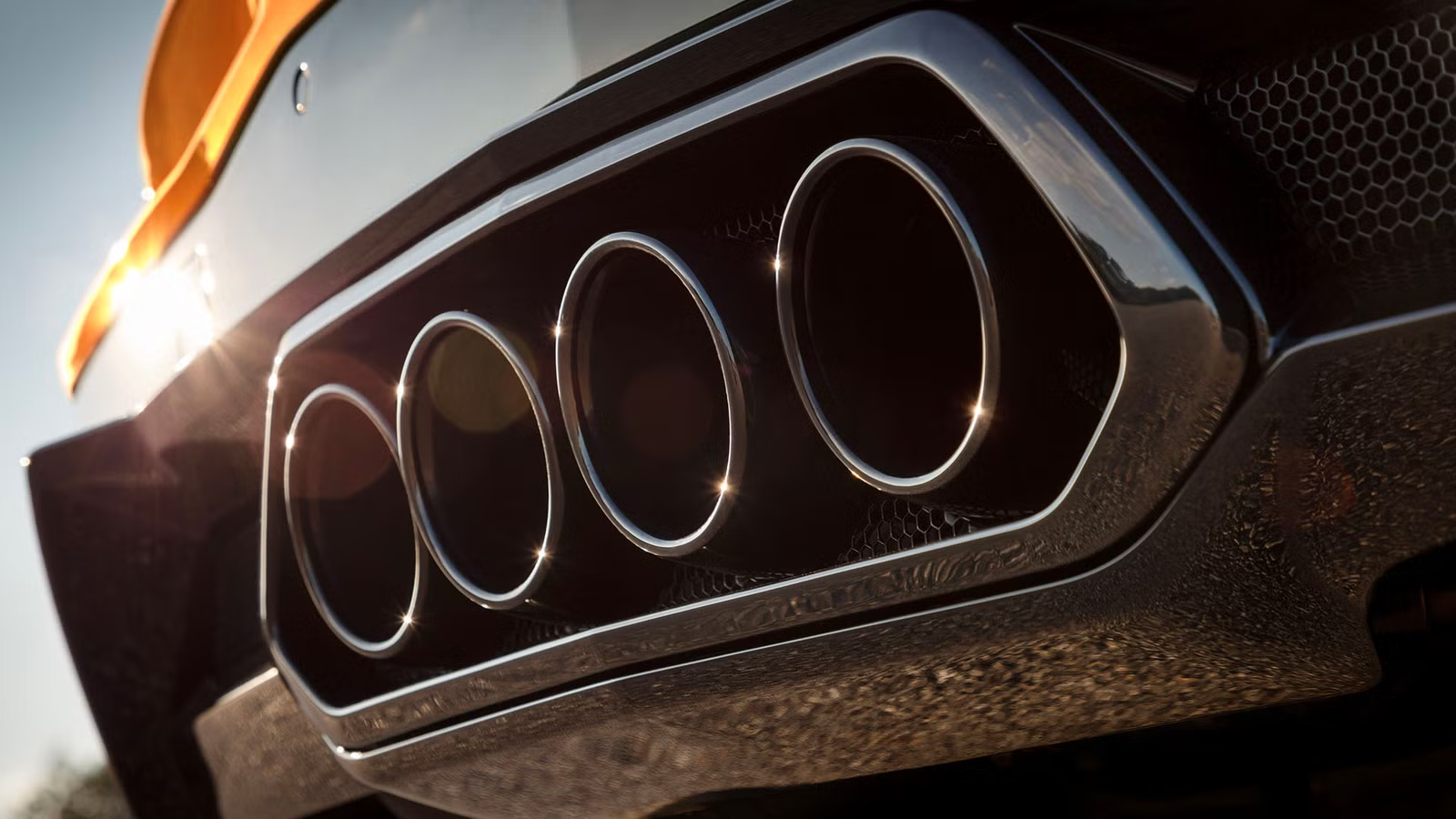
Something has changed in the engine bays of American performance cars. The Camaro is gone. The Challenger is gone. The cars that replaced them, or that are being built to succeed them, run on boost, batteries, or both. Even within surviving lineups, the highest-powered variants now route their figures through turbochargers or electric motors rather than earning them through displacement and revs alone. The era of the great naturally aspirated American performance engine is not ending gradually — It has already ended almost everywhere, with one conspicuous exception. Chevrolet is still building it, and what it has produced is not a compromise or a swan song. It is the best naturally aspirated performance engine an American manufacturer has ever made.
When American Performance Started Reaching for Help

For most of the twentieth century, the American performance car formula was straightforward: build a large displacement V8, keep it simple, and let cubic inches do the work. The approach produced iconic engines and iconic cars. It also had limits, and by the 2010s those limits were showing. Emissions regulations tightened. Fuel economy standards climbed. The fastest way to extract more power without getting into trouble with either was to add forced induction, and one by one the major players reached for the turbocharger or the supercharger to hit the numbers their customers expected.
The muscle car segment felt this most sharply. The last Dodge Challenger rolled off the line after 2023, its supercharged Hellcat era finished. The Camaro followed it out the door after 2024, with no confirmed naturally aspirated successor on the horizon. The Ford Mustang retains its V8 and remains the last standing muscle car, but the next generation is expected to bring electrification of some kind. Across the entire American high-performance landscape, the direction is the same. More power is coming from electricity or boost, and less from atmospheric combustion alone. That shift makes what one Corvette variant is doing right now all the more remarkable.

The Most Powerful Naturally Aspirated V8 Engine Ever Produced
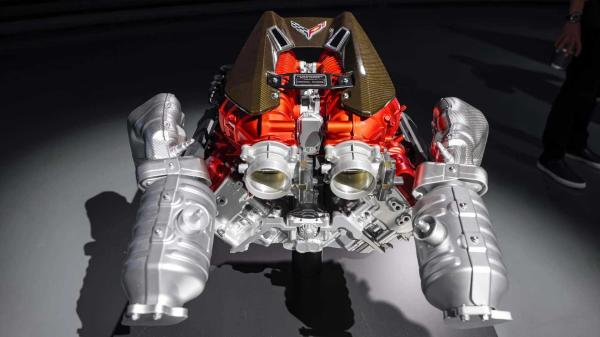
America makes the world’s most powerful naturally aspirated V8, and it makes its peak power at a stratospheric 8,400 RPM.
The Engine That Belongs in a Different Country

Traditional American V8 engines are built around a cross-plane crankshaft, a design that produces a deep, burbling exhaust note and keeps torque strong low in the rev range. They are tractable, they are durable, and they rarely need to rev past five or six thousand rpm to make their best numbers. The engine in question here does none of those things. It uses a flat-plane crankshaft, a design associated almost entirely with European race-derived machinery, most famously a certain Italian manufacturer’s V8 that the engineers reportedly used as a reference point. The flat-plane layout fires the cylinders in a different sequence, creating a sharper, higher-pitched exhaust note and allowing the engine to rev far beyond what a cross-plane unit of similar displacement would manage, with the redline sitting at 8,600 rpm.
Without a single turbocharger or supercharger, this engine produces 670 horsepower from 5.5 liters. The specific output of 121 hp per liter is higher than any other naturally aspirated production V8 in history. Reviewers reached for Ferrari comparisons instinctively and correctly. The engine does not sound or behave like any American V8 that came before it, and that is entirely the point. It represents a deliberate decision to solve the performance equation the hard way, at a moment when almost every other manufacturer had already decided the hard way was not worth the effort.
The Corvette Z06 and the LT6: America’s Highest Mark

|
Model |
Engine |
Power |
Torque |
0-60 mph |
Top Speed |
|---|---|---|---|---|---|
|
2026 Corvette Z06 |
5.5-liter DOHC flat-plane V8 |
670 hp |
460 lb-ft |
2.6 sec |
195 mph |
|
2026 Porsche 911 GT3 |
4.0-liter DOHC flat-six |
502 hp |
331 lb-ft |
3.2 sec |
193 mph |
The C8 Corvette Z06 is the car that makes the headline’s claim possible. Introduced for the 2023 model year, it sits above the standard Corvette Stingray in the range and below the twin-turbocharged ZR1, occupying a specific and increasingly rare position: a mid-engine supercar producing genuine supercar performance without a single turbocharger, supercharger, or electric motor contributing to the output figure. Its 5.5-liter V8 is an entirely different engine from the one in the base car, developed specifically for this application and sharing no major components with the Stingray’s LT2. The Z06 is wider, lower, and aerodynamically more aggressive than the car it shares a platform with, and it is built around that engine the way a racing car is built around its powertrain.
The numbers justify the engineering investment behind them. The Z06 covers the quarter-mile in 10.6 seconds at 131 mph and reaches 60 mph in as little as 2.6 seconds with the Z07 package, figures that put it ahead of the 911 GT3 in a straight line despite a substantial price gap between the two cars. The chassis around the LT6 is equally serious, with a mid-engine layout, magnetic ride control, and available carbon ceramic brakes and carbon fiber wheels. The Z06 is not a muscle car wearing a track kit. It is a purpose-built supercar that happens to carry American plates.
The LT6 V8 That Rewrote What a Naturally Aspirated Engine Can Do

The engine at the center of the C8 Corvette Z06 is the LT6, a hand-built 5.5-liter dual overhead cam V8 developed specifically for this application and carrying over no major components from the standard Corvette Stingray’s LT2. The flat-plane crankshaft allows the engine to rev to 8,600 rpm, and the powerband is tuned to reward drivers who use the full range. Output is rated at 670 horsepower at 8,400 rpm and 460 lb-ft of torque, making it the highest-output naturally aspirated V8 ever put in a production car. The dry-sump oiling system, forged titanium connecting rods, and forged aluminum pistons are borrowed from racing architecture rather than road car convention. Every LT6 is hand-assembled at the Bowling Green plant in Kentucky, and buyers can option a build experience where they assemble part of their own engine alongside a factory technician.
What a C8 Z06 Costs New and on the Used Market

|
Model |
New MSRP (Base) |
New MSRP (Top Spec) |
Used Market Benchmark |
|---|---|---|---|
|
2026 Corvette Z06 Coupe |
$119,695 |
$160,000+ |
$138,418 |
|
2026 Porsche 911 GT3 |
$224,495 |
$260,000+ |
$310,000+ |
The 2026 Corvette Z06 starts at $119,695 for the base 1LZ coupe, including destination. The mid-spec 2LZ opens at $128,595 and the fully loaded 3LZ coupe at $133,245. Convertible variants add $7,000 across the board. The optional Z07 performance package, which adds carbon ceramic brakes, carbon fiber wheels, and track aero, adds $27,495, pushing a fully specced example well past $160,000. That is still less than the 911 GT3’s base price of $224,495, which makes the value case for the Z06 almost unfair.
On the used market, current market data across more than 140 listings puts the benchmark for C8 Z06 examples at approximately $138,418. The spread between lightly used base cars and heavily optioned Z07 examples is considerable, and buyers willing to take on a pre-owned 2023 or 2024 example can access the LT6 experience at a meaningful discount to the new car price.
The Outlier in Its Own Lineup

Look at the Corvette range and the Z06’s position becomes striking. The ZR1 above it uses the LT7, a twin-turbocharged version of the same flat-plane architecture, producing 1,064 horsepower with boost where the LT6 makes 670 without it. Above that sits the ZR1X, which pairs the turbocharged LT7 with an electric front motor for 1,250 combined horsepower and all-wheel drive. Chevrolet has also confirmed the hybrid E-Ray is being phased out in favor of a new Grand Sport lineup, including a Grand Sport X variant that pairs a naturally aspirated 6.7-liter V8 with a front electric motor for a combined 721 horsepower. Every other performance variant in the lineup either uses forced induction, electrification, or both. The Z06, sitting in the middle of this increasingly hybridized and turbocharged family, is the only model that still relies on atmospheric combustion alone to make its case.
That position will not last indefinitely. The C8 generation is approaching the end of its run, and nothing currently confirmed for the platform that follows it returns to a pure naturally aspirated V8 in this power range. When the C8 Z06 eventually winds down, it will have been the last Corvette powered this way. More broadly, it may well be the last American production car to extract supercar-level performance from a naturally aspirated V8 without any assistance from turbochargers or electric motors. The cars that succeed it will be faster. Some will be significantly faster. But they will be getting there with help, and the LT6 will remain the high-water mark for what an American naturally aspirated engine could do when given every advantage except boost.
Sources: Classic.com, Chevrolet.

Related posts


Latest Post


No Comments