
The Japanese Hybrid SUV That’s Worth Every Penny
Hybrid SUVs have firmly moved from niche curiosity to mainstream must-have in the U.S. market — and it’s easy to see why. By pairing efficient internal combustion engines with compact electric motors, they deliver real-world fuel savings without the range anxiety or charging-infrastructure headaches that come with a fully electric vehicle. They also tend to carry friendlier price tags than their battery-only counterparts, making the transition to electrified motoring far more accessible for everyday buyers.

That growing demand has pushed virtually every major automaker to field a gasoline-electric version of its best-selling crossover, turning the segment into one of the most competitive — and consumer-friendly — corners of the new-car market. The result is a wide field of capable, well-equipped options, each brand striving to out-value the next.
Sitting at the top of that field is a popular Japanese model from a brand with a long, proven track record in hybrid engineering. Based on its popularity, we can comfortably say that it is well worth the competitive asking price. It’s a nameplate that has been on U.S. roads for several decades, and one that has benefited from a hybrid drivetrain offered in both front-wheel drive and all-wheel drive configurations. It has become so successful for its Japanese manufacturer that it effectively outshines every other vehicle in the brand’s current lineup.
The Honda CR-V Hybrid Offers The Best Bang For Your Buck

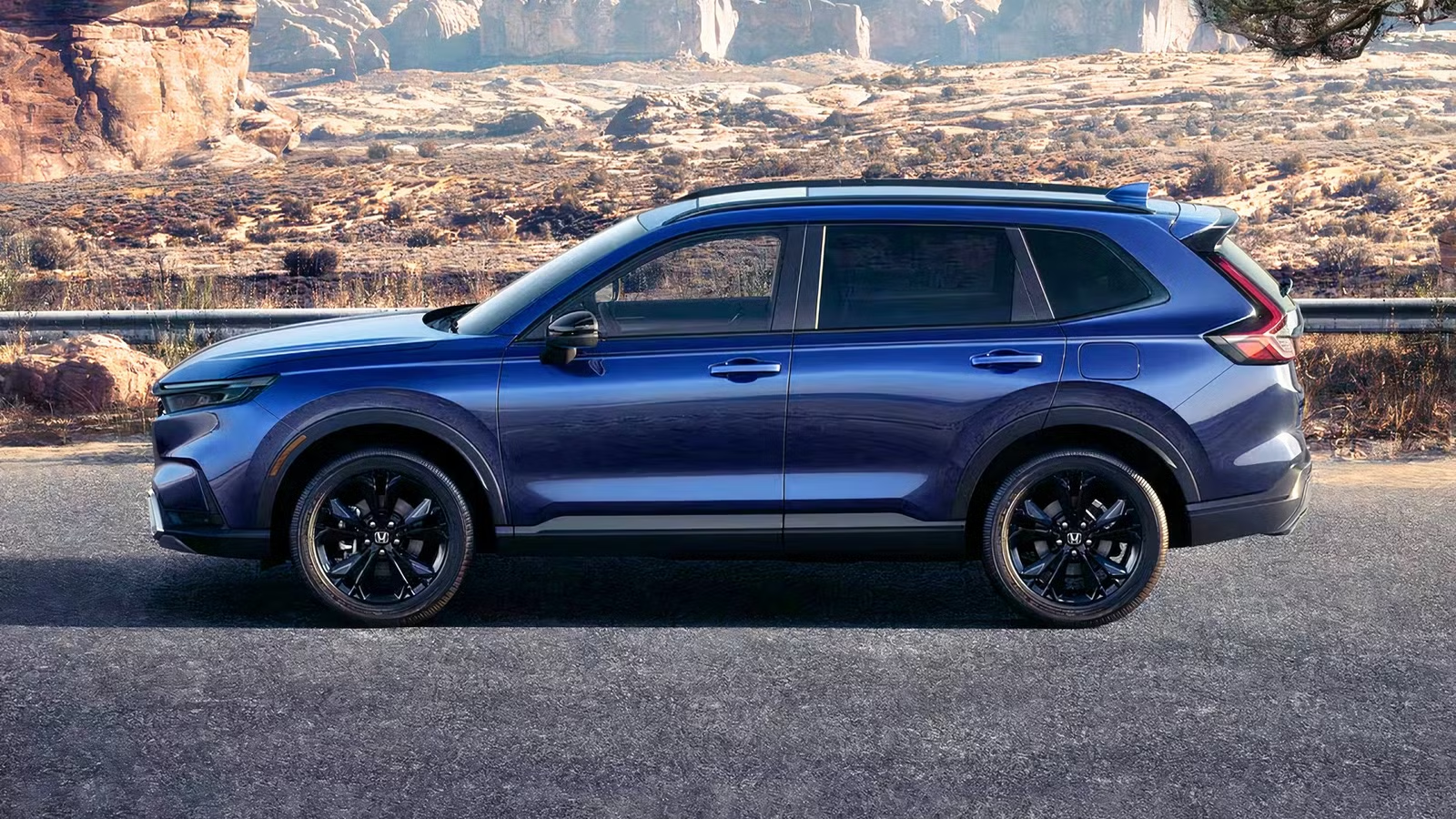
Many would think that the Toyota RAV4 Hybrid is the best hybrid crossover option that you can consider, but the Honda CR-V Hybrid presents itself as a more comprehensive package. A big reason for its market success is the impressive gasoline-electric powertrain, which pairs a naturally aspirated 2.0-liter four-cylinder engine with two permanent-magnet motors.
Honda offers the CR-V Hybrid with a choice of front- or all-wheel drivetrains, both of which produce a combined 204 horsepower and 247 pound-feet of torque delivered through a direct-drive eCVT. Honda claims an 8.0-second 0–60 mph time for the front-wheel drive model and a 7.6-second time for the all-wheel drive variant. Independent tests suggest these figures hold up well in real-world conditions.
Honda limits both drivetrains to a 111 mph top speed. Unlike the RAV4, Honda routes drive to the rear wheels through a conventional driveline rather than a dedicated rear electric motor — which is why the combined output figure stays the same regardless of which drivetrain you choose.
The CR-V Hybrid’s Impressive Efficiency
The Honda CR-V’s hybrid system employs a supplementary 1.1 kWh lithium-ion battery pack, resulting in a strong 40/34/37 MPG EPA estimate on the city/highway/combined cycle for the front-wheel drive option. The all-wheel drive model returns a slightly lower 37/34/37 MPG result.
The 14-gallon fuel tank provides up to 560 miles of range in front-wheel drive form, dropping to 518 miles with all-wheel drive. Honda’s hybrid system is a series-parallel design, meaning the electric motor can operate independently of the combustion engine. The eCVT uses a clutch-based arrangement that also allows the motor to function as a generator for auxiliary loads, including the starter and climate control.
Again, unlike Toyota, Honda applies this same drivetrain architecture to other models in its lineup, namely the Civic and Accord Hybrid. The Accord benefits from higher power outputs, while the Civic is marginally less powerful. It’s also worth noting that the Accord’s front-wheel drive and all-wheel drive variants produce different combined output figures. The CR-V Hybrid outsells its sedan stablemates because it offers greater versatility, capability, and practicality — qualities that are increasingly valued as crossovers continue to displace traditional sedans and coupes across the industry.
The CR-V Hybrid’s Reliable Reputation

The Honda CR-V has long enjoyed a strong reliability reputation, and the current generation is no exception. Consumer Reports gives the model a predicted reliability rating of 54/100 — admittedly modest — but its 4/5 owner satisfaction score and 93/100 road test rating inspire considerable confidence, lifting its overall score to an impressive 84/100. J.D. Power awards the entire CR-V range an 84/100 quality and reliability rating, placing it among the most dependable models in its segment. That said, the CR-V Hybrid has been subject to recalls relating to a leaking fuel pump and a faulty steering gear spring, both of which Honda rectifies at no cost to the owner.
Honda includes its standard three-year or 36,000-mile limited warranty and five-year or 60,000-mile powertrain warranty with every CR-V Hybrid. You also receive a five-year corrosion warranty with no mileage cap. Replacement parts fitted by the dealer are covered for one year, and accessories carry a three-year or 46,000-mile warranty. The hybrid system itself is covered for three years or 36,000 miles, while the battery pack receives the industry-standard eight years and 100,000 miles of coverage.
For added peace of mind on the road, every CR-V Hybrid also includes a 36-month or 36,000-mile roadside assistance plan. Honda also offers in-house extended warranty packages in various term and mileage combinations for buyers who plan to keep the vehicle long-term.
How Much A New Honda CR-V Hybrid Costs

The CR-V Hybrid isn’t Honda’s most affordable model, but it is very competitively positioned within its segment. Even at the base Sport Hybrid trim level, which starts at $35,630, the standard equipment list is genuinely comprehensive, covering most of the essentials buyers expect at this price point. All-wheel drive is available on the Sport and Sport-L trims for an additional charge, while the flagship Sport Touring comes exclusively with all-wheel drive and starts at $42,550. Prices quoted exclude Honda’s destination and handling fee. Options and packages are focused on all-season equipment and cosmetic upgrades for buyers who want a more distinctive look, along with a selection of optional exterior colors. All trims come standard with front heated seats, dual-zone climate control, a six-speaker audio system, and Honda’s touchscreen infotainment system.
The Sport-L adds a wireless smartphone charger, leather upholstery, more premium exterior trim, an eight-speaker audio system, and a larger 9.0-inch touchscreen. The Sport Touring brings a Bose premium audio system, power-adjustable front seats with memory functions, and a heated steering wheel — and is available exclusively with all-wheel drive. Honda offers several optional packages across all trims, including all-weather accessories and the HPD performance-inspired visual kit. Be sure to factor in the brand’s destination fee when budgeting.
Sources: Honda, EPA, J.D. Power, and the NHTSA.

Related posts


Latest Post


No Comments