
10 Used Mercedes-Benz Models You Should Avoid Like The Plague
Mercedes-Benz produces some of the most desirable automobiles on the planet. Even people who aren’t car enthusiasts recognize the three-pointed star, and owning one can signal luxury, status, and a taste for fine engineering. The brand’s roots go back to 1886, when Carl Benz patented a three-wheeled motor car widely recognized as a landmark in automotive history. Since then, Mercedes-Benz has built a reputation around innovation, comfort, and high-end engineering, with many models earning praise for their durability.

But even a company with that kind of pedigree has produced its share of troublemakers. Some models hide costly suspension faults, troublesome electronics, or engine problems that can turn an affordable used-car purchase into a financial headache. Before chasing that bargain-Benz, here are ten models worth approaching with caution.

10
R230 SL-Class
The R230 SL-Class was a major step up from the legendary R129 it replaced, trading its predecessor’s classic roadster styling for a sleeker, more modern look. Its headline innovation was the Vario folding hardtop, backed by sophisticated electronics and available Active Body Control (ABC) suspension.
Unfortunately, the reliability story took a turn for the worse. ABC-equipped models can suffer failures involving hydraulic struts, pumps, and valve blocks, while the folding roof’s 11 hydraulic cylinders introduce another set of potential repair headaches. Roof leaks can also let moisture into the trunk, putting expensive electronic modules at risk. Certain 2003–2004 models were also recalled over the Sensotronic Brake Control system. Together, these problems can turn a bargain-priced SL into an expensive ownership proposition.
9
W211 E350

The W211 generation of Mercedes-Benz E-Class was among the best of the whole range. It was spacious, luxurious, comfortable, and smooth – everything one desires in a mid-size German executive sedan. Unfortunately, there were a few niggles.
Certain W211 E-Class models were affected by fuel leaks involving components around the fuel tank, including the fuel filter/sender and fuel pump. The V6-powered mid-spec trim suffered from fuel supply issues which forced owners to replace almost all the pipes and pumps used to supply the engine with fuel. NHTSA investigated the fuel leakage issue, and Mercedes-Benz later extended warranty coverage for specified fuel-tank components on applicable 2003–2009 models. Buyers should check for fuel odors, evidence of leakage, and relevant repair records.
8
W221 S550

The W221 S-Class was a complete turn-around from the horrid W220 (more on that later) preceding it. It was better styled, had more intuitive technology, and was more reliable in the long – and short – run. Unfortunately, the 2007 S550 model suffered from a curious software issue that made it randomly switch into Limp Mode.
Drivers reported the car drove brilliantly without any issues, before suddenly breaking down. Mercedes’ answer was to replace the ECU – at great cost to the owner – which mostly solved the issue. Early W221 S550 models equipped with certain M273 V8 engines can also suffer premature wear of the timing-chain idler gear, potentially disrupting valve timing and causing serious engine damage if the problem is not addressed.
7
W205 C300

More recently, the 2015 C300 had a host of issues not pertaining to the drivetrain, but rather the fit and finish of the interior and exterior parts. Some owners reported that their sunroofs flew off the car at highway speeds, leading to damage. Mercedes-Benz blamed a weak application of adhesive sealant and quickly rectified the issue.
Other issues included the airbag inflators randomly exploding and steering locknut failure, both leading to unnecessary accidents. The C300 also suffered from a lack of pace as the 4-cylinder turbo had a difficult time hauling the nearly 3,700 lb coupe around. It was definitely one of the less reliable Mercedes-Benz models in recent years.
6
W168 A-Class

The W168 A-Class marked Mercedes-Benz’s entry into the small-car segment, combining compact exterior dimensions with a tall body and an unusually space-efficient interior. The W168 represented a departure from Mercedes-Benz’s traditional luxury-sedan image, and its compact dimensions and cost-conscious positioning divided opinion among some buyers and commentators.
The W168 became notorious after it tipped onto its side during a 1997 Swedish elk test, an evasive maneuver designed to assess a vehicle’s stability when abruptly changing direction to avoid an obstacle. After the test, Mercedes-Benz suspended A-Class sales and revised the suspension and tire setup while making ESP and brake-assistance technology standard. The company also upgraded approximately 18,000 already-delivered vehicles free of charge, with the retrofits completed over about three months.
5
W163 ML-Class

The W163 M-Class marked Mercedes-Benz’s entry into the modern luxury-SUV market, expanding the brand’s lineup alongside the more specialized G-Class. The ML was a collaboration between Mercedes and Mitsubishi and as a way of getting extra publicity, Mercedes put the ML in the second installment of the dinosaur movie franchise, Jurassic Park.
The W163 ML was a relatively solid vehicle, achieving what it set out to do. Unfortunately, it was quite an expensive vehicle to maintain, and in multiple surveys conducted in the UK, it was named the least user-friendly to live with every day.
4
W251 R-Class

The R-Class was Mercedes-Benz’s attempt to combine family-friendly MPV practicality with luxury and dependability, but costly mechanical problems undermined that promise. Certain R350 models with the M272 V6 are vulnerable to balance-shaft sprocket wear, an engine-internal repair that can run into thousands of dollars. Airmatic-equipped versions can also develop leaking air springs, failing compressors, and faulty valve blocks.
Diesel models offered in some markets bring additional risks, including leaking injector seals and oil-cooler seals on the OM642 V6. Even the wild R63 AMG isn’t immune. Its naturally aspirated 6.2-liter M156 V8 delivered 503 hp and 465 lb-ft, but known trouble spots include failure-prone cylinder-head bolts, premature camshaft and lifter wear, and faulty camshaft adjusters.
3
X164 GL-Class

The GL-Class was a larger version of the ML-Class, but it also featured a more upmarket and luxurious demeanor. Unfortunately, this was slightly lost during the actual design. Firstly, the X164 GL was way too big for the time and driving them anywhere, but American cities had proved quite an annoyance – as James May proved when he drove one through London during rush hour.
The GL was also a bit of a letdown in the luxury department compared to some of the vehicles it was trying to outshine. There were also reliability issues. One of the X164 GL-Class’s biggest ownership risks is its Airmatic suspension, which can develop leaking air springs and compressor problems that are costly to put right. Certain early models with the M273 V8 also have a known timing-chain idler-gear weakness, making an engine-specific inspection essential before buying.
2
W210 E-Class

The W210 E-Class was the first Mercedes-Benz model to be accused of ‘cheapening’. It became associated with criticism of Mercedes-Benz’s cost-cutting and corrosion protection during the 1990s.
Reported W210 E-Class problems include harmonic-balancer pulley failures on certain engines, blower-motor regulator faults, window-regulator failures, and premature wear of some suspension components. Buyers should also inspect for serious corrosion, particularly around the front suspension spring supports, and verify which issues apply to the specific engine and model year.
1
W220 S-Class

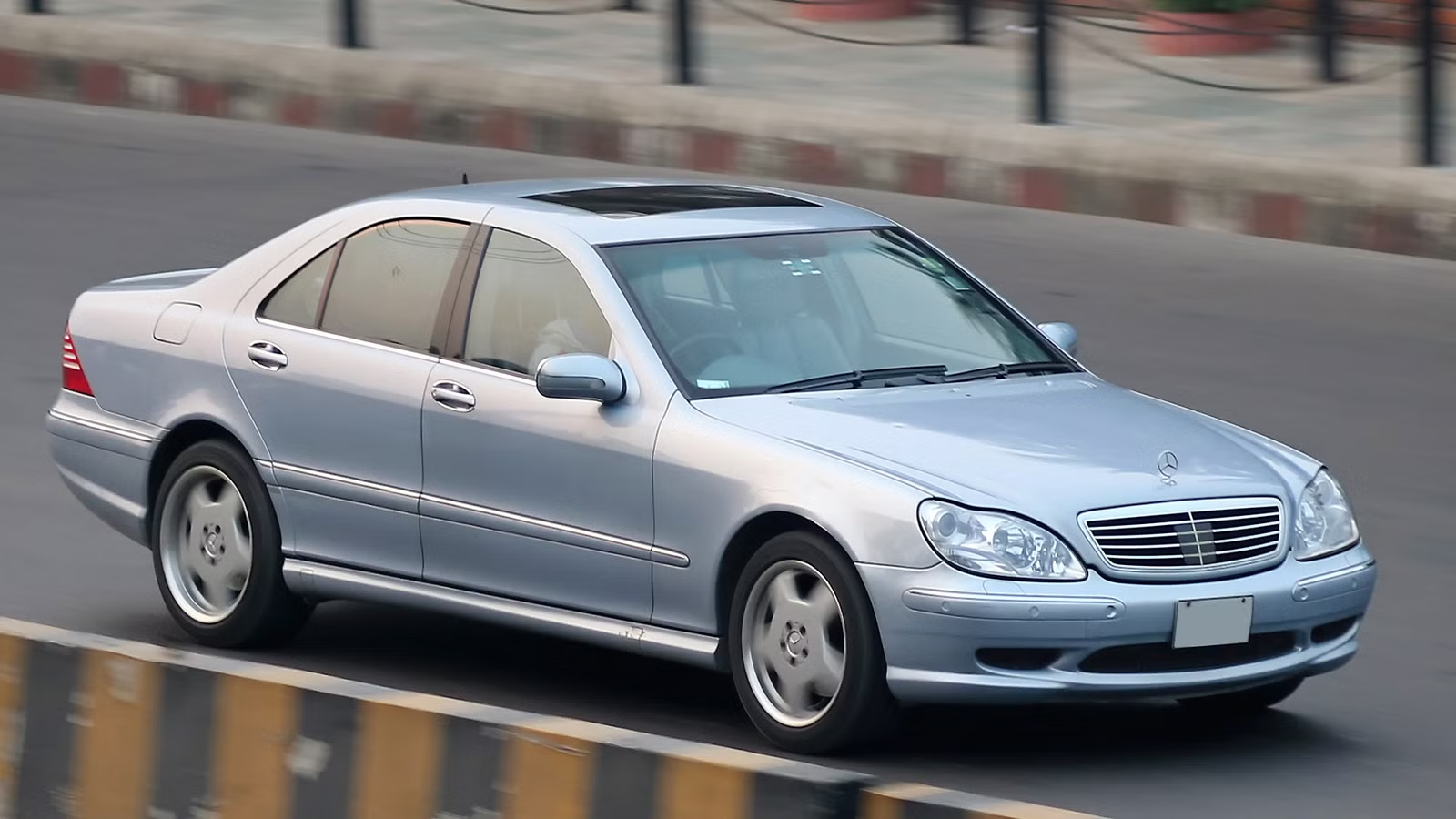
The W220 was a complete departure from the fabled W140 it succeeded, swapping the older car’s imposing, squared-off profile for a more rounded, aerodynamic design. Mercedes-Benz also packed it with advanced technology, including Keyless-Go, Airmatic suspension, and a complex network of electronic systems. Unfortunately, that technological leap came with a serious reliability trade-off.
While the W140 was renowned for its tank-like construction, the W220 developed a reputation for expensive failures. Its air suspension can suffer leaking struts and burned-out compressors, while cars equipped with Active Body Control face additional hydraulic repair risks. Faulty soft-close doors, troublesome COMAND electronics, battery-draining electrical faults, water-damaged control modules, and premature corrosion add to the headaches. To many fans, the W220 is the most unreliable Mercedes-Benz of all time, which explains why one of the cheapest ways into full-size luxury on the used market.

Related posts
Latest Post


No Comments