
The Japanese V-6 Engine So Reliable, The Automaker Still Hasn’t Replaced It
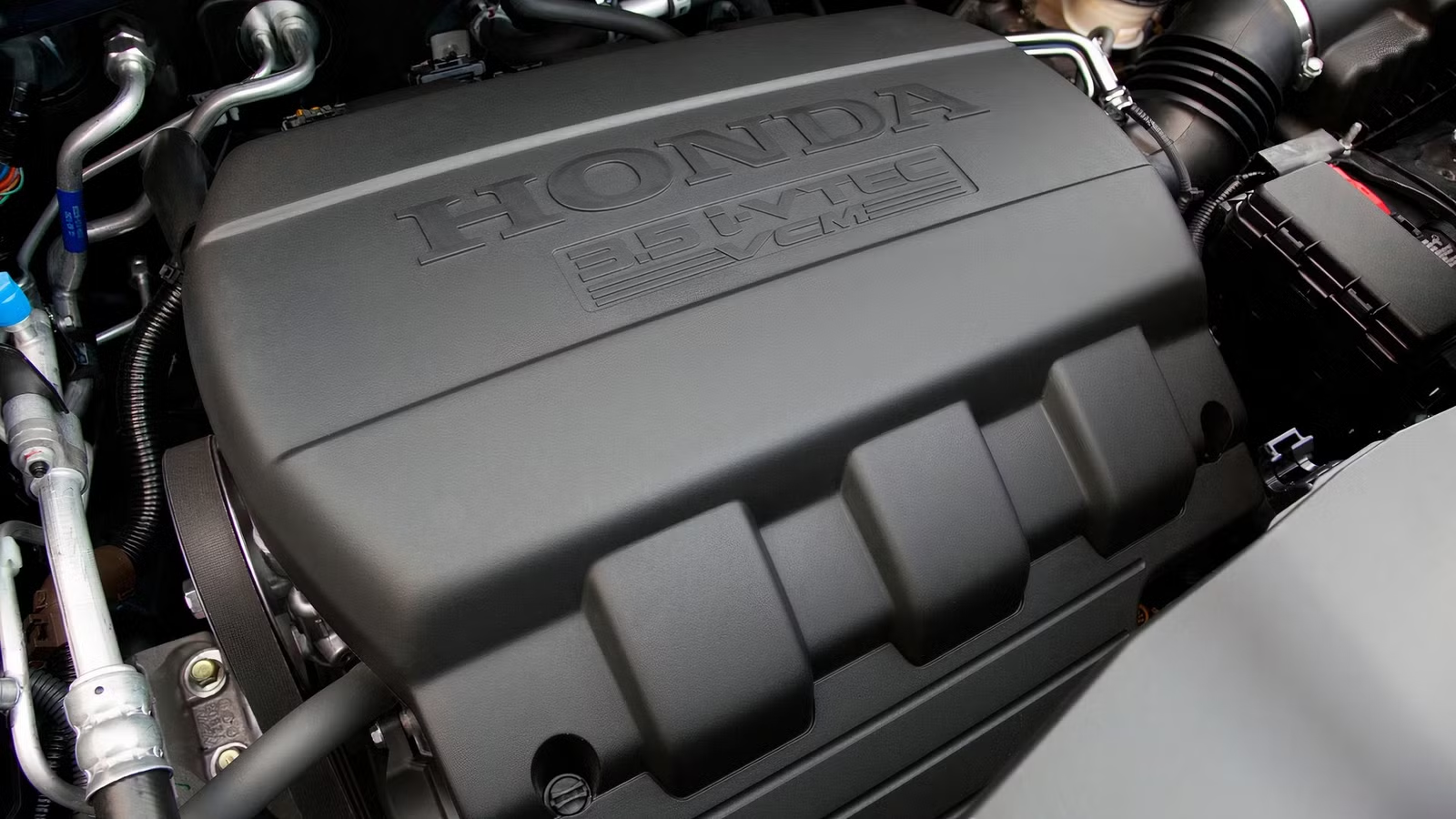
Since Japan’s introduction to the global automotive market, it has cemented a reputation for creating engines that are efficient and reliable without sacrificing power. The industry achieved this by adopting traditional manufacturing philosophies that date back hundreds of years. This expertise came into play during its postwar industrial recovery, resulting in Japan becoming a global leader in powertrain engineering.

Over the past 70 years, Japanese brands have refined a unique approach that combines extensive quality control with the use of tried-and-tested technologies. In doing so, these brands ensure that performance gains never come at the expense of long-term durability. This engineering discipline was particularly evident as they expanded into the American premium market, where they introduced sophisticated six-cylinder engines aimed at competing with the region’s heavier and less reliable V-8s. Honda is considered one of the leaders in this space, thanks to a well-balanced six-cylinder unit that remains in production today.
How Honda Gets Engine Longevity Right
After a successful initial run in the U.S., Honda began taking its approach to the American premium segment far more seriously. 1986 saw the introduction of the Acura sub-brand, which hit its stride during that same period and into the 1990s. “Precision Crafted Performance” was the primary ethos the brand applied to challenge far more established European and American segment leaders.

Reliability and engineering acted as Honda and Acura’s trump card, led by the Legend sedan and coupe. These premium midsize models quickly rose to become the best-selling luxury import in the United States for six consecutive years, spanning the late 1980s and early 1990s. Acura followed this up with the NSX Benefiting from a lightweight, all-aluminum body and VTEC technology, it became an everyday supercar that could outperform the exotics of its era.
Today, both Honda and Acura have pivoted toward crossovers and SUVs to align with market trends, but their ethos of doing more with less remains unchanged. In fact, many of the brand’s powertrain foundations from the 1990s can still be seen in the vehicles they sell today.
The Art Of Making A Powertrain Reliable

Honda’s focus in the 1990s centered on powertrain mastery. The Japanese brand applied a philosophy that focused on extracting high power output from smaller-displacement units without sacrificing longevity. The brand achieved this by opting for aluminum components, including lightweight die-cast alloys for both blocks and heads to improve thermal efficiency and lower weight. A key design element was the refinement of variable valve timing and lift, which allowed engines to switch between distinct cam profiles. Honda’s famous VTEC system This dual-mode capability optimized low-end fuel economy for daily commuting and high-RPM airflow for performance. It was supported by racing-derived innovations such as low-friction internal coatings, forged steel connecting rods, and high-precision secondary balancer shafts that virtually eliminated the vibrations inherent in inline four-cylinder designs.
Honda went as far as developing its own specialized machining tools to achieve micron-level tolerances, cultivating a bulletproof reputation in the process. These engines were engineered to operate reliably at high rotational speeds that would have caused mechanical failure in many American and European rivals.
Almost Three Decades In, The Honda J30 V-6 Is Still In Production

The Japanese company first introduced this powertrain in the 1997 Acura CL, effectively debuting its J-Series V-6 family. This was Honda’s official successor to the C-Series, maintaining a smooth 60-degree V-angle configuration. Its construction utilized a die-cast aluminum alloy block with iron cylinder liners for durability, paired with single overhead cam aluminum heads featuring four valves per cylinder. Honda also opted for a belt-driven valvetrain and a dual-stage intake manifold.
Pairing this configuration with the VTEC system gave the engine a broad torque curve and high-RPM breathing capacity that rivaled larger-displacement engines in refinement. Reliability was a fundamental aspect of the development process, made possible by a forged steel crankshaft, high-strength connecting rods, and a simplified cooling circuit that reduced potential leak points. This robust approach to internal components means that the J30 can easily surpass 200,000 miles with basic maintenance, setting a gold standard for the premium segment by offering a trouble-free ownership experience without sacrificing performance.
Cars That Made Honda’s V-6 Popular

Honda applied the J30 V-6 to several models that enjoyed considerable success in the U.S. market. The first vehicles to adopt it were the 1997 Acura 3.0CL and the 1998 Honda Accord V-6. Honda also used variations of this engine internationally in the Odyssey Prestige and Absolute trims, as well as the Honda Inspire and Avancier. Depending on the model, the J30 produces from 200 horsepower in the early J30A1 variants to a peak of 244 horsepower in the 30th Anniversary Edition J30A5. The torque range typically spans from 195 to 212 pound-feet.
Honda typically mated these engines to four- or five-speed automatic transmissions paired with front-wheel drive, though the 2003 to 2007 Honda Accord V-6 Coupe was available with a six-speed manual transmission to appeal to driving enthusiasts. The engine’s legacy was revived in a modernized, turbocharged form as the J30AC, which powered the now-defunct Acura TLX Type S and continues to power the MDX Type S via a ten-speed automatic transmission and the brand’s Super Handling All-Wheel Drive system, pushing outputs to 355 horsepower and 354 pound-feet of torque.
Toyota’s V-6 Philosophy Treads A Similar Path


Several parallels can be drawn between Honda’s V-6 engineering and Toyota’s. Compared to Honda’s J-Series V-6, Toyota’s 2GR has carved its name in automotive history thanks to overengineered components and high stress limits that not only broaden its performance ceiling but also serve as a durability safety net. Many 2GR-powered vehicles are known to regularly cross 250,000 miles with little more than basic maintenance — a testament to genuine long-term toughness.
Many enthusiasts and experts would place the 2GR above the J-Series, and they wouldn’t be completely wrong. The 2GR served dutifully across an equally broad range of vehicles as the J-Series — from sedans to pickups, minivans to supercars (see: Lotus Evora). And while the naturally aspirated 2GR was a staple of grunty dependability, it was dropped from the Toyota lineup in favor of the V35A twin-turbo V-6 engine family, which hasn’t been as reliable as the 2GR since its debut in the late 2010s.
Simple Servicing Keeps The Unit Kicking For Hundreds Of Thousands Of Miles

According to Kelley Blue Book, keeping a J30-powered vehicle in peak condition requires strict adherence to its maintenance schedule. The most critical service is the timing belt and water pump replacement, typically recommended every 105,000 miles or seven years. Because this is an interference engine, a belt failure will cause the valves to strike the pistons, leading to catastrophic internal damage. Owners should also perform valve clearance adjustments every 105,000 miles — doing so ensures optimal engine breathing and prevents the ticking noise or burnt valves that can result from neglect.
Routine oil changes should occur every 3,000 to 7,500 miles, depending on the oil type used, and transmission fluid replacements every 30,000 miles are standard. A full major service covering the timing belt, water pump, spark plugs, and coolant typically costs between $800 and $1,400, according to data from RepairPal, depending on local labor rates and whether OEM parts are used. While the J30’s engine block itself is robust, models produced between 2001 and 2004 that were mated to the five-speed automatic transmission are notorious for overheating and internal clutch failure. On the engine side, common age-related issues include oil leaks from the VTEC spool valve or valve cover gaskets, EGR valve clogging that causes a rough idle, and cracked air intake boots that lead to vacuum leaks and lean engine codes.
The Problem Years And Common Issues

Of course, no engine is without its faults, and as reliable and proven as the J-Series engine family is, some variants are more renowned than others. Early J30-powered models — including the 1998–2002 Accord V-6, 1999–2003 Acura TL, 1999–2004 Honda Odyssey, and 2003–2008 Honda Pilot — have been reported to have more issues than later variants, including timing belt problems, oil leaks, excessive oil consumption, and occasional fuel injection and electrical quirks. For those shopping for used V-6 Hondas, a professional inspection should always come before any paperwork is signed.
Owner forums and discussions on Reddit often point to the transmission as more of a problem area than the engine itself, with numerous owners reporting transmission problems around the 80,000 to 100,000-mile mark. Common issues include:
- Oil consumption: Some owners have reported excessive oil consumption, particularly on high-mileage examples. This can be attributed to worn piston rings or valve seals, leading to oil burning and frequent oil top-offs.
- VTEC issues: While beneficial, the VTEC system can sometimes malfunction, leading to a noticeable loss of power and poor acceleration. This is often attributed to faulty solenoids or pressure switches.
- Overheating: This isn’t necessarily a “common” problem, but some owners have reported overheating, often due to a failing water pump or clogged radiator. Regular maintenance of the cooling system is critical to prevent this issue and keep it on the road.
- Timing belt wear: The timing belt should be replaced according to the manufacturer’s recommendation. Failing to do so can result in belt failure, which could cause critical engine damage.
- Fuel system problems: Issues with the fuel injectors and fuel pump have been reported and often lead to poor engine performance, misfires, or difficulty starting. Regular fuel system maintenance becomes more important as the vehicle ages, though proactive care can greatly mitigate these problems.
The Current State Of Honda’s Production V-6

The modern state of the J-Series engine is characterized by a significant shift away from the traditional single overhead cam layout toward a more complex dual overhead cam configuration. Turbocharging is also a fundamental aspect of the engine’s modernization, keeping it alive and relevant today. While the original J30 relied on a belt-driven valvetrain, today’s flagship variants, such as the J30AC, adopt a twin-scroll turbocharger and a timing chain to produce more robust power and torque outputs. The latest naturally aspirated 3.5-liter J35Y8 variant powers the 2026 Honda Pilot and 2026 Honda Passport.
This powerplant has also transitioned to a DOHC setup, producing 285 horsepower, with direct injection and a Variable Cylinder Management system designed to cut emissions. A ten-speed automatic remains the transmission of choice for these engines, available with either front-wheel drive or an advanced all-wheel drive system. Despite these advancements, the engine family maintains its signature 60-degree V-angle, which Honda insists is best for overall smoothness throughout the rev range. The brand has phased out the traditional VTEC engagement profile on these DOHC heads in favor of continuously variable timing control for more linear and efficient power delivery.
Modern J Series Hurdles

Honda is currently facing backlash due to widespread V-6 engine failures among Honda and Acura models. Honda recalled over 200,000 V-6-powered models in 2023 due to a manufacturing defect involving the engine crankshaft, wherein the connecting rod bearings can prematurely wear and seize. Owners report unusual engine noises, misfires, power issues, stalled engines, and hesitation when accelerating. Affected models stretch all the way back to 2014.
In January 2026, a lawsuit was filed stating that, despite the recall and subsequent remedy, Honda failed to address the underlying issues. Owners experiencing engine failure well before the 70,000-mile mark are being left to fend for themselves due to lapsed warranties, with some receiving repair quotes in the $10,000-plus range. While not all modern V-6 Honda and Acura models experience this issue, it has been widely reported and should be taken into account before purchasing.
Sources: Honda, Kelley Blue Book, RepairPal, and Motor Reviewer

Related posts


Latest Post


No Comments