
How One Mainstream Brand Quietly Mastered Luxury
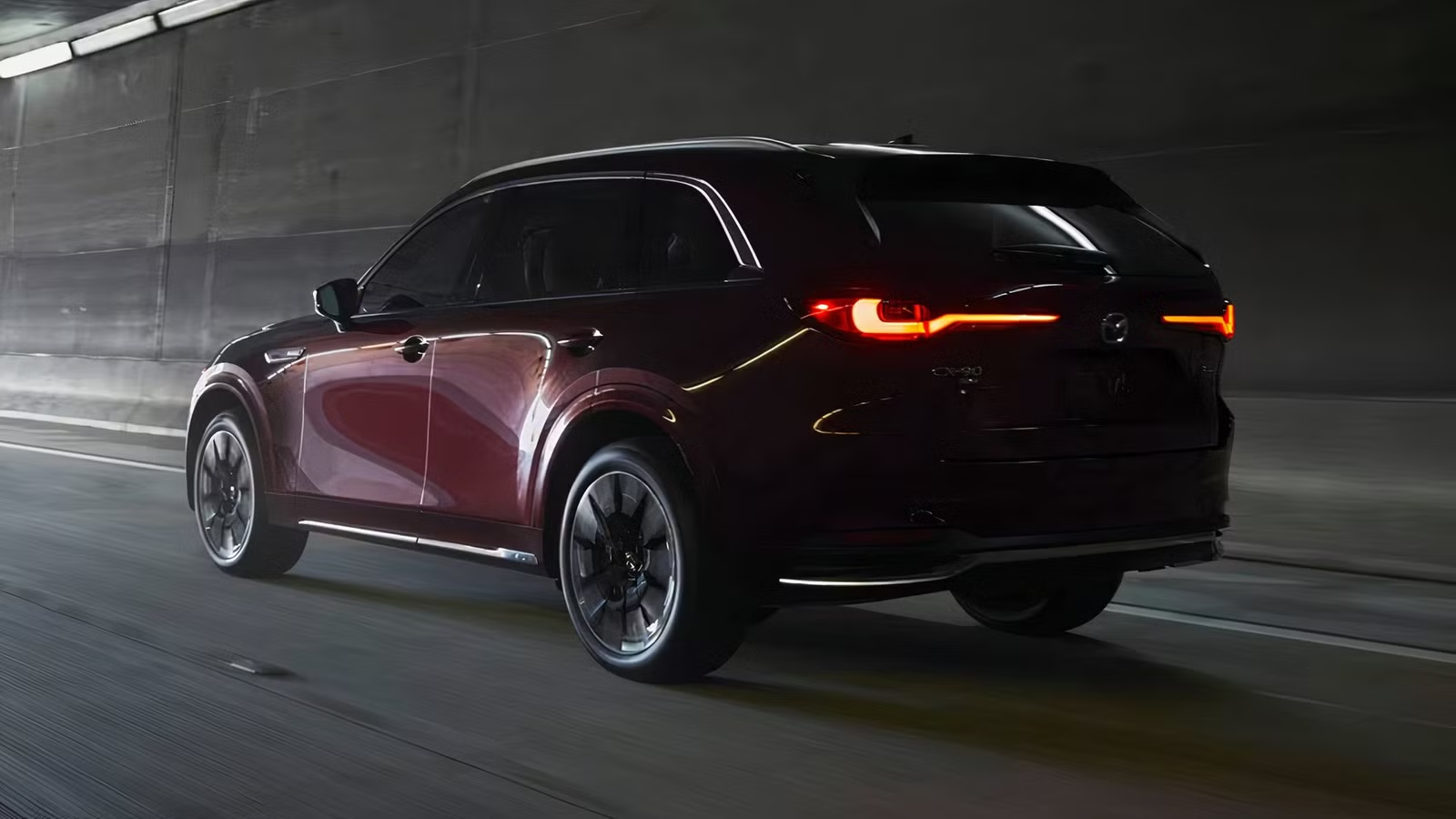
Luxury, in the automotive world, has long followed a familiar playbook: announce yourself loudly, stack the spec sheet high, and let the badge do the talking. Oversized grilles, eye-watering price tags, and feature lists engineered to dazzle on a showroom floor — that’s been the accepted formula for decades. If you wanted credibility in the premium space, the conventional wisdom said you either bought into an established prestige badge or built one from the ground up. Mazda chose neither path.

Instead of spinning off a luxury division or chasing prestige head-on, Mazda took a slower, quieter route. It focused on refinement rather than recognition, on feel rather than flash. Over time, that approach reshaped the brand’s identity — not through marketing declarations, but through the cars themselves. Today, Mazda occupies an unusual position. It’s still considered a mainstream brand, yet its products increasingly deliver an experience that rivals — and sometimes surpasses — traditional luxury competitors. The shift didn’t happen overnight, and it wasn’t accidental.
Mazda’s Unconventional Path Toward Luxury
Why Mazda Chose Refinement And Restraint Over Badges And Prestige
Most manufacturers that aspire to luxury follow a predictable script. They either add more features, more power, and more screens, or they create an entirely separate brand to signal upward movement. Mazda did neither. Instead, it began refining what it already did well: ride quality, steering calibration, cabin design, and material selection. The goal wasn’t to impress at first glance, but to feel right over time. That distinction matters. First impressions sell cars; long-term satisfaction builds brands.


This intent became increasingly apparent with cars like the later-generation Mazda6 and, more decisively, the Mazda3. The Mazda3 Astina, in particular, represented a quiet inflection point. It wasn’t positioned as a luxury car, nor priced like one, yet its interior execution told a different story. Mazda was testing whether refinement alone — without prestige — could shift perception. It could. Rather than announcing a move upmarket, Mazda let customers discover it for themselves. That discovery process is slower, but it’s also more convincing.
Design Philosophy That Elevated The Entire Brand

Mazda’s rise wasn’t driven by dramatic styling reinvention. It was driven by subtraction. The Kodo design language evolved gradually, shedding excess rather than adding complexity. Early iterations were expressive and sculptural. Later versions became calmer, projecting a quiet self-assurance. Visually, the latest iterations of Mazda’s design philosophy reflect deliberate thought and genuine confidence. Where rivals leaned into sharp creases, oversized grilles, and decorative aggression, Mazda focused on surface quality and proportion.
Kodo Design, Simplicity, And The Move Away From Visual Noise

The Mazda3 is a strong example of Mazda’s evolution. The third-generation BM/BN Series, produced between 2014 and 2018, already demonstrated the brand’s commitment to quality — cars that aged well and continued to hold their own against newer rivals. But with the fourth-generation BP Series from 2019 onward, reflecting the mature Kodo design philosophy, the recipe was refined further and leaned more decisively toward luxury. The improvement was unmistakable.

The Mazda3 Astina BP series represents growth and maturity. There’s no drama, and the Japanese marque avoids unnecessary lines, relying instead on restraint and a sense of light. No need to shout for attention — the design moves with ease and grace. That same thinking scales upward in the CX-60. Despite its size and premium positioning, it resists visual clutter. There’s a sense that the design trusts itself — and trusts the buyer — without resorting to theatrics. In an era where many cars feel styled for social media thumbnails, Mazda’s approach feels almost counter-cultural.
Interior Quality That Redefined Expectations
Materials, Craftsmanship, And Human-Centred Cabin Layouts

Where Mazda truly gives its rivals a run for their money is inside the cabin. Step into the Mazda3 Astina and the brand’s philosophy is immediately present. Simplicity defines the space. The dashboard is uncluttered, and materials are chosen for their purpose — to be used, to age, and to wear honestly. No gimmicks compete for attention. That same thinking becomes even more pronounced in the CX-60.

In Takumi specification, Mazda leans into Japanese craftsmanship rather than European imitation. Nappa leather, subtle textures, and thoughtful stitching communicate quality without excess. The CX-60 Individual specification takes a slightly different material approach, yet the layout and intent remain unchanged. What matters here isn’t the presence of luxury features — it’s the absence of distraction. Mazda’s interiors are calm places to spend time. That calmness is increasingly rare. Many traditional luxury brands chase novelty inside their cabins. Mazda chases coherence.
The CX-90 exemplifies its subtle evolution, with its bespoke grille, thin-profile headlights, and overall clean and fuss-free panels, all of which exude a very sophisticated and mature presence. In essence, Mazdas have always looked far more expensive and upscale than their affordable prices suggested, and the CX-90 carries this torch in spades.
– TopSpeed review of the CX-90
Why Less Technology Can Sometimes Feel More Premium

It’s a counterintuitive notion — the usual instinct is to give the car more: more tech, more screens, more alerts clamouring for your attention. Mazda said no. The brand aimed for restraint in cabin technology, a genuinely bold move. Screens are present in Mazda’s cabins, but they don’t dominate the space. The interface is logically mapped, so drivers learn it quickly rather than constantly hunting through menus.

Physical buttons are retained, resulting in a cabin that feels simple, well-considered, and never overwhelming. This matters more than it seems. Luxury isn’t about being impressed once; it’s about feeling comfortable every day. Mazda’s interiors reduce cognitive load. They don’t demand attention or adaptation. Subtly, this reinforces the brand’s broader philosophy: luxury isn’t about more — it’s about better decisions.
Driving Refinement As A Form Of Luxury
Why Balance, Smoothness, And Predictability Matter More Than Speed

Luxury isn’t always about performance. Often, it’s about the absence of effort. Mazda’s engineering philosophy reflects this. Rather than chasing outright speed or aggressive tuning, the brand has prioritized balance and predictability. Steering systems are calibrated for natural response. Suspensions are tuned to control body movement without resorting to stiffness. Noise, vibration, and harshness are managed carefully — not eliminated, but reduced to a level that meaningfully lowers fatigue on longer drives.

In smaller cars like the Mazda3, this translates into composure and stability. In larger vehicles like the CX-60, it shows up as polish and refinement. The experience isn’t designed to excite constantly; it’s designed to remain calm across a wide range of conditions. That approach reframes what luxury means behind the wheel. Luxury isn’t how a car behaves when pushed — it’s how little it demands when you’re not.
The Models That Shaped Mazda’s Quiet Rise
From The Mazda3 To The CX-60, Consistency Over Reinvention

Mazda’s transformation didn’t hinge on a single breakthrough product. It was built through repetition. The Mazda3 proved that premium thinking could be accessible. The CX-5 showed that mainstream success didn’t require abandoning refinement. The CX-60 represents confidence — not an attempt to outgun German rivals, but to offer a credible alternative built on Mazda’s own terms. Spending time with Mazda’s modern lineup, from the Mazda3 Astina to multiple CX-60 specifications, the consistency becomes difficult to ignore. The same values appear again and again: restraint, clarity, and attention to detail. That consistency is rare — and it’s powerful.
Why Mazda’s Version Of Luxury Works In The Real World

Mazda’s approach wouldn’t matter if it only worked on paper. The reason it resonates is that it aligns with real-world ownership. Pricing remains accessible relative to traditional luxury competitors. Ownership anxiety is lower. Servicing and long-term reliability perceptions are stronger. Buyers aren’t asked to justify their choice emotionally or financially. The CX-60 illustrates this balance clearly. It offers a level of interior quality and refinement that feels genuinely premium, without the prestige tax that often accompanies it. For many buyers, that matters more than a badge. Mazda’s version of luxury works because it’s sustainable — emotionally and financially.
A Different Definition Of Success
The MX-5: The Foundation Of Mazda’s Philosophy

Before Mazda ever started talking about premium cabins or upmarket ambitions, it had already solved a much more complex problem: it knew how to make a car feel right. The MX-5 has always been the clearest expression of that thinking. Not because it was fast, or powerful, or expensive — but because it was honest. Light on its feet. Predictable. Confidence-inspiring without being demanding. It never chased numbers or status. It chased balance and trusted that the rest would follow.

That philosophy didn’t end with a two-seat roadster. Over time, the same priorities — mechanical clarity, restraint, and a focus on the driver rather than the spec sheet — filtered into the broader range. When Mazda later began talking about refinement and human-centred design, it wasn’t trying to reinvent itself. It was simply applying familiar principles to different kinds of cars.

That’s the part that often gets overlooked. Mazda’s idea of luxury didn’t arrive suddenly, and it wasn’t imported from elsewhere. It grew organically, shaped by years of building cars that rewarded smooth inputs and penalized nothing unnecessarily.
Mazda’s Organic, Strategic Glow-Up Needs To Be Studied

In a market obsessed with spectacle and short-term impact, Mazda took the slower route — trusting that good design, thoughtful engineering, and consistency would eventually be noticed. They were. Luxury doesn’t always announce itself with a badge or a price tag. Sometimes it reveals itself quietly, over time, in the way a car responds — and in how little it asks of you. That’s the lesson Mazda learned early. And it’s why the brand’s version of luxury feels so convincing today.
Sources: Mazda USA, CarEdge

Related posts






Latest Post


No Comments