
The Japanese Engine That Became More Impressive With Every Generation
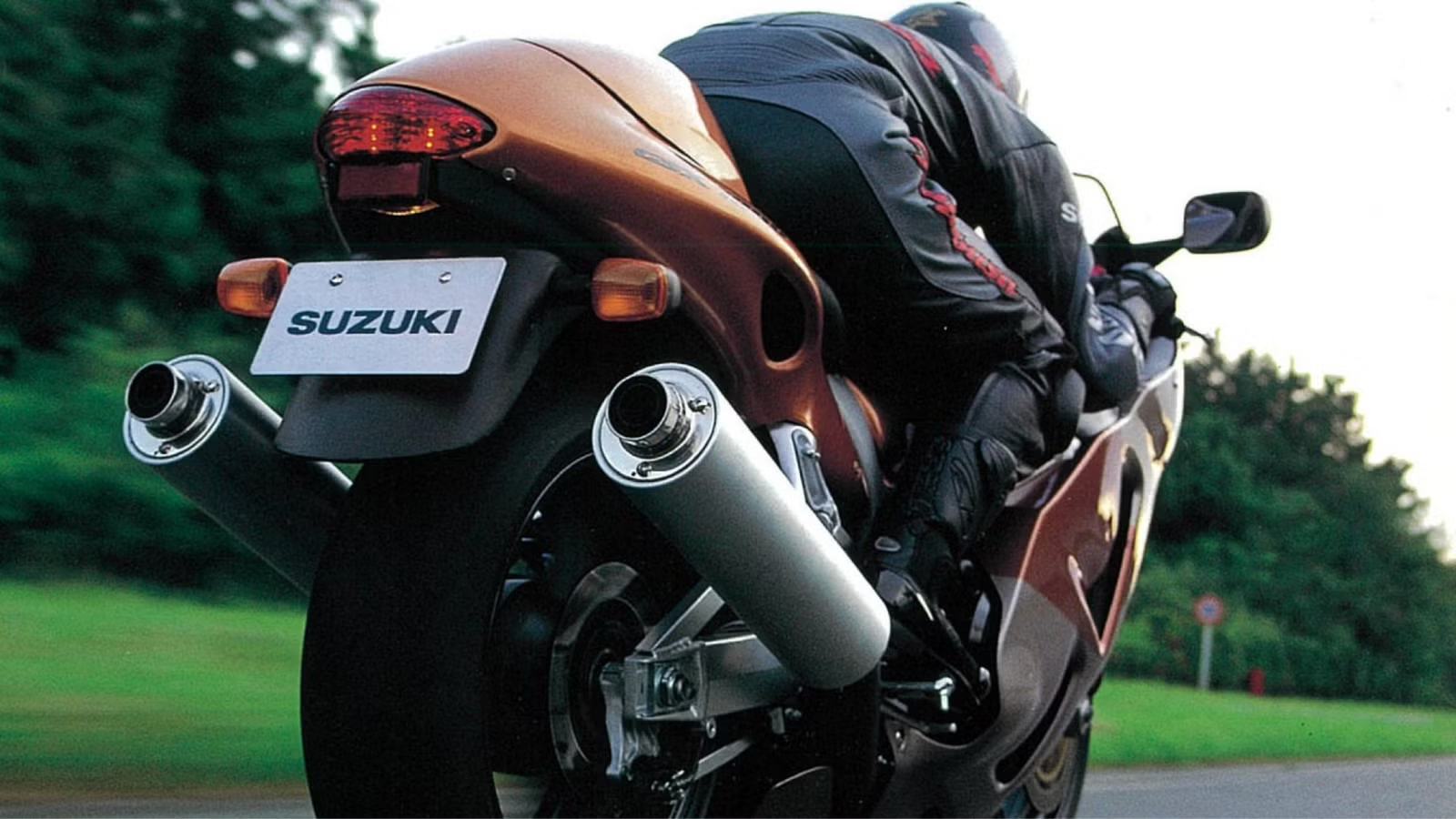
Some engines only need to be good once. You pull the clutch in, roll on the throttle, and the power arrives the way a tide comes in: no drama, no wheelspin anxiety, just a steady swell that feels like it was always meant to be there. That kind of power feels intuitive rather than aggressive, and it’s much harder to build than a big peak number.

Most motorcycle manufacturers chase bigger numbers. Far fewer chase better ones, and fewer still keep doing it across generation after generation without losing what made the bike worth riding in the first place. One Japanese inline-four-cylinder engine managed exactly that.
Why Some Engines Age Better Than Others
The engines that people still talk about years after they’ve left showrooms are rarely the ones that made the most power on launch day. It’s the ones that were easy to live with. They pulled cleanly from low revs, they didn’t punish a clumsy throttle hand, and they gave you the sense that there was more in reserve than you would ever need to use.

That quality comes from decisions made long before an engine ever reaches a dyno, and a design with enough margin built in that engineers can keep improving it without starting over. An engine like that doesn’t feel dated when the next model arrives, because the next model is mostly a sharper version of the same idea. One Suzuki in particular exemplifies this better than its Japanese counterparts.
The Hayabusa’s Engine Was Built To Get Better, Not Just Bigger

The Hayabusa’s engine is a liquid-cooled inline-four, and it has stayed that way for more than a quarter of a century. Suzuki reportedly weighed some wilder options when it planned the latest model, including a bigger four, a turbocharged version, and even a six-cylinder. In the end, it kept the layout it already had. The company’s own engineers have spoken about how much the bike’s identity depends on that basic layout staying put, so the brief for the newest engine was a better version of the same thing.
That’s an unusual stance in a segment where the easy marketing move is always more cylinders, more cubic inches, and more power. The Hayabusa made its name by following the opposite approach.
What “Refinement Over Reinvention” Actually Means In Motorcycle Engineering

Refinement sounds like a polite way to say “we changed very little,” but in practice it’s a lot of small but deliberate work. It means reshaping the intake and exhaust tracts so the torque fills in where the old curve sagged. It means lighter internals, tighter tolerances and better fuel delivery. It also means electronics that tidy up how the power arrives instead of hiding what’s underneath.
Reinvention resets everything to zero. A new engine has to relearn what the old one already knew: how the power feels at 4,000 rpm, how the bike behaves when you are tired and the road is wet, and how it sounds when you are cruising on the highway. Refinement means keeping all of that and adding to it. Every Hayabusa generation is a lesson in that difference.
First Generation: Where The Hayabusa’s Reputation Was Born (1999–2007)

The original Hayabusa’s engine looks almost ordinary. It’s a liquid-cooled inline-four with double overhead cams and four valves per cylinder, displacing 1,299 cc from an 81 mm bore and a 63 mm stroke. Suzuki quoted 173 horsepower at 9,800 rpm and 102 pound-feet of torque at 7,000 rpm. The cylinders were lined with a coating which Suzuki called SCEM.
It shed heat and resisted wear, which matters when you expect an engine to sit at huge speeds without complaint. A two-stage injection system kept the throttle response smooth, and the SRAD ram-air setup used the bike’s own speed to push more air into the intake. The faster the Hayabusa went, the better it breathed.
Built For Stability At 186 MPH

At 186 MPH an engine has a different job than it does on a back road. It’s under constant heavy load, it’s making a lot of heat, and any sudden change in power delivery will get magnified by everything else that’s going on. That’s why the original engine’s calm manners while working flat out mattered as much. Early bikes could hit a top speed of 194 mph. From 2001, manufacturers agreed to hold production bikes near 186 mph as part of a gentleman’s agreement.
Second Generation: Refinement Without Losing The Plot (2008–2020)

For 2008, Suzuki went after the engine and left the rest of the formula alone. The stroke grew by two mm, from 63 to 65 mm, and capacity rose from 1,299 cc to 1,340 cc. The claimed output climbed to 194 horsepower and 114 pound-feet. Most of the interesting work happened inside. Titanium intake and exhaust valves were lighter than steel ones, which let the engine rev more freely.
Suzuki’s Dual Throttle Valve system added a second, electronically controlled throttle valve in each intake tract, which smoothed the transition when you opened the throttle. None of this looked like much on a spec sheet, but the difference was felt in the first inch of throttle travel.
Modern Electronics, Same Old Soul

The headline electronic feature was the Suzuki Drive Mode Selector, which let you choose between three engine maps. One softened the delivery for wet roads or heavy traffic, and another kept things sharp for a spirited ride. The same inline-four was still there underneath, but it could now be accessed in a few more ways.
The 2013 update brought Brembo monobloc front calipers and ABS, so the brakes finally matched the engine’s capability. The engine itself carried on largely unchanged for the rest of the generation. That’s a long run for a powerplant, and it ended only because emissions rules moved past it.
Third Generation: Restraint As A Statement (2021–Present)

Euro 5 made life difficult for big, old-school engines, and the previous generation Hayabusa had already been pulled from several markets as regulations moved on. Suzuki could have let the model die quietly or replaced it with something unrecognizable. Instead, it reworked the same 1,340 cc four, keeping the 81 mm bore and 65 mm stroke.
On paper, the figures dipped slightly. Peak output settled at 190 horsepower at 9,700 rpm, and peak torque went from 114 to 111 pound-feet. But the engineers weren’t chasing peaks. They rebuilt the intake and exhaust to flatten the torque curve, filling in a soft spot in the low- and mid-range that earlier bikes had. The result was a Hayabusa that pulled harder from lower revs and launched quicker than any before it.
Smarter Electronics, Familiar Styling

The electronics moved forward in a much bigger way. A six-axis IMU now feeds traction control, cornering-aware ABS, engine-braking control and launch control. Cruise control and a quickshifter that works in both directions were also added. Brembo Stylema calipers on 320 mm discs replaced the older setup.
In terms of styling, the lines got sharper, and the aerodynamics improved, but you’d still recognize it from across a parking lot. That mattered because riders who love the Hayabusa love that shape as much as the engine.
Three Generations, One Engineering Philosophy

Lay the three bikes side by side, and the pattern is obvious. The first Hayabusa proved the idea, with an engine strong enough to set a speed record and calm enough to ride at that speed. The second added capacity and precision without changing the character. The third rebuilt the engine to meet modern rules and came out more flexible, more controllable and just as recognizable.
At no point did Suzuki reset the formula. Each generation took what the previous one did well and worked on what it did less well. The result is an engine that has been improving for more than a quarter of a century without ever becoming a different engine.

That is a harder discipline than it sounds. It means resisting the pressure to reinvent, accepting slightly lower peak figures when the rules demand it, and trusting that riders care more about how a bike feels at 5,000 rpm than what it produces on paper at 9,700. Few manufacturers manage it once, and the Hayabusa has managed it across three generations.
Source: Suzuki

Related posts


Latest Post


No Comments