
Forgotten Powerhouse: One Of The Rarest Production Engines From AMC’s Golden Era
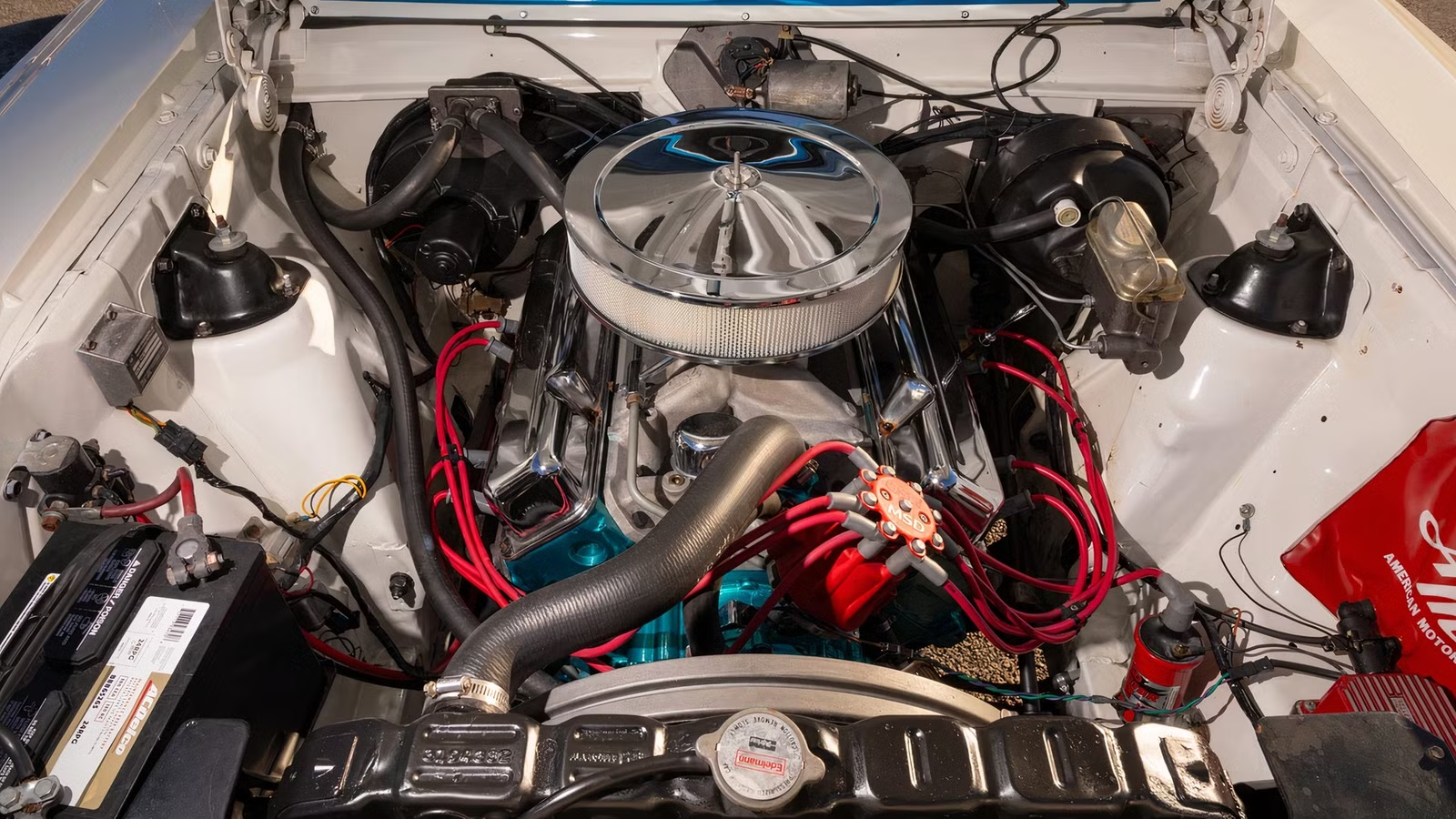
Ask most car enthusiasts to name the rarest muscle car engines of the late 1960s and early ’70s, and you’ll hear the usual suspects: the Hemi, the LS6, the Ram Air IV. What you almost certainly won’t hear is the AMC Machine 390 — and that’s exactly the problem. The American Motors Corporation has largely faded from collective memory, perpetually overshadowed by the Big Three and eventually swallowed whole by Chrysler. AMC never had the resources to compete on equal footing, and the company was plagued by chronic mismanagement, yet somehow it produced some genuinely ferocious machines during the Golden Age of muscle cars.

Being a smaller company, their models are rare simply because they didn’t have the sales numbers of the big boys. Even within that, there were some elusive cars, with even more scarce engine options. The 1970 AMC Rebel Machine is one of the coolest classic muscle cars from any manufacturer, and its exclusive 390ci V-8 is a genuine unicorn engine. Maybe most of the collecting public has forgotten about this rare powerplant, but TopSpeed, and hopefully our readers, have nothing but love for it.
The AMC Machine 390
Unlike most other automakers, AMC didn’t have small-block and big-block families of V-8s, but rather a single-block size used across their entire engine lineup. It was, however, very close in displacement to the other manufacturers’ small blocks, so that’s how they’re generally categorized. One key distinction of AMC engines is that they were built with heavy-duty internals capable of withstanding high-revving conditions — a weakness that plagued other large-displacement small-blocks, which could snap connecting rods under sustained high-rpm use. AMC introduced the AMX 390ci V-8 in 1968, producing a respectable 315 horsepower and 420 pound-feet of torque.
The Machine 390 Specs
 34 autotech Displacement |
390ci |
|---|---|
|
Induction |
Naturally aspirated |
|
Fuel |
Gasoline |
|
Bore x Stroke |
4.165 x 3.574 (inches) |
|
Compression Ratio |
10.2:1 |
|
Power |
340 HP @ 5,000 RPM |
|
Torque |
427 LB-FT @ 3,600 RPM |
|
Max Engine Speed |
6,500 RPM |
When 1970 arrived, AMC made a significant engineering shift from their “short-deck” second-generation V-8 engines to the third-generation “tall-deck” design, which featured increased deck height for improved performance potential. The reliable 390 engine had proven both popular with consumers and mechanically robust, so AMC carried it forward into the new generation while maintaining its established power figures.
However, AMC engineers had bigger plans for the 390. They developed a high-performance variant specifically for their 1970 Rebel performance model, aptly named “The Machine.” This specialized version of the 390-cubic-inch V-8 delivered an impressive 340 horsepower and 430 pound-feet of torque, making it the most powerful vehicle AMC produced during the muscle car era. Unfortunately, both The Machine model and its potent 390 engine variant had an extremely brief production run, lasting just one model year before AMC discontinued the program.
The Difference In Breathing

The Machine 390 received a special camshaft, revised cylinder heads, and an upgraded valvetrain, but the single biggest departure from the standard 390 was its breathing. With a functional hood scoop feeding the ram-air-style intake, the engine drew in a denser charge of cool outside air, wringing an extra 25 horsepower from the same displacement. It also came equipped with a 690-cfm Motorcraft four-barrel carburetor, as well as a redesigned exhaust system that contributed further to the power gain.
Stroked Out 401

Both the 390 and the Machine 390 were replaced in 1971 by the 401ci V-8, which was essentially the same engine stroked out to achieve the additional displacement. More cubic inches, however, didn’t translate into more power — the 401 was rated at 330 horsepower in 1971, and then, when the emissions-driven detuning that ended the classical muscle car era arrived the following year, it was downgraded to 255 horses. The 401 was actually still a pretty good engine that remained in production until 1978, and it had its roots firmly in the 390.
Plonked Under The Hood Of – Wait For It – The Machine

The Machine 390ci V-8 was designed specifically to go under the hood of AMC’s greatest muscle car, The Machine. The car is actually called The Machine, but it is often listed as an AMC Rebel Machine, because “AMC Rebel The Machine” just sounds awkward. It started out as a collaboration between AMC and Hurst Performance, but the partnership faded as production began. Introduced in 1970 as a performance trim of the fifth-generation Rambler Rebel — shortened to simply “Rebel” in 1968 — The Machine was also an appearance package with killer striping, the most famous being the red, white, and blue scheme.
1970 Machine Power And Performance
|
Engine |
390ci V-8 |
|---|---|
|
Horsepower |
340 HP |
|
Torque |
425 LB-FT |
|
Transmission |
Four-speed manual |
|
0-60 Time |
6.6 seconds |
|
Quarter-mile |
14.3 seconds |
|
Top Speed |
117 MPH |
The Machine featured a hood-mounted tachometer integrated into the ram-air scoop, and a Borg-Warner T-10 four-speed manual transmission with a Hurst floor shifter. It also rode on a heavy-duty suspension with station wagon rear springs — chosen for their higher load rating — that gave the car a raked stance, only amplifying its already aggressive presence. Disc brakes were standard as well, and when combined with the stiffened suspension, they made The Machine one of the best-handling cars of the classic muscle era. Where most muscle cars wallowed, rolled, and bounced, The Machine was composed in the corners and planted on the straights.
Less Than 2,400 Cars Were Produced

The first 1,000 Rebel Machine cars shipped were finished in the iconic white body with red and blue striping, but after that, buyers could choose from 17 different paint schemes. There is no way of telling how many of each color were produced, but the total production run for The Machine was just 2,326 units. Since the Machine 390ci V-8 was both standard equipment and exclusive to The Machine, that makes the engine one of the rarest powerplants of the entire Golden Age of American Muscle — and worthy company alongside some truly legendary V-8s.
Rare Classic V-8s
- Pontiac 400 Ram Air IV – 1,808 units
- AMC Machine 390 – 2,326 units
- Chevrolet 454 LS6 – 4,475 units
- Chrysler 426 Street Hemi – 9,778 units
- Chrysler 440 Six Pack/6BBL – 13,883 units
Out Went The Rebel, In Came The Matador

The Rebel Machine was a one-hit wonder, discontinued after 1970 and taking the Machine 390ci V-8 with it. In fact, all 390 engines were replaced by the 401, and the Rebel name was retired in favor of “Matador” for reasons that remain baffling. AMC felt the name “Rebel” carried negative connotations amid the social unrest of the early ’70s, but whatever executive made that call got it badly wrong — it’s one of the most badass nameplates in muscle car history. And why would anyone name a car after the guy holding the cape, when it’s the charging bull that better captures a muscle car’s ferocity?
AMC’s 390 Lineup
The AMC 390 engine enjoyed a surprisingly short production lifespan, manufactured for just three model years from 1968 through 1970. This brief production window makes any vehicle equipped with the 390 a genuinely rare find today. AMC typically reserved the 390 for their highest-performance trim levels and option packages, including the popular SST designation and the performance-oriented “Go Package.”
The rarity becomes even more pronounced when examining actual production figures. While AMC sold 127,066 Ambassador SST models during the 390’s three-year run, the engine itself was far from standard equipment. Documentation suggests that only approximately 46,048 of those SST models actually received the 390 under the hood — meaning that even within AMC’s performance-oriented lineup, the 390 was installed in roughly one-third of eligible vehicles, making precise production tracking particularly challenging for collectors seeking authentic examples.
AMC 390 Rides
- 1968-1970 AMC Ambassador – 46,048 units (est.)
- 1968-1970 AMC AMX – 6,725 units (est.)
- 1968-1970 AMC Javelin SST – 5,707 units (est.)
- 1968-1970 Rebel SST – 15,540 units (est.)
- 1970 AMC Rebel Machine – 2,326 units
The problem is, there aren’t any reliable sources with production numbers broken down by engine for most AMC models. The total production of 390 cars for the Javelin is mixed up with the numbers from the AMX, so those two figures are educated guesses. It is also unclear whether the Rebel numbers include or exclude the Rebel Machine production. One thing is certain: there were 2,326 Machines built, which gives us a hard count of exactly 2,326 Machine 390ci V-8s produced.
Rage Against The Machine

The 1970 AMC Rebel Machine and its Machine 390ci V-8 are undeniably awesome, but much like during the Golden Age, they don’t command the same respect as Big Three muscle cars in the collector’s market. A Ford, GM, or Mopar muscle car with a similarly limited production run would likely be a half-million dollars and up, but The Machine tops out at around $100,000 according to Hagerty and as little as $45,000 in top condition per J.D. Power’s valuation.
1970 AMC Rebel Machine Values
- Original MSRP: $3,475
- Adjusted for Inflation: $28,256
- Classic.com auction sales: $36,000 – $145,750
- Hagerty Valuation: $36,200 – $103,000
- J.D. Power Retail: $10,950 – $45,000
A lot of posted vehicle values are theoretical, but on Classic.com there are Rebel Machines that have sold at auction for close to $150,000, and obviously some that went for substantially less. In the real world, a cherry, matching-numbers 1970 AMC Rebel Machine is a six-figure ride, but it genuinely feels like it should be worth so much more given its inherent coolness and rarity. The good news for collectors is that something this head-turning and historically significant can still be picked up for a genuine bargain price.
Sources: Classic.com, Hagerty, J.D. Power

Related posts

Latest Post


No Comments