
The Ioniq 5 N Has Been Reimagined As A Group B Monster With A WRC Engine
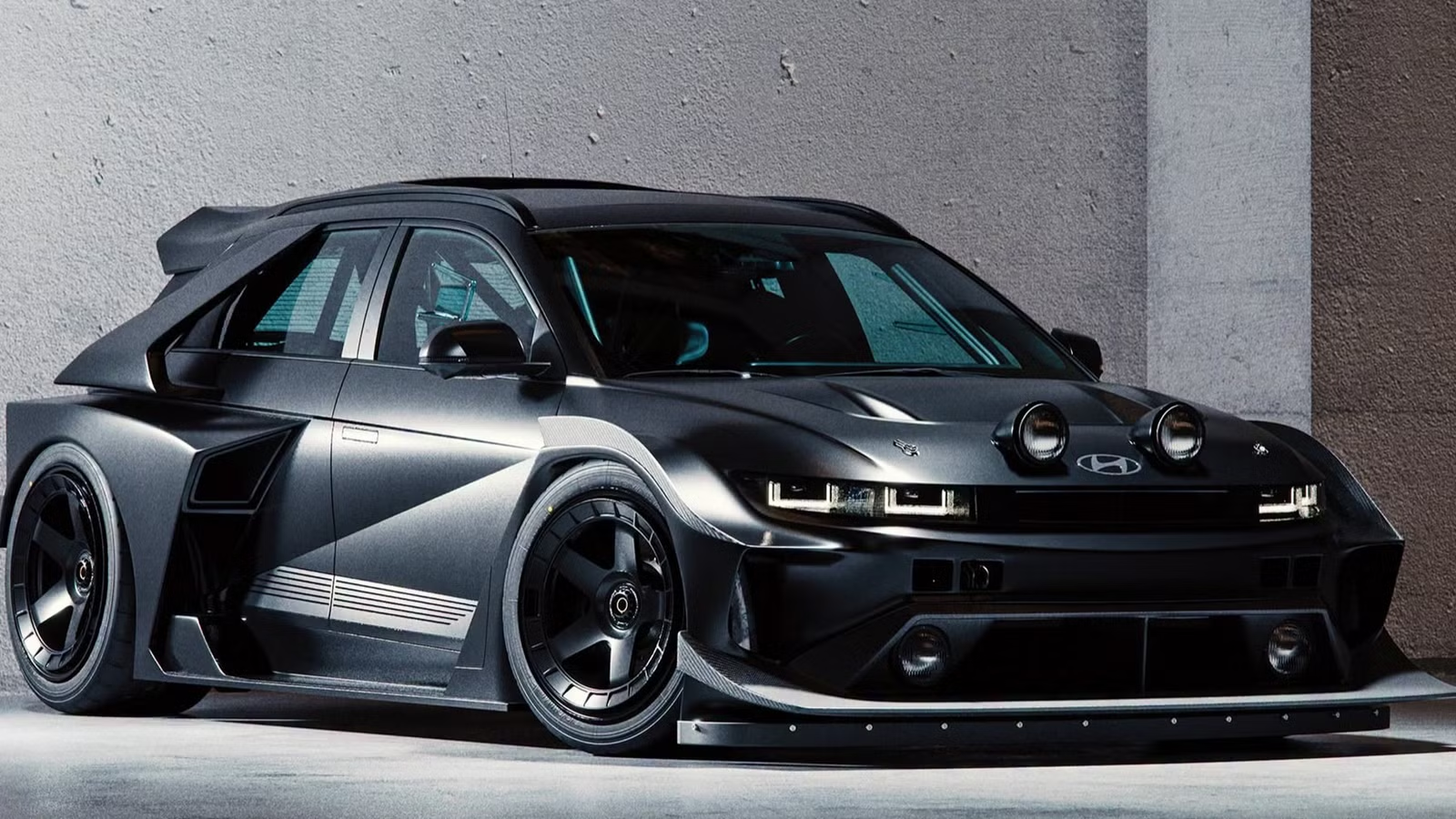
Digital artist Khyzyl Saleem dropped a render this week that’s hard to scroll past: the Hyundai Ioniq 5 N, stripped of its dual-motor electric drivetrain and rebuilt as a Group B-era rally weapon, complete with flying buttresses, Lexan windows, a full roll cage, and a turbocharged 1.6-liter four-cylinder pulled straight from Hyundai’s current WRC i20 N Rally1 program. The concept went live on September 16 and was produced for Hyundai USA — not a random fan exercise, but a commissioned follow-up to last month’s Baja-inspired Santa Fe render that the brand shared with its own social following.

What makes this land differently than a typical render-drop is context. Hyundai N is no longer a brand playing pretend at motorsport. The i20 N Rally1 program has delivered back-to-back WRC Manufacturers’ titles in 2019 and 2020, and Thierry Neuville wrapped up a Drivers’ title in 2025. Imagining the brand’s halo EV as a combustion-powered rally monster feels less like pure fantasy now — and more like a genuinely missed chapter in the WRC history books.
Group B Design Language, Applied With Precision
Saleem didn’t just slap a wing on the Ioniq 5 N and call it a day. The bodywork is a coherent translation of 1980s Group B visual grammar onto a car that, as it turns out, has decent bones for it. The Ioniq 5’s upright greenhouse and angular C-pillar already carry faint echoes of the Lancia Delta’s proportions — Saleem leaned into that by adding flying buttresses that rise from the rear fenders to meet the C-pillars, a direct nod to the Delta S4.

The nose was rebuilt around a deep carbon-fiber splitter extending well forward, with extra LED lighting integrated across a massively vented hood. Ultra-wide fender extensions flare out over all four corners, concealing cooling intakes that feed — notionally, at least — whatever powertrain lives behind the firewall. The transformation drops the Ioniq 5 N’s relatively tall stance into something planted and predatory.
At the tail, the primary version runs a massive rear wing paired with a full diffuser. Saleem also produced a second variant with a smaller wing finished in bronze — the kind of restrained, road-legal look that reads immediately as a homologation special. A third treatment, which Saleem calls the Birmingham spec, goes wingless in black and is apparently his personal favorite of the three.
Swapping 641 HP of Electric Power for a Screaming WRC Four-Cylinder
The engine choice is where the concept gets genuinely interesting — and a little ironic. Saleem’s preferred powerplant is the turbocharged 1.6-liter four-cylinder from Hyundai’s i20 N Rally1 car, ideally mounted mid-ship if packaging allows. Under current Rally1 regulations, which removed the hybrid boost system, that engine is capped at 375 horsepower. The stock Ioniq 5 N’s dual electric motors produce 641 hp in Unleashed Mode — meaning the combustion swap would actually represent a significant step backward on paper.
Saleem acknowledges the gap. The appeal isn’t raw output; it’s character. A screaming turbo four spooling through a special stage is a different sensory proposition than instant electric torque, and the render is really asking a different question: what would a Hyundai rally weapon from the Group B era have looked like if the brand had been there? Rotary power is his stated second preference, which would push the concept further into the speculative, but the WRC engine choice keeps one foot in Hyundai’s actual motorsport DNA.
The renders were built in 3ds Max and Corona, and for now the Group B Ioniq 5 N stays on screen.
Why Hyundai’s Real WRC Record Makes This What-If Resonate

Khyzyl Saleem
Hyundai never entered Group B — the series ran from 1982 to 1986, well before the brand had any serious motorsport ambitions. But the company has been a WRC presence since the Accent program in 2000, escalating through the i20 WRC in 2014 and arriving at the i20 N Rally1 in 2022. The Manufacturers’ titles in 2019 and 2020 and Neuville’s 2025 Drivers’ championship aren’t footnotes; they put Hyundai N in genuine conversation with Toyota Gazoo Racing as the sport’s dominant forces.
That track record is what separates this render from a purely hypothetical exercise. Five years ago, a Group B Hyundai concept would have read as wishful thinking. Today, with a legitimate works team winning at the highest level, the what-if has a foundation under it. Saleem’s collaboration with Hyundai USA — an ongoing arrangement that produced the Baja Santa Fe last month and invited fans to vote on which model should come next — suggests the brand is actively interested in using these renders to test enthusiast appetite. Whether that ever translates to something tangible is another question, but the conversation is clearly open.
For now, gearheads will have to settle for the renders. But given that Hyundai USA is commissioning these concepts and actively soliciting feedback, it’s worth keeping an eye on what Saleem drops next — and what Hyundai chooses to do with the response.

Related posts


Latest Post


No Comments