
The Harley Alternative That More Riders Should Consider
Picture a big American cruiser, and you probably picture the same three things every time: chrome, a V-twin thumping between your knees, and the word “Milwaukee” somewhere on the case cover. That reflex isn’t wrong. After all, Harley-Davidson has spent over a century building that association into muscle memory, so deeply that most riders never stop to ask whether another engine, built by another company, on another continent, might deliver the same gut-level shove and the same appetite for open highway. This is exactly what one Bavarian cruiser promises, and we think more riders should consider it.
The Ubiquitous Harley-Davidson Empire

Walk into pretty much any biker meetup, tattoo parlor waiting room, or roadside diner parking lot in the U.S., and the math is simple: more than half the cruisers lined up outside will wear the bar-and-shield badge. Harley-Davidson didn’t just build motorcycles for the better part of 120 years — it built an entire vocabulary around what a cruiser is supposed to sound like, feel like, and mean. Softails handle the classic, low-slung stuff while Street Glides and Road Glides own the bagger-touring conversation. Somewhere in between sits an ocean of Sportsters, Fat Boys, and Low Riders.
None of that dominance happened by accident. Roughly 700 dealerships blanket the country, an aftermarket industry worth billions keeps every generation of owners invested, and there’s a cultural mythology — leather, open road, rebellion — that Harley has marketed better than anyone else on two wheels. It’s a genuinely great engine backed by an even better story.
Past The Clichés Lie A Distinct Set Of Capable Cruisers

That success has created an interesting side effect. Ask a first-time cruiser buyer what their options are, and you’ll usually get a list of Harley trim levels, not a list of brands. The V-twin has become shorthand for the whole category, which quietly writes off any engine that doesn’t share that layout. That’s why cracking this segment has been incredibly difficult for the big names, even ones with heritage running just as deep. Yet, if you look deep enough and past the cliches, you will find some brilliant cruisers that deserve more attention. Here’s a prime example of that.

The BMW R 18 Is More Than Just An Alternative To Harley Motorcycles
Base Price: $15,395

The alternative in this case is the BMW R 18. However, calling it “an alternative” undersells what the Bavarian brand actually built. This isn’t a boutique curiosity aimed at riders who already own three motorcycles — it’s a direct, unapologetic strike at the heart of the American heavyweight cruiser market, priced to be cross-shopped rather than merely admired from a distance.
The base R 18 starts at $15,395 before the $895 destination charge—a perfect matchup against the Harley-Davidson Street Bob, the most accessible entry point into Harley’s Softail family at $14,999. This isn’t the “cheaper import” pitch that usually accompanies a European bike crashing an American party. It’s a straight, equal-footing comparison, dollar for dollar, aimed at exactly the buyer who’d otherwise walk into a Harley dealership without a second thought.
The Big Boxer Engine Runs On A Completely Different Kind Of Heritage

BMW has been building boxer engines since 1923, which means the company’s flat-twin lineage predates Harley-Davidson’s Knucklehead by more than a decade. The R 18 doesn’t borrow that heritage lightly — its 1,802cc air/oil-cooled “Big Boxer” is the largest boxer engine BMW has ever put into production, and the cylinders sit flat and exposed on either side of the bike. Output lands at 91 hp at 4,750 rpm, with peak torque of 120 lb-ft arriving at just 3,000 rpm. So this is an engine tuned for the same low-rpm, chest-deep pull that makes a big American V-twin satisfying to ride away from a stoplight.
Torque On Par With Harley’s Biggest V-Twins

The number that should stop cruiser shoppers in their tracks is 120 lb-ft of torque. This is exactly what the Street Bob’s Milwaukee-Eight 117 Classic engine produces at its own peak, despite the extra displacement for the Harley. Additionally, a boxer’s cylinders sit low and wide instead of stacked in a V, which drops the engine’s mass closer to the ground and spreads it side to side rather than fore and aft. At walking pace — pulling out of a parking spot, filtering through a gas station — that low, wide mass makes the R 18 feel more planted and less top-heavy. There’s also a faint side-to-side rock at idle, a boxer quirk BMW has never bothered to engineer out, because riders who buy this bike tend to like being reminded of what’s underneath them.
Shaft Drive And A Low Center Of Gravity Change How This Cruiser Rides

Underneath the retro sheet metal sits a double-loop steel frame with bolted beams, holding a telescopic fork up front with 4.7 inches of travel and a twin-sided steel swingarm out back, controlled by a single central shock strut with 3.5 inches of travel. It’s a straightforward setup, tuned more for stability at highway speed than for canyon-carving, which is exactly the brief for a bike built to eat interstate miles.
Final drive runs through an enclosed Cardan shaft rather than a belt or chain, and that’s a genuine, ongoing ownership-cost argument against Harley’s belt-drive setup. A belt still needs periodic tension checks and eventual replacement; a shaft drive largely disappears from the maintenance schedule outside of routine fluid changes. It’s not a flashy selling point, but it’s the kind of detail that becomes more significant with every passing year of ownership.
Seat Height And Real-World Rideability

The R 18 sits at a 28.3-inch seat height and tips the scales at 760.5 lbs wet. On paper, that reads as a disadvantage against the lighter Street Bob. In practice, you should remember the weight distribution we talked about above. Elsewhere, stopping power comes from dual 300mm front discs with 4-piston fixed calipers and a matching 300mm rear disc, with BMW Motorrad Integral ABS standard across the board. It’s worth noting most Harley Softails have only one disc in comparison.
The R 18 Quietly Hides Modern Features

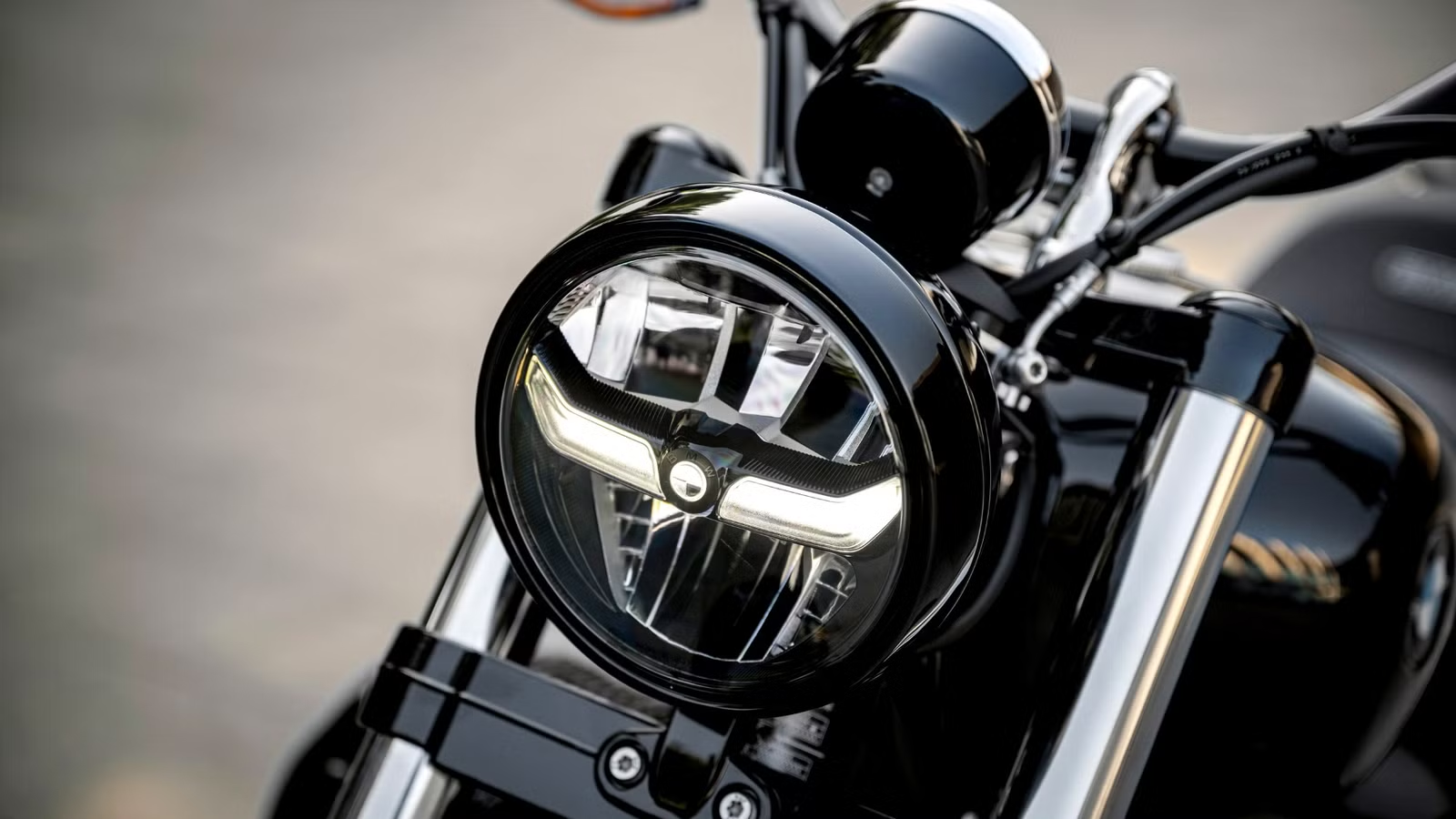
The R 18 also makes a strong case when you look beyond displacement and styling. BMW equips it with throttle-by-wire, a closed-loop three-way catalytic converter, full LED lighting, and three selectable riding modes: Rain, Roll and Rock. Automatic Stability Control and Engine Drag Torque Control, or MSR, are also part of the standard package. For 2025, BMW added a USB-C charging socket, revised the seat with softer padding, retuned the rear shock for greater comfort, and moved the R 18 to an 18-inch rear wheel. Besides these, keyless ride comes standard.

Accessories sweeten the deal further. BMW offers an adaptive cornering headlight as an option for riders who want the beam to follow their lean angle, and a reverse assist system is available as a factory option. The latter makes sense on a machine where a low-speed drop is a two-person job to pick back up, and you can’t have this even as an option on Harleys.
Source: BMW Motorrad

Related posts

Latest Post


No Comments