
The Honda That Performs Like A Sports Bike But Rides Like A Tourer
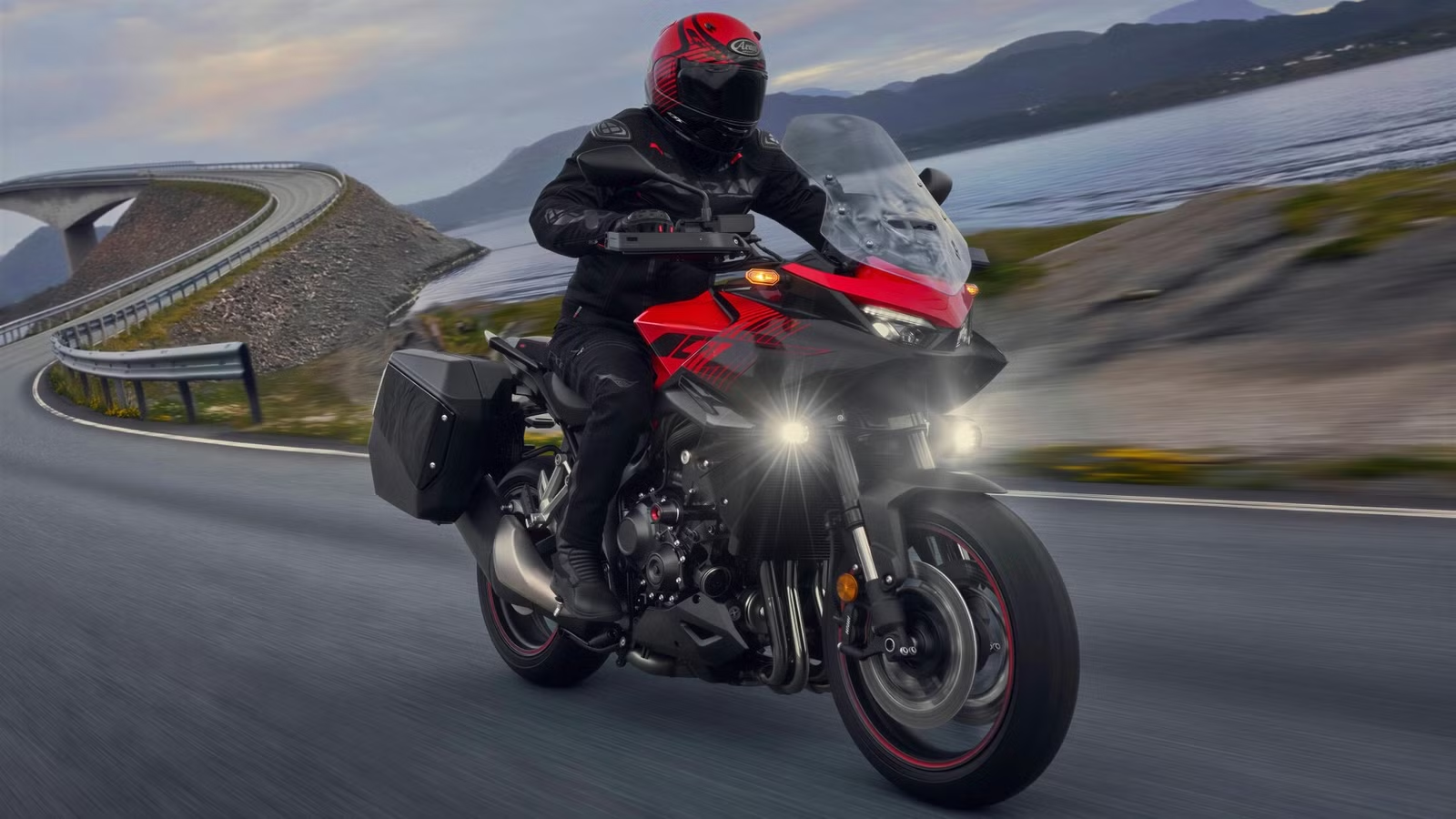
Usually, adventure bikes take the spotlight for their versatility both on and off the roads. But what if one wants to have a highly versatile do-it-all motorcycle for the road only? One that can be both an adrenaline-pumping triple-digit runner on the highway and a stable leaning machine through the canyons and even racetracks. This is where the ripening bunch of sport-touring bikes comes in.

Its crossover sub-segment gets more attention because it fuses the best of sports bikes and adventure bikes. Basically, these are sports bikes on stilts that offer elevated comfort with long-travel suspension, ample wind protection, and an upright riding stance. While the Yamaha Tracer 9 hits all the right spots here, there is a brand-new Honda sport-tourer that packs enough punch to make the Tracer 9 sweat and shake the segment up. This is one exciting motorcycle that we are eagerly awaiting.
Comfortable Touring Dynamics And Peaky Performance Are Opposite Attributes
Balancing comfort and performance is one of the hardest challenges to achieve on motorcycles. This is because they require polar-opposing engineering strategies. Comfortable motorcycles require a relaxed riding posture, a well-padded saddle, and sufficient damping to keep the bike stable and the rider cozy. All of these increase curb weight. This is why cruisers, full-dressers, and baggers excel at this.


However, for a performance-focused motorcycle, saving weight is crucial. The power-to-weight ratio is of the utmost importance; therefore, lightweight engine and chassis components are non-negotiable. Even the rider triangle is aggressive, helping balance weight between the wheels. The suspension is stiff, and the performance curve is quite aggressive. A perfect balance of comfort and performance was considered near-impossible until we were introduced to sport-tourers.

10 Best Touring Motorcycles For Relaxed Weekend Rides
Tour in total comfort with these 10 top-rated sport and full-dress touring motorcycles, built for big miles, smooth rides, and stress-free weekends.
Sport-Tourers Make This Possible

While this segment is slowly gaining traction today, sport-tourers have been around for quite some time. The 1977 BMW R100RS is widely considered to be the first-ever true touring motorcycle. Today, we have a concise but well-stacked lineup of sport-tourers, broadly divided into two sub-segments.

One focuses more on the sporty side of things, essentially touring-ready sports bikes modified with relaxed ergonomics, upgraded seats, standard side cases, and full fairings. The other, commonly called a crossover, takes a different approach by fusing the properties of a sports bike and an ADV. The engine and main frame are mostly derived from sports bikes, but the sub-frame is stronger to handle extra load, and the suspension travel is much longer for comfort in varied terrain. Electronics play a vital role, too.
Honda’s Representation Is Lacking In This Space

In 2026, the variety is wide in this space. The most affordable true crossover is the $10,445 Triumph Tiger Sport 660, followed by options like the $13,070 BMW F 900 XR, the $14,695 Triumph Tiger Sport 800 Tour, and the popular $12,599 Yamaha Tracer 9. Then, you also have the liter-class crossovers like the $18,759 Suzuki GSX-S1000GX+ and the $23,367 BMW S 1000 XR.

If you look closely, you’ll realize there’s no representation from Honda here. That’s because the bikemaker has two crossover-type bikes, neither of which is actually sporty. One is based on a scooter, while the other is based on the ADV engine and chassis. But as peer pressure goes, the world’s largest bikemaker has answered back with its new creation.
The Honda CB1000GT Performs Like A Sports Bike But Rides Like A Tourer

On paper, the Honda CB1000GT takes the fight to flagship models like the Suzuki GSX-S1000GX and the BMW S 1000 XR. However, in the international market, it is so aggressively priced that it ends up locking horns with the middleweight bunch, especially the Yamaha Tracer 9 GT and the Triumph Tiger Sport 800 Tour. In fact, it even undercuts Honda’s own well-rounded NT1100 DCT tourer.
A Forbidden Fruit For Now

Yes, we know — it’s disappointing. However, given Honda Powersports’ track record, we think the CB1000GT’s US launch is a matter of when, not if. When that happens, a cutting-edge MSRP is expected, too. Taking into account the price differences of recently launched Honda motorcycles, we expect the new Honda crossover to be priced in the $12,000 ballpark. If achieved, this would make the CB1000GT the most bang-for-buck sport-tourer of 2026.
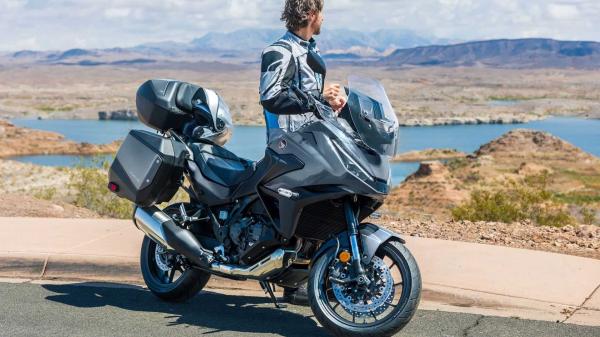
The Affordable Tourer That Feels Made For 500-Mile Days
This Honda stands out in the touring market with its value pricing and impressive feature set, making it a top choice for long highway days.
Powered By A Fireblade-Derived Engine

A 1,000 cc four-cylinder powers the CB1000GT, which is shared with the CB1000 Hornet. This, in turn, is based on the 2017 Honda CBR1000RR Fireblade engine, giving it an underlying sports bike character. The engine has been tuned for on-road duties with emphasis on mile-munching. Hence, the low and mid-range torque is stronger with a more linear power curve. As for numbers, the GT produces 147 horsepower at 11,000 RPM and 73 pound-feet of torque at 8,750 RPM. Power is sent to the rear wheel via a six-speed manual gearbox and a final chain drive system.
Tuned For Mile-Munching Duties, Not Lap Times

The engine retuning and a more linear power curve also help eke out more MPG ratings. According to Honda UK, the CB1000GT returns a maximum fuel efficiency rating of 40 MPG. Couple this with its sizable 5.5-gallon fuel tank, and we have a sport-tourer that can travel up to 220 miles between gas stops. This figure is superior to many liter-class sport-tourers currently on sale in America.
Electronic Suspension Helps With Adaptive Riding Dynamics

The Fireblade-derived engine is an integral part of a steel diamond chassis and is utilized as a stressed member. The sub-frame is reinforced to take the added weight of an adult pillion and the standard all-weather side cases. Making the underpinnings versatile is its sophisticated suspension setup, comprising Showa Electronically Equipped Ride Adjustment (Showa-EERA) as standard fitment. It comprises 41 mm inverted front forks with 5.1 inches of travel and a rear monoshock with 5.6 inches of travel. Both ends are fully adjustable electronically.
Helping this suspension work flawlessly are a six-axis IMU and a Suspension Control Unit that monitor parameters such as speed, stance, altitude, and damping, rebound, and compression behavior. There are four standard modes catered to different riding scenarios, namely Standard, Sport, Rain, and Tour. The result is an instantly adaptive suspension setup that can quickly adapt from plush straight-line comfort to firm cornering performance.

10 Powerful Inline-Four Motorcycles That Are Not Sports Bikes
The most powerful inline-4 motorcycle here is a gorgeous-looking Italian naked bike with 208 horsepower.
Lightweight And Comfortable

Honda has strived to keep the CB1000GT compact, giving it solid urban appeal, too. It has a wheelbase of 57.2 inches, a length of 84 inches, a width of 36.6 inches, and a height of 50.7 inches. The seat height is accessible at 31.85 inches. Its 25-degree rake angle also contributes to Honda’s nimble riding dynamics. This sport-tourer weighs just 504 pounds, giving it a commendable power-to-weight ratio. Rounding things off is a simple braking setup. Dual 310 mm discs up front coupled to Nissin four-piston radial calipers, and the rear gets a 240 mm disc coupled to a Nissin single caliper. Complementing its nimble riding dynamics are 17-inch lightweight alloy wheels wrapped with 120-section front and 180-section rear tires.
Loaded With Technology That Emphasizes Creature Comfort And Safety

The CB1000GT is loaded with commendable technology features. The cockpit gets a five-inch TFT with Honda RoadSync smartphone connectivity. Making the ride more engaging and reassuring are a slew of assistive features like traction control, engine brake control, cornering ABS, and even wheelie control. It also gets five ride modes—Standard, Sport, Tour, Rain, and User-defined. Keeping highway comfort in mind, the GT also comes standard with heated grips, keyless ignition, cruise control, and a USB port.
The Honda CB1000GT Promises To Stir Up The American Segment
While the Honda CB1000GT is nothing exceptional when compared to its liter-class rivals, its strength lies in value. If priced similarly to the EU-spec model for the US, this Honda will offer the most bang for the buck. Moreover, on paper, the only other rival that outclasses the CB1000GT in performance is the 150-horsepower Suzuki GSX-S1000GX.
Without the side cases, the CB1000GT is also the lightest sport-tourer in its class at 504 pounds. The GSX-S1000GX comes in at a close 511 pounds. The weight management is so good that even with the side cases on (+27.5 pounds), it’s still lighter than the bare-bones Kawasaki Ninja 1100, which has a curb weight of 571 pounds.
Source: Honda Powersports

Related posts



Latest Post


No Comments