
Audi’s New RS5 Avant PHEV Packs 639 HP Into A Wagon Body—And That Changes The Super-Estate Game
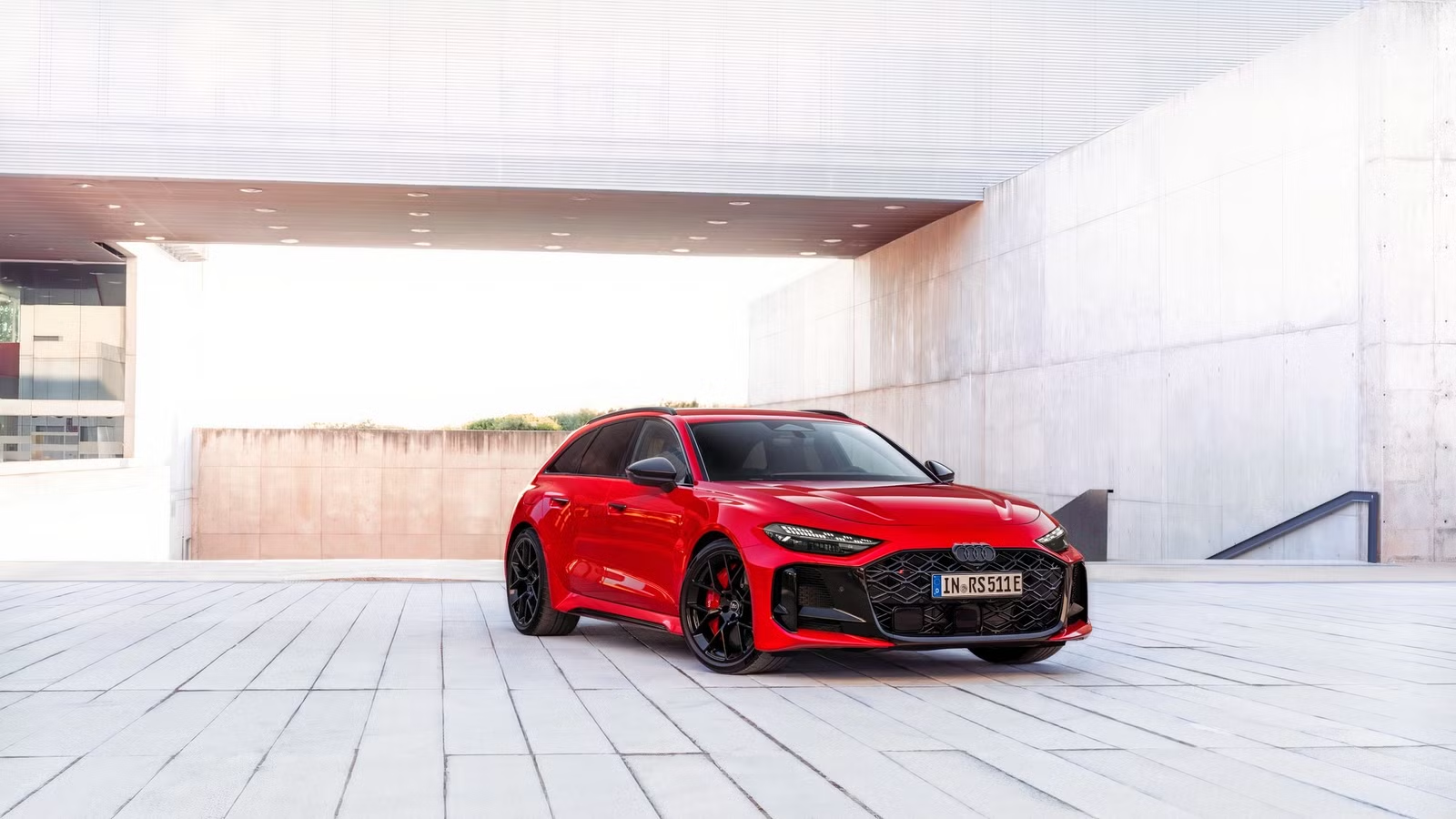
Six hundred and thirty-nine horsepower in a load-hauling wagon body. That’s the headline figure Audi has attached to the new RS5 Avant PHEV, confirmed this week in the first full spec breakdown and road test of the super estate. It’s a number that would have seemed implausible for a family wagon even five years ago—and it arrives not from a tuner, but straight from Ingolstadt.

The RS5 Avant PHEV represents a meaningful shift in what a factory performance estate can be. By pairing a combustion engine with an electric motor in a wagon body, Audi is making a direct argument that electrification doesn’t have to mean compromise—at least not the kind that performance buyers typically fear. Whether that argument holds up under real-world scrutiny is the more complicated question.
What 639 HP Actually Means For A Wagon
The RS5 Avant PHEV’s combined output puts it in genuinely rare company. For context, the current RS6 Avant—long considered the benchmark for the performance estate class—produces 621 horsepower from its twin-turbocharged 4.0-liter V8. The RS5 Avant PHEV clears that figure, making it the most powerful factory Audi wagon available. That’s not a minor footnote; it’s a repositioning of where the RS5 nameplate sits in the lineup.

The PHEV powertrain pairs a combustion engine with an integrated electric motor, with the combined torque figure and all-wheel drive ensuring the power reaches the road with minimal drama. Audi’s quattro system has always been well-suited to managing big outputs in practical body styles, and the Avant platform gives it the low center of gravity and long wheelbase that help mask the added mass a plug-in hybrid system inevitably brings.
The PHEV Formula: Genuine Benefit or Added Complexity?

The honest answer is both, and the balance depends heavily on how the owner uses the car. A plug-in hybrid super-estate makes a compelling case for daily driving: electric-only range covers typical urban and suburban commutes without touching the combustion engine, which keeps fuel costs manageable and emissions low in city environments. For buyers who charge regularly, the PHEV powertrain can genuinely reduce running costs relative to the RS6 Avant’s V8.
The trade-off is weight. Battery packs add mass that no amount of chassis tuning fully neutralizes, and in a segment where driving feel matters as much as outright pace, that’s a real consideration. The RS6 Avant’s V8 delivers its power with a directness—a linear, analog quality—that a hybrid system’s torque-fill logic doesn’t quite replicate. The RS5 Avant PHEV is likely faster in measurable terms, but whether it’s more satisfying to drive hard is a different question. Early driving impressions suggest the power delivery is smooth and immediate, with the electric motor filling in low-end response before the combustion engine builds its contribution—effective, if not quite as visceral as a naturally aspirating V8.
How It Stacks Up Against The Competition

The super-estate segment is small but fiercely contested. The Mercedes-AMG E63 S Estate remains the emotional benchmark — a 603-hp, 4.0-liter twin-turbo V8 in a wagon body, no electrification required, with a sound and character that are difficult to replicate. BMW’s answer has shifted; the M5 Touring now uses a PHEV setup of its own, producing 717 hp in a similar hybrid configuration, which makes it the outright power leader in the segment but also the heaviest and most complex.
The RS5 Avant PHEV slots between those two in terms of output, and arguably offers the most coherent daily-driving case of the three. It’s less extreme than the M5 Touring, less old-school than the AMG, and more efficient than either. For buyers who want a wagon that can genuinely serve as a primary vehicle—school runs, long motorway trips, occasional track days—the PHEV formula makes practical sense in a way that a 600-hp V8 sometimes doesn’t.
Who Actually Buys A 639 HP Wagon?

The performance estate buyer is a specific type. They’ve usually considered an SUV and rejected it—either on driving dynamics grounds, on aesthetic preference, or both. They want the cargo space and the family usability, but they’re not willing to give up the way a proper car feels on a back road. The RS5 Avant PHEV is built precisely for that person, with the PHEV angle adding a layer of appeal for buyers who are conscious of running costs or face urban emission restrictions.

Charging logistics are worth addressing plainly. A PHEV is only as efficient as its charging routine. Buyers who can charge at home or at work will see real-world fuel savings; those who can’t will carry the weight penalty without the efficiency benefit. Audi’s long-term reliability record with PHEV systems is still building, and that’s a legitimate consideration for buyers planning to keep the car beyond the warranty period. None of that diminishes what the RS5 Avant PHEV is—it’s a remarkable machine—but the ownership calculus is more involved than it is with a straightforward combustion wagon.
The RS5 Avant PHEV doesn’t replace the RS6 Avant so much as it opens a new lane in the super-estate conversation. For buyers willing to engage with the charging routine, it offers more power, lower running costs, and a genuinely usable wagon body. That’s a strong combination — and one that will push Mercedes-AMG and BMW to think carefully about where their own estates go next.
Sources: AutoNext.co

Related posts


Latest Post


No Comments