The Honda Crossover That Quietly Became One Of Its Best Family Vehicles
9 minutes reading
Saturday, 12 Sep 2026 11:30 0 48 autotech
Honda and crossover SUVs have had a fantastic working relationship in the U.S. since the mid 1990s. Today, its lineup is growing with the likes of the Pilot, the Passport, the Prologue, and the HR-V, all of which offer sensible pricing, family-friendly features, solid reliability, and long ownership lifespans.
Then there is this Honda crossover SUV; its nameplate was one of the originals in the U.S., and it has become one of the best family SUVs on the modern market.
Front 3/4 shot of 2026 Subaru Outback parkedLyndon Conrad Bell | Top Speed
The family crossover has become the automotive equivalent of a Swiss Army Knife. A Subaru Outback can disappear down a dirt road, a Toyota Highlander can seat three rows of passengers, and a Kia Sportage offers plenty of everyday vehicle usability without taking up the whole driveway. The formula is about doing everything well, not about speed and showing off.
That doesn’t mean that every family crossover SUV is interchangeable. The good ones understand that parents spend more time loading groceries, dropping kids at school, and sitting in traffic than chasing apexes. Easy access, a useful cargo area, good visibility, and a ride that remains comfortable after hours are worth more than chasing horsepower.
Why A Square Cargo Opening And Wide Rear Bench Beat Raw Cubic Footage
Rear seating area of a 2026 Toyota Grand Highlander LimitedToyota
Interior space is where the sensible family SUV earns its keep. A wide rear bench makes fitting child seats easy, while a square cargo area can mean the difference between taking extra luggage and leaving it at home. Clever storage matters, too, because families will find a way to somehow fill every compartment.
Then there is comfort for long hauls, reliability for long ownership, sensible controls, and enough room for adults in the back—all of which turn a crossover from just a vehicle into something that can be trusted and something that isn’t a pain to use. Add in decent fuel efficiency and predictable running costs, and you have something that was made to serve family life easily.
The 2026 Honda CR-V Nails The Family Formula
Front 3/4 shot of 2026 Honda CR-V Sport Touring Hybrid parkedHonda
That may sound like a lot of things for one vehicle to juggle, but the 2026 Honda CR-V does it all exceptionally well. The Honda CR-V was technically Honda’s first crossover model in the U.S., released back in 1997, and today it carries on what it set out to do: be a family-friendly, affordable, and useful vehicle to own.
This year’s lineup is made up of the LX ($30,920), the EX ($33,150), the Sport Hybrid ($35,630), the EX-L ($35,400), the TrailSport Hybrid ($38,800), the Sport-L Hybrid ($38,725), and the Sport Touring Hybrid ($42,550).
More Rear Cargo Space Than The Toyota RAV4 — And A Back Seat Adults Can Actually Use
Shot of 2026 Honda CR-V Sport Touring Hybrid interior showing cabinHonda
At the heart of its family-friendly credentials is the space you get inside. The new CR-V has 106 cubic feet of passenger space, and seating for up to five people. You get 40 inches of front headroom as standard, 38.2 inches of front headroom if you opt for a model with a moonroof, 57.9 inches of front shoulder room, and 41.3 inches of front legroom.
In the back, there is 38.2 inches of headroom, 55.9 inches of rear shoulder room, and 41 inches of legroom. With the second-row seats in place, in non-hybrid models, there is 39.3 cubic feet; there is 36.3 cubic feet of space in hybrid models. With the rear seats folded away, you get 76.5 cubic feet across the range. That is 6.5 cubic feet more space than you get in the new RAV4.
60:40 Split Rear Seat, Low Loading Floor, And Hands-Free Tailgate Cover The Family Bases
The 2026 CR-V is also clever about how it makes use of its small stature and how it uses the interior space. The second-row splits 60:40 and can recline, fold, and split, so you can carry passengers and bulky gear at the same time. Fold one side for a bike or long box while keeping two seats available, or drop both sides when you need the full cargo floor. It also has a low, wide cargo opening, so loading up isn’t the biggest chore.
A power tailgate is available on higher trims, while the Sport Touring Hybrid gets hands-free access. Honda has also fitted seatback protectors and a retractable cargo cover, which make for useful touches for families who actually use their SUV rather than just driving down to the supermarket and back.
The Hybrid Powertrain And Ride Dynamics That Justify The CR-V’s Sales Crown
Rear 3/4 shot of 2026 Honda CR-V Sport Touring Hybrid parked off-roadHonda
There is a good reason why over 6.5 million Honda CR-Vs have been sold in the U.S. since it debuted, and why, according to Honda’s latest sales report, 226,114 models have been sold year-to-date (June 2026). It is a proper all-rounder. The 2026 sales represent an increase compared with this time last year, rising from 212,561 sales, or 6.4 percent.
The CR-V is currently Honda’s best-selling model; it is rated on J.D. Power as 83 out of 100 overall, and 4.3 out of 5 for value and quality, and 4.6 out of 5 for performance, comfort, styling, and reliability by owners on Kelley Blue Book.
Hybrid Power Delivers Better Efficiency Without Sacrificing Usability
Profile shot of 2026 Honda CR-V Sport Touring Hybrid parkedHonda
Power is available from two powertrain options for this year’s model: a 1.5-liter turbocharged inline-four rated at 190 horsepower and 179 pound-feet of torque in non-hybrid models, and a 2.0-liter inline-four mated to a two-motor hybrid system good for 204 horsepower and 247 pound-feet of torque in hybrid models. Non-hybrid models get a CVT, while hybrid CR-V models get an eCVT.
Front-wheel drive is standard fare, with Real-Time AWD optional for both hybrid and non-hybrid models, except for the TrailSport Hybrid and Sport Touring Hybrid, which both get AWD as standard. Neither model is gas-guzzling, with the EPA estimating that the non-hybrid model can achieve between 29 and 30 combined mpg, costing you between $2,100 and $2,150 a year for gas.
2026 Honda CR-V TrailSport off roadNicole Wakelin | TopSpeed
Predictably, the CR-V Hybrid is more fuel-efficient. FuelEconomy.gov says the TrailSport Hybrid can achieve 35 combined mpg (38 mpg city/33 mpg highway) and will cost you an estimated $1,800 a year for gas.
FuelEconomy.gov also says that the AWD hybrid model can achieve 37 combined mpg (40 mpg city/34 mpg highway), costing you $1,700 a year for gas, while the FWD variant does better at 40 combined mpg (43 mpg city/36 mpg highway). This is estimated to cost you just $1,550 a year for gas.
Amplitude-Reactive Dampers Keep It Calm On Bumpy Roads Without Going Soft
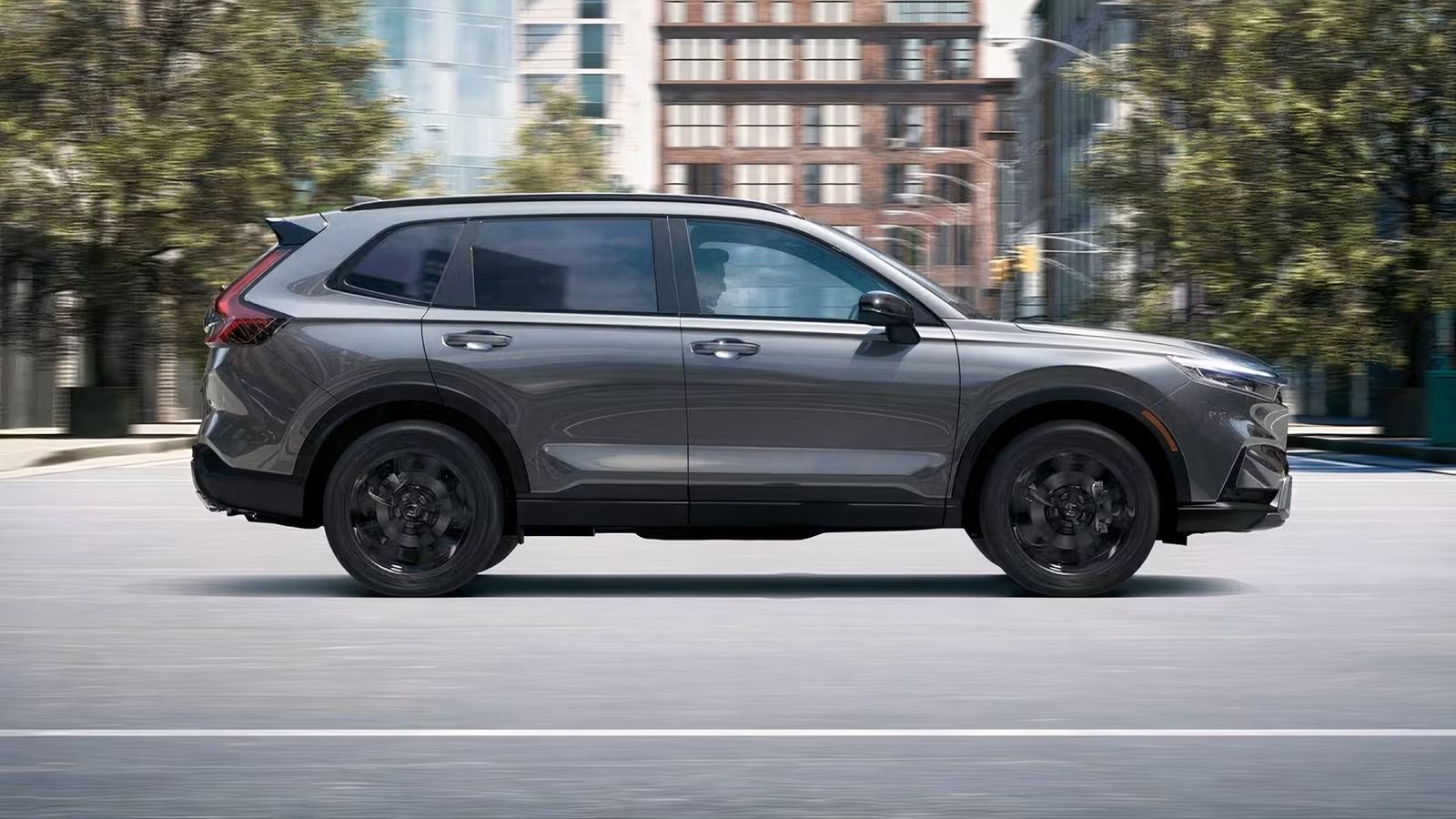
Side profile shot of a grey 2026 Honda CR-V Sport Touring Hybrid driving in the rainHonda
Don’t expect anything too sporty from the CR-V; it is made for easy road manners. That starts with the suspension, which consists of MacPherson struts up front and a multi-link rear, with amplitude-reactive dampers helping the suspension soak up smaller bumps without making the body feel loose. Agile Handling Assist brakes individual wheels when needed, and helps it turn cleaner at both low and high speeds.
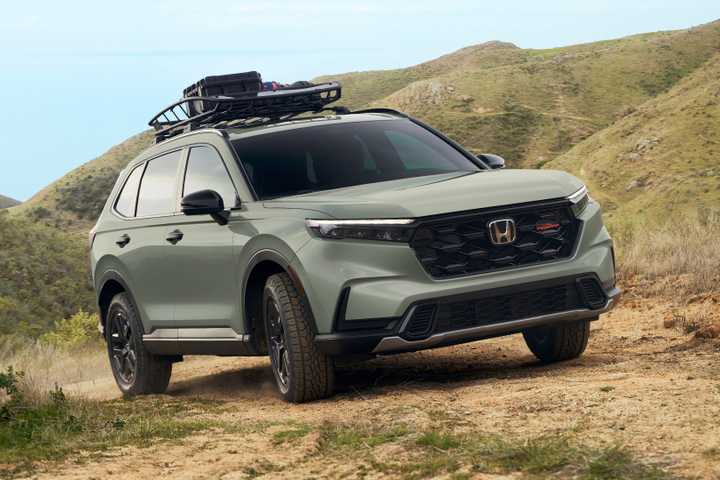
Real Time AWD also helps the CR-V stay predictable when it is wet out. The system can send extra torque to the rear when it detects the steering wheel turning, giving the front tires more traction on slippery surfaces. If you opt for the most off-road-focused variant, the CR-V TrailSport, you also get all-terrain tires and a four-mode drive system, while Sport Hybrid models get Sport mode to sharpen throttle response when you want a bit more punch. A recent TopSpeed review of the Honda CR-V TrailSport sums it up well.
Steering was crisp and responsive, with a suspension system that soaked up the bumps and stayed composed even over patches of rough pavement. Off-road, hill descent control made steep slopes a breeze, proving this SUV a family-friendly adventurer that makes getting to that remote cabin easy.
How The CR-V Beats Larger, Pricier SUVs On Storage, Longevity, And Daily Usability
2026 Honda CR-V side shot parkedTopSpeed | Michael Frank
Buying a new CR-V isn’t like buying a luxury family SUV, and it won’t tackle proper rock crawling (not even in TrailSport trim), but it gets the job done in the most sensible fashion. Everything you need is there, and you still get a nine-inch touchscreen, wireless phone connectivity, a wireless charger, available rear USB-C charging ports, an available Bose Premium Sound System, and an available 10.2-inch fully digital instrument cluster.
What makes the CR-V a very handy crossover is its size; despite having a substantial amount of space inside, it only measures in at 184.8 inches in length by 73.5 inches in width. This is especially true if you go for one of the hybrid models, making it a great city SUV. Even something like the well-regarded Lexus RX, which measures in at 192.5 inches by 75.6 inches, can only handle a maximum of 46.2 cubic feet of storage space. Yes, it is fancier, but for family life, that doesn’t always matter.
2024 Honda CR-V Hybrid Sport Touring AWDLyndon Conrad Bell | TopSpeed
iSeeCars says the expected lifespan for a Honda CR-V is 185,137 miles, or about 16 years; they also say it has a 40.3 percent chance of reaching at least 200,000 miles. Something like the larger Toyota Sequoia offers more room, has a longer shelf life (234,456 miles), and has an extra row of seats, but it does also cost nearly $66,000, as a minimum, and is massive (208.1 inches by 79.8 inches).
Where the CR-V nails it is that it understands that the best family SUVs are rarely the ones with the most stuff or the biggest footprint. It is the one that is easy to use every day and won’t cost you a fortune to keep. The CR-V fits places where larger SUVs don’t, carries what you need, can be very fuel efficient without making a fuss, and is easy to live with. It’s hard to argue against the CR-V: it gets the boring stuff just right.
Base Trim Engine
1.5L I4 Turbo
Base Trim Transmission
CVT
Base Trim Drivetrain
Front-Wheel Drive
Base Trim Horsepower
190 HP @6000 RPM
Base Trim Torque
179 lb.-ft. @ 1700 RPM
Base Trim Fuel Economy (city/highway/combined)
28/34/30 MPG
Make
Honda
Model
CR-V
Segment
Compact SUV
Sources: Honda, iSeeCars, J.D. Power, Kelley Blue Book, and FuelEconomy.gov.














No Comments