
The Harley-Davidson Powerplant That Still Sets The Reliability Benchmark
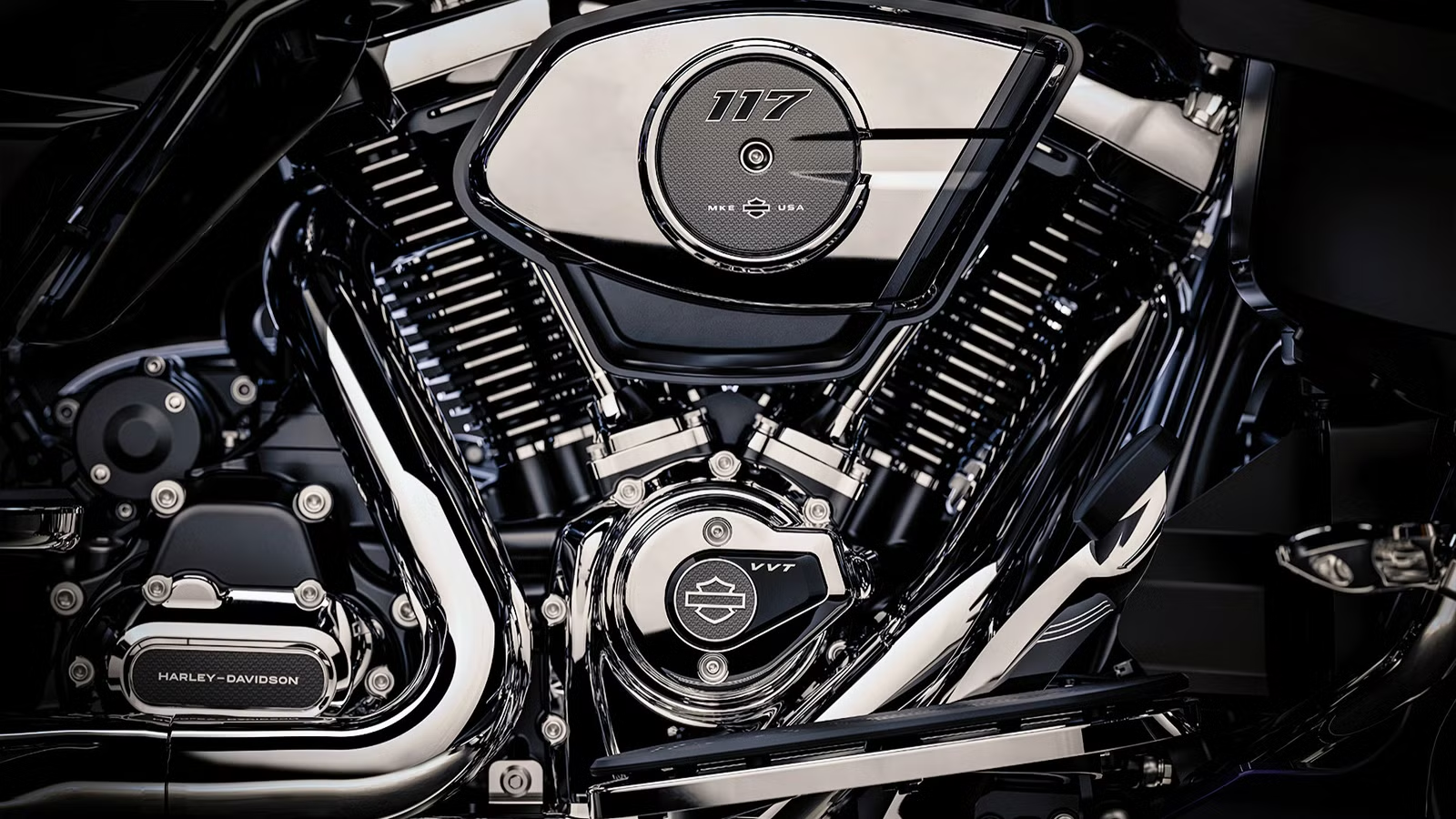
Harley-Davidson engines tend to inspire discussions about character before anything else. Torque, sound, vibration, and that unmistakable 45-degree V-twin layout have defined the brand for generations. But modern Harley ownership also depends on something less romantic: having an engine that can pile on highway miles without constantly asking for attention. One of the Motor Company’s current big twins has matured into exactly that, while also becoming the backbone of an enormous portion of its 2026 lineup.
Harley’s Modern Big Twin Had To Do More Than Make Torque

Building a modern Harley engine presents an unusual engineering problem. It has to meet increasingly strict emissions standards, produce considerably more performance than its predecessors, stay comfortable inside motorcycles designed for all-day riding, and still behave enough like a traditional Harley that longtime owners don’t reject it. Simply replacing everything familiar with an entirely different design was never going to work.
Reliability matters even more because these aren’t lightweight weekend toys. Harley’s cruisers and touring motorcycles are commonly used for long interstate trips, often loaded with luggage and a passenger. Some weigh well over 800 pounds ready to ride, and they’re expected to sit at highway speed for hours in high ambient temperatures. That’s an entirely different workload from an engine spending most of its life doing short Sunday rides.

Harley has had plenty of time to refine its current architecture, too. The Milwaukee-Eight family arrived for the 2017 model year, meaning the design is approaching a decade of mass-production experience. Early examples weren’t completely trouble-free, with oil-transfer and oil-sumping concerns becoming well-known among owners of certain models. But continued revisions have turned the platform into a considerably more mature powerplant, and today’s versions benefit from years of development.

The Milwaukee-Eight 117 Has Become Harley’s Workhorse

The engine at the center of all this is the Milwaukee-Eight 117, which has effectively become Harley-Davidson’s mainstream big-block V-twin for 2026. Its 117-cubic-inch displacement works out to 1,923cc, with a 4.075-inch bore and 4.5-inch stroke. Compression is 10.3:1, fueling is electronic, lubrication uses a pressurized dry-sump system, and power reaches the rear wheel through a six-speed transmission.
Underneath the increasingly sophisticated electronics, the recipe remains refreshingly straightforward. It’s a 45-degree, four-stroke V-twin using a single camshaft, four valves per cylinder, and dual counterbalancers. That combination lets the Milwaukee-Eight retain the low-speed character owners expect while running smoother and cooler than older generations.

The key to its reputation isn’t that nothing ever goes wrong. No mass-produced motorcycle engine can make that claim. Rather, the current 117 combines a relatively understressed state of tune with years of production development, a huge dealer and aftermarket network, and relatively conventional mechanical construction. It makes substantial torque without relying on sky-high rpm, extreme compression, or exotic components to do it.
One Displacement, Several Personalities

Harley doesn’t give every 117 the same tune. The 2026 cruiser range alone uses Classic, Custom, and High Output versions. The Classic emphasizes low-rpm response, while the Custom moves the power farther up the tachometer. The High Output tune gets more aggressive intake and exhaust hardware and is designed for riders who actually enjoy making a heavyweight cruiser hustle.
The Low Rider S provides the clearest example of what the High Output version can do. For 2026, its Milwaukee-Eight 117 High Output produces 114 horsepower at 5,000 rpm and 128 pound-feet of torque at 4,000 rpm. Those aren’t superbike numbers, but they don’t need to be in a 670-pound cruiser. The important part is how much thrust is available without having to chase the upper reaches of the tachometer.

On the opposite side of the family, the Fat Boy’s 117 Custom makes 103 horsepower at 4,800 rpm and 126 pound-feet at 3,000 rpm. Harley tunes the 117 Classic for an even more traditional torque delivery in bikes such as the Heritage Classic and Street Bob. Same basic displacement and architecture, but different intake, exhaust, and calibration choices let Harley tailor the engine to each motorcycle’s purpose.
Touring Duty Is Where The 117 Really Makes Its Case

Cruiser performance is impressive, but long-distance touring arguably tells us more about an engine’s durability. Harley’s current Street Glide uses another version of the Milwaukee-Eight 117, producing 105 horsepower at 4,600 rpm and 130 pound-feet at just 3,250 rpm. That’s enough output to move an 811-pound motorcycle, luggage, and potentially a passenger without asking the engine to spend its life anywhere near its redline.
That low-rpm workload is part of what makes the formula so compelling for longevity. A large-displacement engine producing its useful performance at modest engine speeds doesn’t need to be constantly wrung out. At highway pace, the six-speed transmission lets the V-twin settle into an easy rhythm while a five-quart oil capacity and substantial cooling hardware deal with sustained heat.

The latest Road Glide Limited pushes the concept further with the Milwaukee-Eight VVT 117. It still displaces 117 cubic inches and retains the same 4.075-inch bore, 4.5-inch stroke, and 10.3:1 compression ratio, but variable valve timing broadens its usable power delivery. In that application, output rises to 106 horsepower and 130 pound-feet. Variable valve timing adds complexity, but it also lets Harley extract stronger performance without simply resorting to more displacement or a highly stressed tune.
Maintenance Still Matters More Than The Badge

Calling an engine reliable doesn’t mean it can survive neglect. Big air- and oil-cooled V-twins generate substantial heat, and regular oil changes become particularly important when they’re used in traffic, hot climates, or sustained touring conditions. Following Harley’s scheduled maintenance, checking fluid levels, and dealing with leaks or unusual noises early still matters enormously if the goal is six-figure mileage.
The enormous aftermarket base helps here. Independent Harley specialists are everywhere in the US, parts availability is extensive, and technicians have years of experience with the Milwaukee-Eight platform. Even owners who perform their own maintenance benefit from an engine that has been produced in huge numbers and thoroughly documented by both Harley and the aftermarket.

That’s an advantage that’s difficult to represent on a spec sheet. A technically reliable engine becomes even easier to live with when parts, service information, upgrades, and experienced mechanics aren’t difficult to find. For riders planning to keep a motorcycle for ten or twenty years rather than trade it every few seasons, that support network matters almost as much as the mechanical design itself.
Harley Has More Powerful Engines, But The 117 Hits The Sweet Spot

Harley-Davidson already offers engines above the 117. The current CVO Street Glide, for example, uses a VVT 121 producing 115 horsepower and 139 pound-feet. There are faster and more exotic Harley powertrains, and performance enthusiasts can extract considerably more from the Milwaukee-Eight platform through the aftermarket.
But maximum output isn’t what makes the 117 interesting. Its appeal comes from the balance between performance, mechanical maturity, widespread parts availability, and the fact that Harley now installs versions of it across such a broad range of motorcycles. It can loaf across several states inside a fully dressed tourer, punch out of corners in a Low Rider S, or deliver relaxed low-end torque in a Heritage Classic without fundamentally changing what it is.

That’s why the Milwaukee-Eight 117 makes such a strong case as Harley-Davidson’s current reliability benchmark. It isn’t the newest or most powerful engine the company builds. Instead, it’s the evolved version of an architecture Harley has spent years refining, backed by conventional servicing requirements and an enormous support network. For an engine expected to carry big motorcycles across very big distances, that’s arguably a more useful achievement than another few horsepower.
Source: Harley-Davidson

Related posts



Latest Post


No Comments