
The Honda CRF450RL Dual-Sport Can Go Where Others Won’t
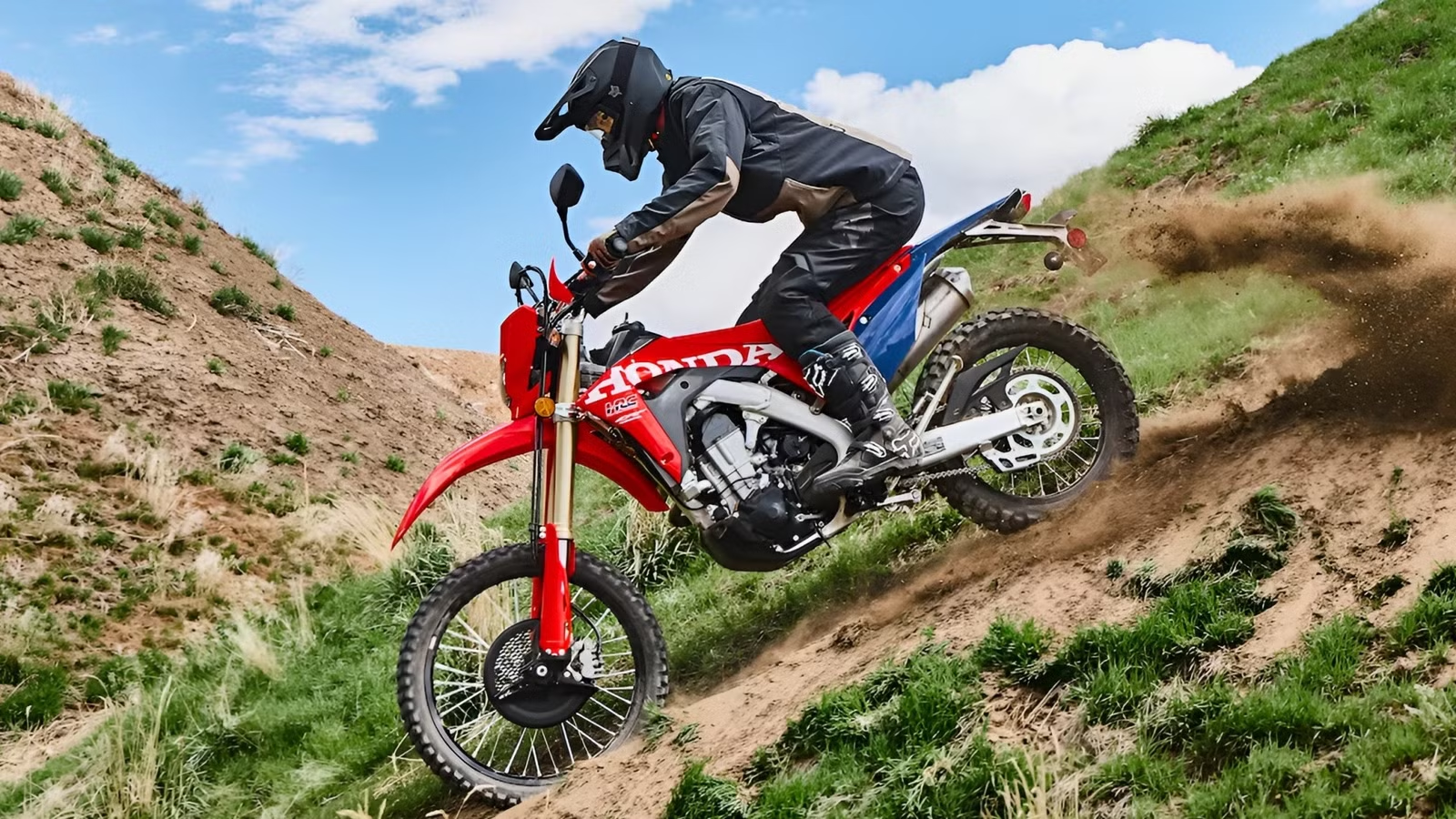
If you’ve ever hesitated at the mouth of an unknown trail, wondering whether your bike could handle what lies ahead, the Honda CRF450RL was built to silence that doubt. It’s the rare machine that makes “why not?” a perfectly reasonable answer to any road — paved, gravel, or otherwise — and it backs that promise with the kind of Japanese engineering that has kept riders moving for decades. Reliability that borders on legendary, a parts ecosystem shared with Honda’s racing lineup, and a price that won’t require a second mortgage: that’s the pitch, and the CRF450RL delivers on it.

This is the kind of motorcycle that belongs in the hands of a rider who looks at an unknown road or dirt path and thinks, “why not?” The worst that will happen is that you’ll drop the bike; all you’ll need to do is pick it up and be on your merry way. Whether it is the commute from hell or exploring a new fire road outside of town, there is one Japanese dual-sport that you absolutely must have in your garage. And it’ll go where others won’t.
The Honda CRF450RL Is Your Companion For All Trails And Terrains
Starting Price: $10,099
There was a time when Japanese bikes took the fight to everyone and came away victorious. With time, the Europeans took over the large-displacement off-road racing crown. Meanwhile, the Japanese stuck to smaller displacements. So, Honda today has a great range of dual-sport bikes, and it has managed to keep up with the competition with the CRF450RL.

It costs a shade over $10,000, offers enough performance to keep all but the most talented off-road riders happy, and it carries the Honda badge. The latter means it will be reliable no matter what you put it through. With all the other Japanese manufacturers stepping back from the 450 cc class for their dual-sport products, the Honda CRF450RL is the Japanese dual-sport motorcycle that will go where others won’t.
Why We Picked The Honda CRF450RL
- Last of the large Japanese dual-sport bikes
- Crushing off-road capability
- The peace of mind that the winged badge brings
53 Horses To Pull You Through
But Still Old School
This is a single-cylinder powerplant with liquid cooling and fuel injection. It puts out nearly 53 horsepower, which is competitive in the segment. Honda derived this engine from its racing applications, but tuned it for real-world use: you get 12 percent more crank inertia than the CRF450R, which translates to stronger low-rev pull for technical terrain. Peak torque comes in at 35.4 pound-feet at 7,000 RPM.
The engine’s output is fed through a wide-ratio six-speed gearbox and a chain to the rear wheel. The clutch is cable-actuated, and Honda says it has worked on making the pull at the lever light. But this isn’t a modern assist-and-slipper clutch, so it will feel noticeably heavier than what you’d find on a current street bike. There are no ride modes or traction control.
Honda CRF450RL Engine Specifications
|
Engine Configuration |
Single cylinder, liquid cooled, Unicam SOHC, 4 valves per cylinder |
|
Displacement |
450 cc |
|
Bore x Stroke |
96 x 62.1 mm |
|
Compression Ratio |
12.0:1 |
|
Power |
52.9 HP @ 9,000 RPM |
|
Torque |
35.4 LB-FT @ 7,000 RPM |
|
Fuel System |
PGM-FI Electronic Fuel Injection |
|
Transmission |
6 speed wide ratio manual transmission, cable actuated clutch |
|
Final Drive |
Chain drive |
Honda CRF450RL Chassis: Interesting Solutions For Refinement
But A Little On The Heavy Side

The CRF450RL uses an aluminum twin-spar frame for weight saving, and its swingarm has urethane injected into it for improved refinement on rough surfaces. This is a chassis that is, once more, derived from racing applications, but with changes for the ordinary rider to exploit. It might feel slow-steering to an experienced hand, but for someone stepping up to the 450 cc class of dual-sport bikes, it makes for an approachable and confidence-inspiring first machine at this displacement.
Suspension is provided by Showa and features adjustable rebound and compression damping at both ends. Travel is a full foot at the front and nearly a foot at the rear. The brakes use single discs at both ends but no ABS. Honda relies instead on a progressive response to keep the rider in control, with upgraded components that can stand up to a full day of hard riding.
Honda CRF450RL Chassis Specs And Dimensions
|
Chassis |
Aluminum twin-spar frame, urethane-injected swingarm |
|
Front Suspension |
49 mm Showa inverted forks, adjustable rebound and compression damping, 12 inches travel |
|
Rear Suspension |
Pro-link Showa monoshock, adjustable rebound and compression damping, 11.8 inches travel |
|
Front Tire And Wheel |
80/100 21 |
|
Rear Tire And Wheel |
120/80 18 |
|
Front Brakes |
260 mm disc, two-piston floating caliper |
|
Rear Brakes |
240 mm disc with single piston caliper |
|
Fuel Tank Capacity |
2.1 Gallons |
|
Length/Width/Height |
86.3/32.6/NA inches |
|
Wheelbase |
58.9 inches |
|
Rake |
28.5 degrees |
|
Trail |
4.8 inches |
|
Seat Height |
37.2 inches |
|
Ground Clearance |
12.6 inches |
|
Curb Weight |
289 LBs (with full tank of fuel) |
Decent Range Of Features And Accessories

A Renthal handlebar is standard equipment, and the graphics are molded into the plastics rather than applied as stickers — a practical touch for a bike you’ll inevitably lay down on the trail. The lighting is all-LED, helping conserve power, and the Li-ion battery saves weight. Flag-style handguards and a side stand that folds up and away in a very unique manner are also standard fitment.
An LCD display gives the rider the relevant information at a glance. One genuine limitation is the 2.0-gallon fuel tank — range anxiety is real on this bike, especially since it’s one of the fastest dual-sport bikes you can buy and will drink fuel accordingly when ridden hard. Thankfully, the aftermarket is extensive: because the CRF450RL shares so many components with its 450 cc siblings, you can tailor your dual-sport Honda almost exactly to your needs.
Honda CRF450RL Notable Features
- Titanium intake and exhaust valves
- Unicam engine
- Li-ion battery to reduce weight
- Flag-style handguards
- All-LED lighting
- Integrated side stand
- LCD instrumentation
It Goes Up Against Models From KTM And Husqvarna
No Other Japanese Present, So We Go European
Ordinarily, we would limit ourselves to Japanese motorcycles since this article is about a Japanese motorcycle. But the sad truth is that there isn’t a comparable Japanese motorcycle. Yes, the CRF450RL alone represents the Land of the Rising Sun in the segment. We therefore turn to the Europeans. The KTM 500 EXC-F is pretty much the king of the segment, offering more power and less weight than the Honda. If that proves a little too much, its sister model, the Husqvarna FE 501, offers a slightly softer power delivery. Both European bikes are priced significantly higher than the Honda, though.
Sources: Honda, KTM, Huaqvarna

Related posts


Latest Post



No Comments