
The 390-hp Oldsmobile Cop Sedan That Out-Accelerated A Base Porsche 911
A bench-seat four-door with acres of sheet metal should’ve been easy prey for a proper sports car. Instead, one police-spec American sedan had enough big-block power to make that assumption look properly silly.

Even better, its badge barely hinted at what was happening underneath. The real story was hidden in an option sheet where ordinary fleet hardware could be paired with one seriously overqualified V8.
When A Family Sedan Could Humiliate A Sports Car
Six seconds to 60 mph sounds pretty respectable today. In the late ’60s, getting there in a gigantic four-door sedan built for highway patrol work was ridiculous. Test figures for the hottest version of this full-size American police car put its 0-60 mph time at roughly 6 seconds, along with a claimed 120 mph top speed.

That put a car with a bench seat and plenty of chrome into acceleration territory occupied by way cooler machinery. A base Porsche 911 represented almost the opposite philosophy, trading Detroit bulk for a compact sports car body. Yet the American cop sedan could out-accelerate it, which says plenty about how much brute force was hiding beneath that otherwise drab bodywork.
Deceptive Speed

There was also the visual contrast worth highlighting. American muscle cars were supposed to announce themselves with cool trim and a reputation that arrived before the car did. This one looked like something your neighbor might’ve driven to work, right up until nearly 400 horsepower shoved several thousand pounds of full-size sedan toward the horizon.
Here, it should be clarified that the 6-second sprint and 120 mph top speed apply to the 1968 Police Apprehender configuration with the 390-hp 455. Those figures shouldn’t automatically be applied to the later version, even though Oldsmobile continued developing the same impressively excessive idea.
The Police Package Hid More Than Heavy-Duty Hardware

Dropping a huge V8 into a police car was only half the job. Highway patrol duty could mean sustained high-speed running across America’s growing interstate network, so the rest of the sedan had to tolerate punishment that ordinary family transportation would rarely experience. Horsepower was useful only if the chassis and drivetrain could survive using it.
The Police Apprehender package, therefore, went way beyond an engine upgrade. Reinforced frame components and heavy-duty suspension helped prepare the full-size sedan for pursuit work, while stronger wheels and upgraded cooling supported sustained high-speed use. The automatic transmission also received performance-oriented calibration suited to the extra demands placed on the car.
Reinforced Goodness

That transmission was the Turbo Hydra-Matic 400, one of General Motors’s heavy-duty automatics and an appropriate partner for a high-output big-block V8. The combination gave police departments something capable of cruising for long periods before suddenly being asked to accelerate hard and stay there. A flimsy driveline would’ve turned that scenario into a massively expensive shoulder stop.
It gets a bit more interesting once you factor in the package structure. By 1970, ordering the B07 Police Apprehender package didn’t automatically put the hottest engine under the hood. A B07-equipped sedan could start with a 350 two-barrel V8, so the pursuit package and the 390-hp powerplant were separate choices. The really entertaining part of the order sheet, however, was still one box away.
The W-33 Turned The Oldsmobile Delta 88 Into A 390-HP Sleeper

That box was RPO W-33, and the car was the 1970 Oldsmobile Delta 88. Selecting W-33 brought a 455 Rocket V8 rated at 390 horsepower, giving Oldsmobile’s full-size four-door one of the great sleeper-car powertrains of the American muscle era.
For a B07-equipped Delta 88, adding W-33 cost $199.05. Even allowing for 1970 money, that figure feels stupidly small given what it bought. The standard police engine could be a 350 two-barrel, while another $199.05 opened the door to 390 horsepower from 455 cubic inches. Detroit’s options sheets occasionally read like someone had forgotten to tell accounting what horsepower was worth.
W-33 was formally advertised as an RPO in 1970, while similar high-performance 455 hardware appeared within Oldsmobile’s B01 and B07 Police Apprehender programs in other years. That’s why references to the 390-hp Oldsmobile police sedan can easily blend different model years together. The 1970 Delta 88 W-33 gives the combination its clearest factory identity.
The body hiding all of this was almost hilariously conventional. The Delta 88 was a large American sedan associated far more closely with comfortable highway travel than street-racing theater. Bench seating and generous chrome did little to advertise the Rocket 455 underneath. That made the 390-hp Oldsmobile W-33 exactly what a factory sleeper should be: ordinary at a glance and increasingly suspicious once the throttle opened.
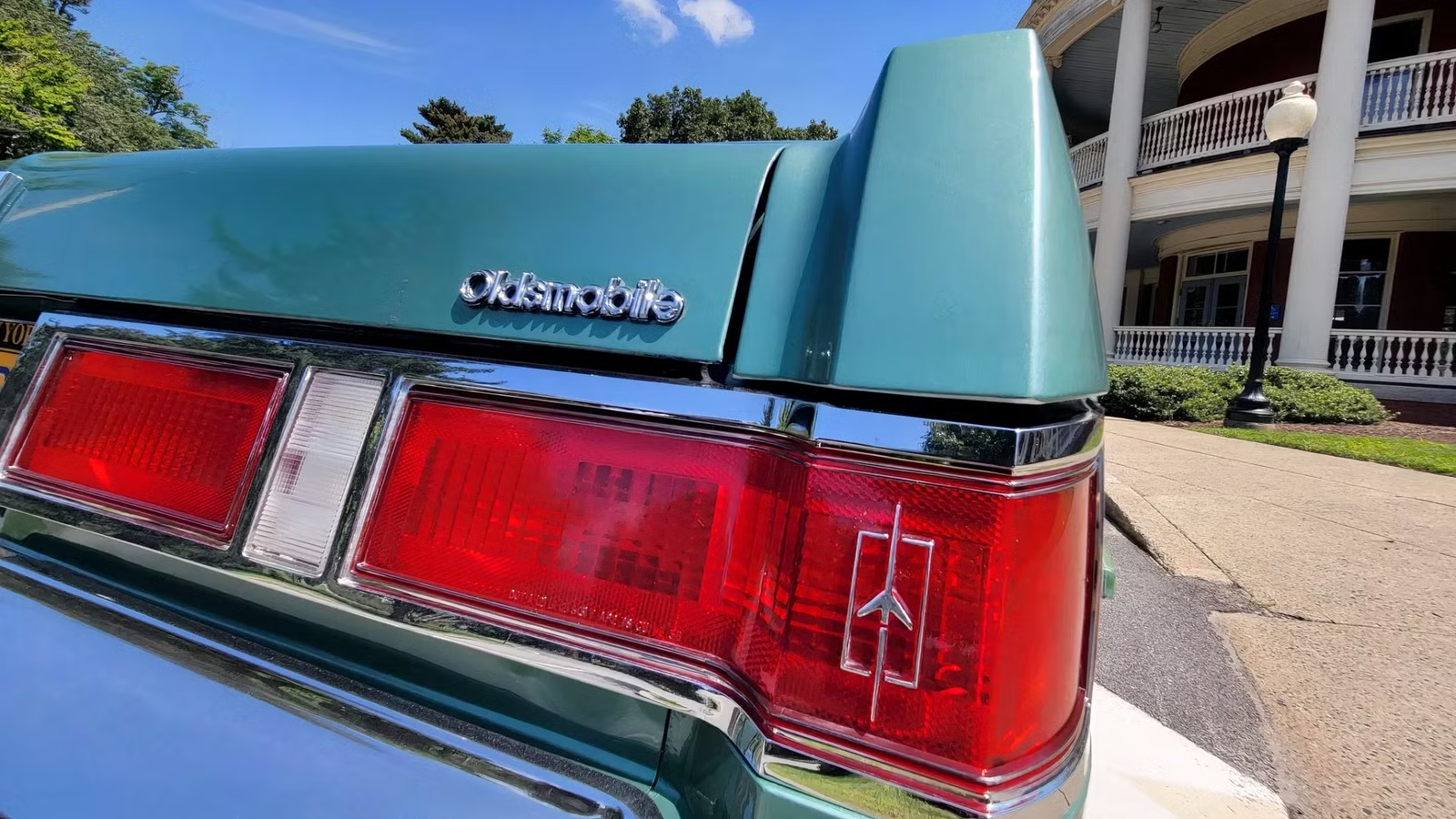
W-33-equipped Delta 88 images are difficult to source, so we’ve used images of a regular ’78 Delta 88 for representational purposes only.
Six Seconds To 60 Was Only Part Of The Trick

The famous 6-second 0-60 mph figure belongs to the earlier 1968 Apprehender, where Oldsmobile offered a 390-hp version of its 455 above the 365-hp spec. The same car carried a claimed 120 mph top speed, figures that show how seriously Oldsmobile approached the idea of a high-performance full-size police sedan.
Those numbers also make sense in the context of American highway patrol work. Police departments needed enough acceleration to catch increasingly powerful civilian cars, then enough cooling and mechanical durability to stay at elevated speeds. A 455 V8 making 390 horsepower offered a nicely straightforward solution. No replacement for displacement and all that.
A Lot Of Subtle Cubes

The 1970 Oldsmobile Delta 88 W-33 carried that philosophy into an even better sleeper package. Its full-size dimensions and restrained appearance worked against every visual cue normally associated with a classic muscle car. The car could look like ordinary transportation while packing engine output that belonged among Oldsmobile’s serious performance machinery.
That contrast is arguably more interesting than shaving another tenth from an old acceleration test. Most famous Muscle Cars tell you what they are before they move. A W-33 Delta 88 could sit unnoticed at a traffic light, looking every bit like a comfortable American four-door until 390 horsepower became relevant.
GM Kept Returning To The Same Sleeper Sedan Formula

The 1970 Oldsmobile Delta 88 W-33 also looks surprisingly important when viewed through the history of American performance sedans. Decades later, GM would again find an audience for four-door cars that mixed everyday practicality with big V8 power, most famously through machines such as the Chevrolet Impala SS and Cadillac CTS-V.
The W-33 reached a similar destination from a very different starting point. Its roots were tied to police fleets and highway pursuit work rather than a carefully developed performance sedan niche. The goal was functional speed, and the full-size body simply happened to make an outstanding disguise for the hardware underneath.
The Opening Salvo

So just another police car footnote? Hardly. The Delta 88 W-33 showed how effective GM’s sleeper sedan formula could be long before the USA had a familiar category for big, fast four-doors. Put serious V8 power into an ordinary sedan, strengthen the hardware around it, and let the bodywork keep everyone guessing.
The 390 hp Oldsmobile cop sedan may never have acquired the fame of the company’s better-known muscle cars, but that anonymity suits it. Its entire appeal came from hiding extraordinary capability inside a completely normal-looking package. Think of it as the opening chapter in the legacy of hot sleeper sedans.
Sources: Barn Finds, Consumer Guide.

Related posts

Latest Post


No Comments