
The Sport Bike For Riders Who Want Performance Without Wrist Pain
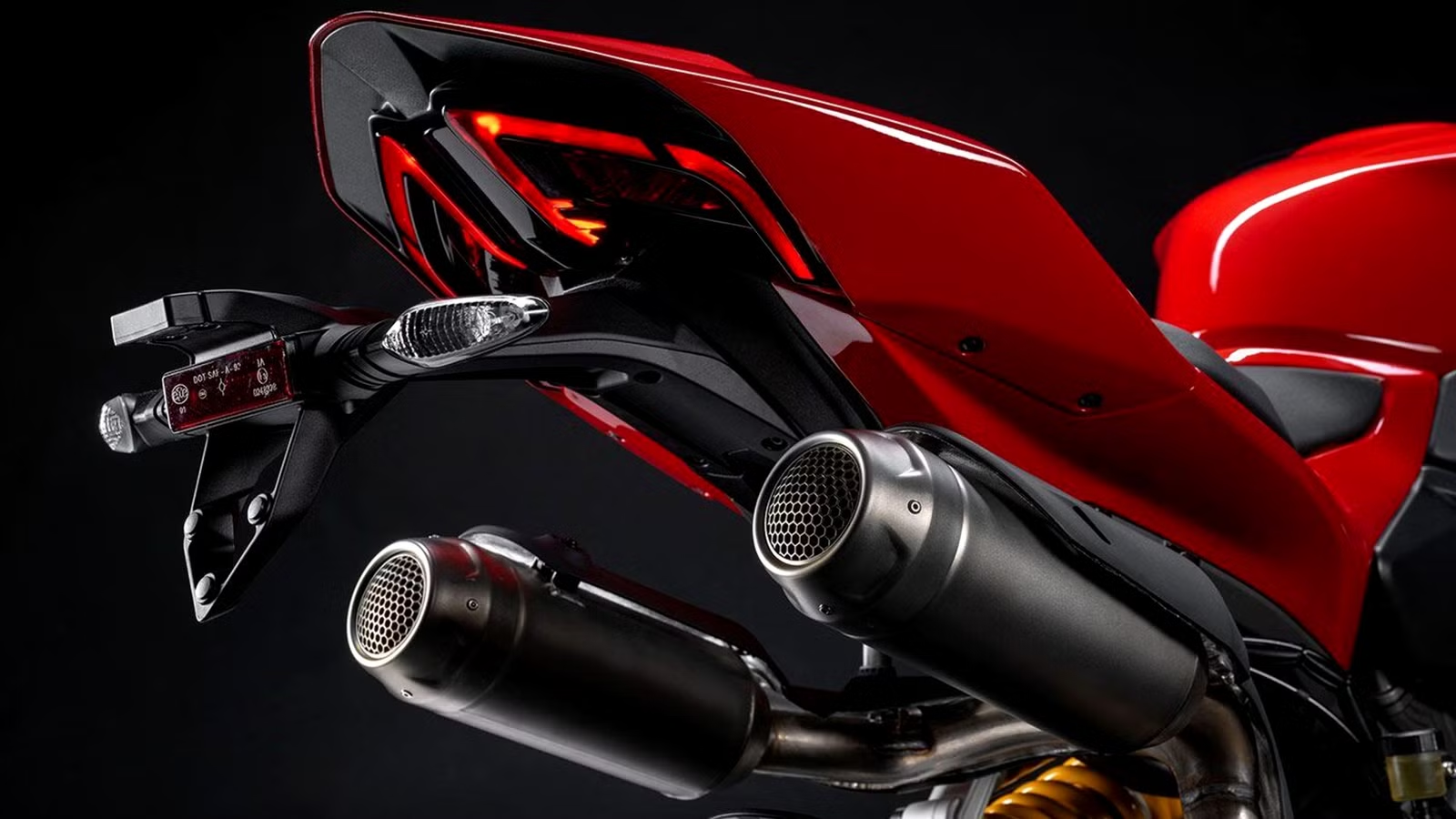
The relationship between wrist pain and sports bikes started decades ago in the 90s when track focus took center stage for these screamer, full-faired machines. Since then, this has just been a part of the sports bike experience, and interested enthusiasts have just had to accept the fatigue. In recent times, though, there’s been a big shift that has brought comfort into the picture. This is particularly evident in the middleweight segment, and if you want performance without the wrist pain, it’s the place where you will find such a sports bike. Our pick hails from Bologna.
Why Wrist Pain Is No Longer A Concern In The Midweight Sports Bike Segment

A few years ago, the midweight sports bike segment was arguably more committed than any other two-wheeler. Uncomfortable ergonomics for road use were part of the deal, as they brought razor-sharp handling with them. Then, around half a decade ago, sales died down, and brands realized the ideal midweight customer had little to do with track riding.

That marked a monumental shift in the segment, which brought comfort into the mix. Today, nearly all middleweight sports bikes follow that approach, trying to balance upright ergonomics (by sports bike standards) with sharp handling. So wrist pain has practically disappeared from this space, barring some old-school examples like the Honda CBR600RR.
Usable Performance Also Takes Center Stage

Along with that, the meaning of performance has also changed. It no longer means chasing 15,000 RPM, keeping the bike in the right rev band, or choosing screaming inline-four engines. Instead, average capacity is well over 800cc for premium middleweights, with an emphasis on low-end, usable torque for punching out of corners. That means you inevitably end up with more performance in most areas compared to an old-school supersport. The prime example of this new midweight sports bike breed comes from Italy’s leading performance bikemaker, wearing the ‘Panigale’ moniker.

The Ducati Panigale V2 Is Comfortable, Punchy, And Performance-Oriented

We’re talking about the Ducati Panigale V2. This is Ducati’s new middleweight supersport, aimed at taking on the evolved segment. Accordingly, the ergonomics are relaxed over the outgoing V2, with barely any pain points on the wrist. At the same time, the entire bike looks way less nose-heavy than anything else in the segment. In comparison, both the KTM 990 RC R and Yamaha YZF-R9 bring a more track-focused approach.

From a performance point of view, the Panigale V2 is right up with the best in the business. The 890cc V-twin engine has 120 horsepower and around 70 pound-feet, all of which is under 11,000 RPM. Ducati has also thrown in variable valve timing for an even sweeter spread of power. Thus, this is what we’d recommend if you want a midweight with ample performance and no wrist pain.
The Panigale V2’s Premium Price Buys You A Premium Package

In typical Ducati fashion, the Panigale V2 sits at the premium end of the midweight sports bike segment. The base price is $16,995, which is around $3,500 more than its direct rivals. In fact, this is even pricier than some liter-class motorcycles on sale today. That moolah does feel a bit justified when you look at the equipment on offer, though. Let’s dive into that.
Non-Desmo V-Twin Engine With Variable Valve Tech

Being an all-new platform, the Panigale V2 uses Ducati’s newest engine: an 890cc V-twin. There are no desmo valves here, and the bikemaker has instead introduced a new ‘Intake Variable Timing’ system. That is said to ensure 70 percent of the peak torque is available at just 3,000 RPM. Additionally, Ducati says this is its lightest twin-cylinder engine ever, thanks to a lot of weight saving measures here. Some include:
- Hollow valve stems
- Racing-derived lubrication system
- Thin inner walls
- Aluminum cylinder liners

As for the output, the new V-twin powerhouse is good for 120 horsepower and 69 pound-feet. The former kicks in at 10,750 RPM, while the latter peaks at 8,250 RPM. A six-speed transmission sends the power to the wheel. While we don’t know the fuel efficiency figures, we do know there’s an impressive 28,000-mile valve clearance check interval.
A Monocoque Aluminum Chassis Pairs Up With Adjustable Suspension

The innovation carries forward to the chassis department. Breaking the trellis and twin-spar setup norm of the segment, Ducati has built the Panigale V2 around an uncommon aluminum monocoque frame. It is inspired straight from the flagship Panigale V4 and works in tandem with a new aluminum dual-sided swingarm. The latter has hollow sections to save weight. Speaking of which, the extensive use of aluminum ensures a wet weight of 395 pounds (without fuel). This is topped with a compact wheelbase of 57.7 inches and a trail at 3.7 inches.

Coming to suspension, the Panigale V2 has Marzocchi 43 mm USD forks and a KYB monoshock. Both are fully adjustable and pair up with 17-inch wheels. These hoops wear Brembo 320 mm discs up top and Brembo M50 calipers, along with a 245 mm rear disc and Brembo caliper. The premiumness is upped on the V2 S version, courtesy of Ohlins NIX30 forks, an Ohlins monoshock, and lighter alloy wheels than the base bike.
Electronic Aids Are Top Notch As Well
Completing the package is an excellent set of modern technologies. This is a properly luxurious experience, starting with a five-inch TFT instrument cluster. It is Ducati’s new-gen display with an improved user interface and serves as the gateway to the extensive rider aids. Three-mode ABS, eight-level traction control, four-level wheelie control, three-level engine brake control, and multiple ride modes are all included as standard. In addition, a two-way quickshifter is included, too. Like the suspension department, the V2 S adds a few bits over this base package, such as a pit limiter, launch control, and a Li-ion battery.
Source: Ducati

Related posts



Latest Post


No Comments