
The Ghia-Styled Italian Exotic Nobody Remembers Shared The Pantera’s 351 V8
If you want to get into the higher echelons of classic car ownership — the ones where people wear blazers and baseball caps and debate design language on the Concept Lawn — you really need one type of car. It needs to be rare, preferably fairly unknown, and usually Italian. Only then can you opine about your preferred design, and discuss the best ways to keep less than 100 miles on the odometer of a 60-year-old car.

The problem is, as anyone who has read a Classic Cars mag will attest, that getting into the rare Italian sports car world requires a lot of money. Generally, it helps if you own the rights to the back catalog of a global space rock band, that kind of thing. But that’s not strictly true. There is one Ghia-designed exotic that is somehow all but forgotten, and it’s rarer than most iconic Italian sports cars. But what exactly is it?
 26 autotech
The Sports Car That Depreciates Faster Than Any Other Model
This Italian GT is considered the poster child of the fastest sports car, but in terms of depreciation.
Rare Italian Exotics Are The Holy Grail For Collectors

Yes, there is no denying that the original AC Cobras and Mustang GT350 Convertibles of this world are exquisite classics, but for many collectors, the most prestigious exotic cars come from Italy. There is a certain passion and style that comes from the country’s carmakers passion and style, but generally, Italian sports cars are a thing of beauty. Everything from a Ferrari GTO (just 36 made) to a Pagani Huayra Tricolore (limited to three units) captures the imagination like little else, with prices to match. In 2023, a 1962 Ferrari 330 LM / 250 GTO sold for $51.7M, making it one of the most expensive cars to ever be sold at auction. But is there a way into ultra-rare Italian classics without being a tech billionaire? Turns out there is…
De Tomaso Blended Italian Looks With American Power

Alejandro De Tomaso was an Argentine racing driver with family roots that led back to Naples. He founded his eponymous company in 1959 with the goal of creating high-performance sports cars that mixed the romance of Italian styling with precision engineering. The first mass-produced road car was the Mangusta of 1966, which was powered by a 4.7-liter Ford V8 engine. Then came the Pantera, which was fitted with a 310 hp, 5.8-liter “Cleveland” V8 mated to a 5-speed ZF transaxle. The car was backed by Ford and destined to be sold in Lincoln-Mercury dealerships across America.
The blend of American power and Ghia styling made the Pantera a svelte exotic, but it was still very much an uncompromising Italian supercar, complete with the expected fit and finish. But what if De Tomaso could make something that looked like the American muscle cars of the ’60s golden era, but with an Italian twist?
10 Gorgeous Classic Cars From The ’60s That Are Now Dirt Cheap
These stunning classics from the ’60s prove you don’t need deep pockets to own a piece of vintage automotive style—each for under $20K!
The Longchamp Is A Forgotten Italian Muscle Car

Before we get to the Longchamp, it is important to mention the De Tomaso Deauville, a four-door muscle car of sorts that had strong links to America and Ford. Ford boss Lee Iacocca joined forces with Alejandro De Tomaso to create a luxury sports sedan in the mold of the Jaguar XJ. The car was designed by stylist Tom Tjaarda and had the Ford-sourced ‘Cleveland’ push-rod cast-iron 5.8-liter V8 in its nose.
The car was unveiled in 1970, and work quickly began on the Longchamp, a two-door named after a Parisian horse racing course. Tom Tjaarda styled the car while working with Ghia, and the two-door coupe used the Deauville’s platform as its base. The Longchamp made its debut two years later. The car drew influences from the Aston Martin DBS V8 and Jensen Interceptor, but its squared-off, bluff lines also seemed to celebrate ’60s muscle cars like the iconic Plymouth ‘Cuda. The Mercedes-Benz 450SLC, which launched in 1971, seemed like an obvious competitor too. The question was whether De Tomaso could launch the Longchamp into the mainstream.
The Longchamp Is A Supercar With A GT Body

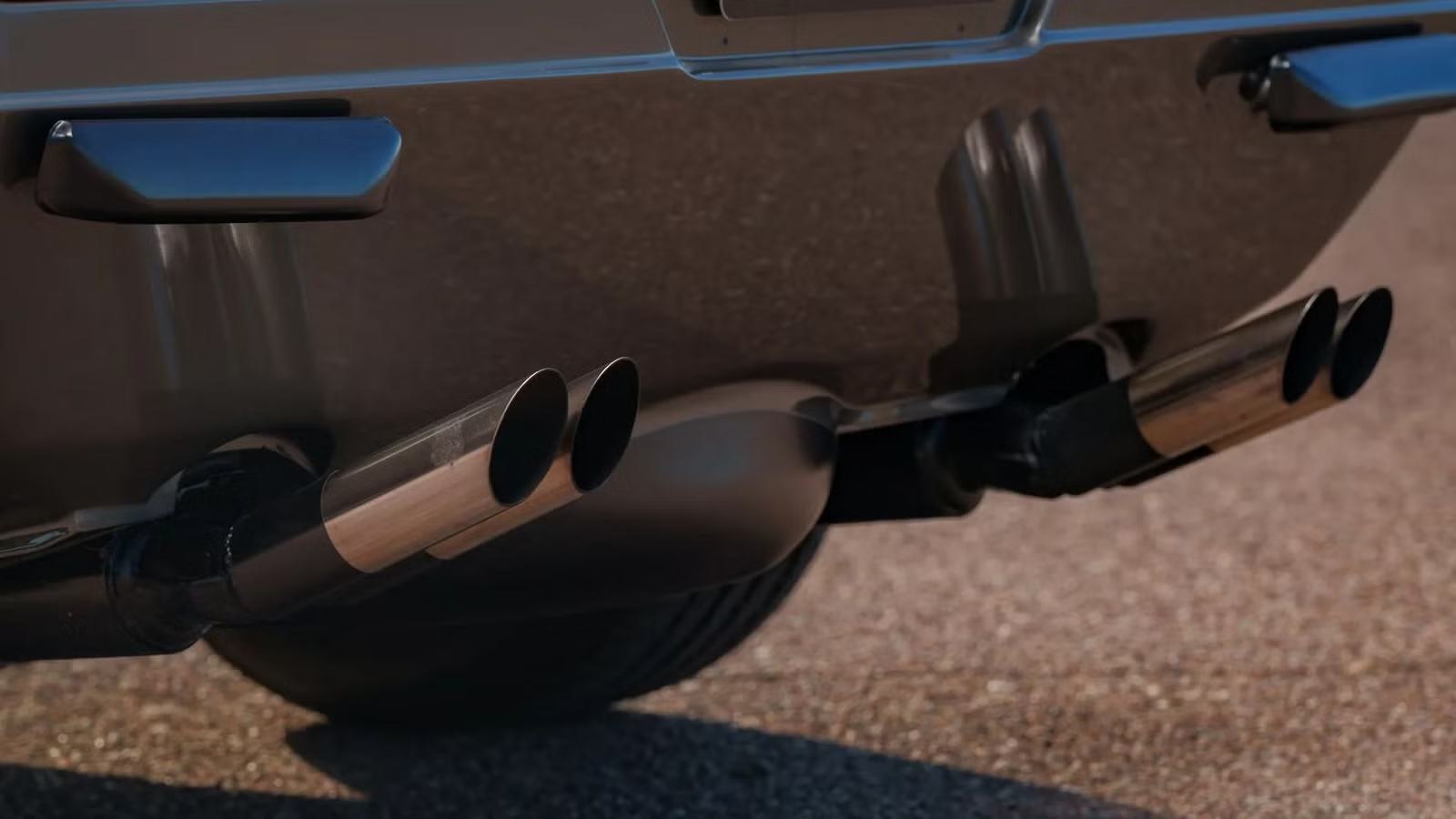
The Longchamp sat on a ladder chassis that had been developed by ex-Lamborghini maestro Gian Paolo Dallara, with independent suspension all round. Under the hood was the Cleveland V8, but whereas this engine had 275 hp in the Deauville, the Longchamp boasted 330 hp.
De Tomaso Longchamp Engine Specs
|
Displacement |
Power |
Torque |
|
351 Cubic Inches |
330 HP |
340 LB-FT |
Most importantly, this was the same engine and output as was fitted in the middle of the Pantera supercar, so Longchamp owners got the same output, albeit with the kind of interior that looked like a Hollywood director’s man cave. There was leather everywhere, with splashes of chrome and wood, and dials that looked better suited to a ’70s superyacht. There were electric windows and a tilt steering column, as well as dual gas tanks. This added to the sense of transcontinental GT touring, but in reality was a useful answer to the car’s likely 12 mpg.
This Was The World’s Most Expensive Car In The ’60s
Widely considered the world’s most important, desirable, and legendary car, this ’60s classic is valued at over $70 million today.
The Longchamp Makes Other Italian Exotics Seem Common

Returning to the point about rare Italian classics, none come much rarer than a Longchamp. Well, a specific couple of versions at least. Most Series 1 cars left the factory with a three-speed Ford automatic transmission, but then there were just 17 cars fitted with a ZF five-speed manual gearbox, says Hagerty. That’s almost as rare as a Ferrari 365 California, and that’s a $4M car. Unfortunately, the Longchamp was a victim of poor timing. The car was effectively launched at the exact moment the muscle car was killed off by an oil crisis, and not many people wanted a 330-horsepower V8 two-door.
De Tomaso Made Several Versions Of The Longchamp

The Series II Longchamp arrived in 1980, and a Spyder drop-top was also offered through Pavesi. The 1985 GTS/E was a sportier version launched towards the end of production. Although an exact figure is hard to find, Hagerty says that just 395 Longchamp coupes were built and about 14 Spyders. That means those convertibles are as rare as a 365 California. But are they as valuable?
The Italian Muscle Car That Mixed Big Block Chevy Power With Ferrari Style
Beneath its sculpted Italian exterior lies an unexpected American heart. Discover the bold machine that rewrote the rules of grand touring.
The Longchamp Is A Lot Cheaper Than You Might Expect

No. Not by a long shot. A 1985 De Tomaso Longchamp GTS, which came with pumped-out wheel arches that made it look like a street version of the Ken Block Hoonicorn RTR, has a good condition price of just $35,000, according to Hagerty’s Valuation Tools. A 1976 Longchamp Spyder, which looks suspiciously like a Euro-spec Ford Granada (they share the same headlights), sold for just $77,007 in 2024 on Bring a Trailer.
A handsome GTS-specification 1974 De Tomaso Longchamp, which appeared to have been later fitted with a 5-speed manual, fetched $117,500. Yes, the Longchamp doesn’t have the sinuous lines of an Italian supercar or the brutish looks of a ’60s American muscle car, but if you want something in between that is rare and unusual, then it’s worth a look.
Sources: Hagerty

Related posts





Latest Post


No Comments