
The Sports Sedan With Acura Reliability And M-Car Handling
German automakers have long dominated the luxury game with their unrivaled refinement and superb handling characteristics. However, they have repeatedly failed to master the art of longevity. Complex electronics have yet to be properly ironed out, and engineers never seemed to consider the idea of owners skipping oil changes. Japanese automakers, meanwhile, happen to offer exactly what the Germans don’t. A Lexus is designed to keep running in the face of neglect, and an Acura can easily make it to the 200,000-mile mark without a single complaint.

When it comes to performance cars in particular, high output figures and electronically-assisted suspensions often come at the cost of durability. Owners must be quick to trade them in before the warranty expires, or else that complex machine will fall apart in their hands. But if that performance car comes from Japan, it is much more likely to offer the best of both worlds, and there is one sedan that effortlessly delivers respectable performance while preserving the robust nature of its Acura internals.
When Honda Decided to Challenge the Germans
With Honda’s reliability reputation successfully solidified in the U.S. by the late 1980s, the automaker decided that it needed to expand this formula to a lower-volume, higher-end corner of the market. While BMW and Mercedes had traditionally dominated this area of the automotive industry, Acura officially entered the scene in 1986 to steal market share from the Germans while outlasting them by thousands of miles. The brand was also driven by the Voluntary Export Restraints imposed on Japanese automakers at the time, which capped the amount of U.S. exports in pursuit of higher margins, meaning that smaller numbers of pricier, more luxurious vehicles was a favorable idea.

When Acura was first released into the wild, its showroom floors were graced with the sporty Integra alongside the larger and cushier Legend, both of which were offered as either a four-door sedan or a two-door coupe. Both models debuted the brand’s philosophy of blending sharp performance with luxury, and Americans were enamored. Acura became the best-selling import luxury performance brand in the U.S. within just one year of its launch.
Ultimately, Honda’s idea successfully proved that a Japanese automaker could make significant waves in the luxury segment. Toyota and Nissan quickly followed suit in 1989 with the debut of their respective Lexus and Infiniti brands.

Acura Once Built A High-Revving Coupe That Slipped Through The Cracks
While iconic JDM cars fetch six figures, this overlooked Acura coupe with a screaming VTEC redline can still be had for around $12,000.
Acura TLX Type S: A Well-Rounded Performance Sedan

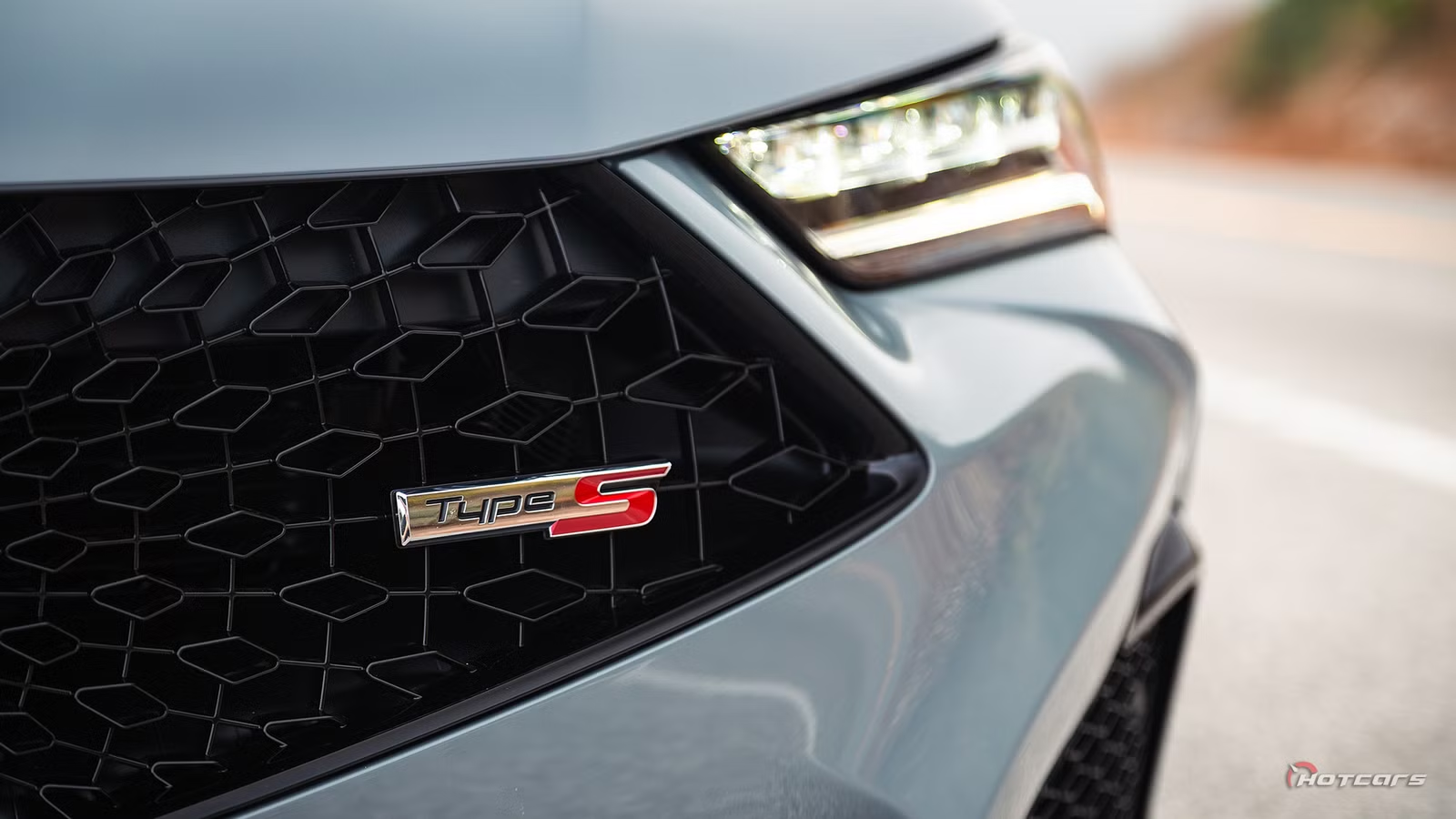
Forty years after Acura’s debut, the TLX Type S carries on its original philosophy, balancing proper speed and handling with signature Honda reliability. Built on an exclusive platform engineered specifically for an Acura midsize sedan, the second-generation TLX successfully avoids overstepping the more humdrum Honda Accord. It benefits from a double-wishbone front suspension, increased structural rigidity, and a completely bespoke 3.0-liter turbocharged V6 for the Type S model. To complement this setup, Acura fitted the Type S with massive four-piston Brembo brakes up front and an electro-servo brake-by-wire setup originating from the NSX supercar. The sedan also remains stable through hard cornering thanks to its adaptive damper system, which also extends to a more comfortable experience during the daily commute.
|
Car |
Power |
Torque |
0-60 MPH |
|
Acura TLX Type S |
355 hp |
354 lb-ft |
4.8 seconds |
|
BMW M340i (G20) |
386 hp |
398 lb-ft |
4.0 seconds |
With nearly every aspect of the TLX built from the ground up, it is no surprise that the Type S delivers crisp turn-in, a compliant ride, and engaging handling to seriously rival the BMW M340i. However, this Acura is anything but a BMW clone. In fact, it manages to set itself apart with all-wheel drive reassurance in rough weather conditions, as well as a far more generous list of standard features in typical Honda fashion.

Why The Acura TLX Type S Is One Of Today’s Most Overlooked Sport Sedans
This overlooked performance sedan ends production in 2025, despite offering 355-hp turbocharged V6 power and advanced all-wheel drive.
How SH-AWD Gives the Type S an Edge

BMW is widely revered for its long-standing tradition of equipping its vehicles with a rear-wheel drive layout, which pushes drivers through corners and creates unrivaled balance with the front-mounted engine. While the TLX Type S still routes power to the front wheels in addition to the rear, there is more to Acura’s SH-AWD system than meets the eye. It is not engineered solely for all-weather traction, and Acura does not simply split power evenly between the front and the rear. Instead, power is split between the left and right wheels, which allows the vehicle to overdrive only the outside rear wheel during turns. The result is the same pushy sensation around corners as a BMW.
In a straight line, the TLX goes back to reaping the traditional efficiency benefits of a front-biased drivetrain while cruising, but it instantly shifts increased amounts of power to the rear during harder acceleration. This allows for remarkable launch traction, a stark contrast from the standard rear-wheel drive BMW M340i, which can easily struggle to find grip and spin its tires in particularly slippery conditions.
Turbo V6 Performance That Doesn’t Disappoint

At the heart of the TLX Type S sits its fully exclusive 3.0-liter turbocharged V6 engine. Since it was developed specifically for Acura’s dedicated performance sedan, it manages to push out 355 horsepower and 354 lb-ft of torque. You don’t even need a track to experience the full grunt of the Type S, as full torque arrives at a low 1,400 rpm, providing satisfying passing power and removing the need for excessive downshifts from the sedan’s ten-speed automatic.
The combination of immense low-end torque and the SH-AWD system allows the Type S to propel itself from 0 to 60 mph in a swift 4.8 seconds, and it takes just 13.3 seconds to reach the quarter-mile mark. While this doesn’t exactly leave the M340i in the dust, as the BMW is undoubtedly quicker, the TLX Type S pulls ahead with its durable Honda roots. Maintenance costs are generally much lower even in spite of its bespoke platform, thanks to Honda’s consistently robust engineering practices. Acura also charges much less for routine oil changes and tire rotations than specialized German mechanics.
Acura Cancels TLX Sedan, Is One Step Away From Becoming An SUV-Only Brand
The automaker blames dwindling sales for the demise of the TLX, but you know the market’s appetite for SUVs and crossovers is the real culprit.
Why The TLX Type S Is Worth Considering

While the TLX model line as a whole was retired last year, there are plenty of Type S examples left on the used market. Clean examples with lower mileage tend to remain closer to the $50,000 mark, while higher mileage brings prices down to around $40,000. On the other hand, a clean, lightly used BMW M340i occupies the same price point, with low-mileage examples priced slightly over $50,000, and clean higher-mileage examples climbing toward $40,000, but never below it.
As a result, buyers are given the choice between a traditional, rear-wheel drive BMW and a lesser-known, all-wheel drive Acura for a nearly identical price tag. While the BMW roundel may seem tempting, the dependable Honda engineering found in the Type S might be well worth giving up the German badge.
Sources: Acura, BMW

Related posts
Latest Post


No Comments