
The 227-HP AWD Homologation Hatch Priced Below A Delta Integrale
The late 1980s and early 1990s are widely remembered as a golden age of motorsport. In the World Rally Championship (WRC), manufacturers were forced to abide by a strict rule: if you wanted to race a high-performance rally machine, you had to sell a highly similar version to the public first. This gave rise to some of the greatest Group A homologation rally cars that rewrote the rules of performance. Yet, tucked away in the shadows was a hatchback that possessed the qualities of all great rally cars but at a fraction of the cost of its European rivals, both then and now.
Group A Rally Created Some Of The Greatest Road Cars Ever

To understand how this pocket rocket came to be, we have to take a look at the transition of the World Rally Championship in 1987. Following the sudden ban of the dangerously fast, lightweight Group B “monsters” due to safety concerns, the FIA pivoted to Group A. Under Group A regulations, manufacturers were required to build at least 5,000 road-going examples (later reduced to 2,500) of their rally cars.
This meant that the engineering used to develop these cars for brutal stage rallying had to make it into cars sitting on dealership floors. For the first time, average consumers could walk into a showroom and buy a vehicle with a competition-ready chassis, a heavy-duty drivetrain, and a turbocharged engine. Among these are legendary machines like the Lancia Delta Integrale, the Ford Escort RS Cosworth, and the Subaru Impreza 555 that have risen to near-mythical status, commanding eye-watering prices on the collector market today.
All-Wheel Drive Cars Dominated

Initially, manufacturers tried to compete with rear-wheel drive or front-wheel drive setups, but the moment all-wheel drive (AWD) took center stage, the landscape changed forever. Lancia pioneered this shift with the iconic HF 4WD, which evolved into the legendary Lancia Delta HF Integrale. With power sent to all four wheels, the Integrale found traction where others spun their tires in vain, racking up six consecutive manufacturers’ titles from 1987 to 1992.

Seeing Lancia’s runaway success, other brands rushed to develop their own all-wheel-drive systems. Toyota had the Celica GT-Four, Mitsubishi launched the early Galant VR-4 (which paved the way for the Lancer Evolution), and Ford countered with the Sierra and Escort RS Cosworths. Traction was no longer an afterthought; it was a key part of winning.
Nissan Needed A Compact AWD Weapon

By the dawn of the 1990s, Nissan wanted a piece of this action. While they had tasted success in endurance safari rallies in the 1970s and 1980s with larger platforms, they needed a nimble, lightweight weapon capable of tackling the tight, twisting tarmac and gravel stages of European rallies.
Nissan looked at the dominance of Lancia’s compact Delta Integrale and realized that their massive R32 GT-R, despite its engineering brilliance, was simply too big and heavy to be an agile WRC contender. They needed something smaller, lighter, and sharper. The goal was simple: engineer a compact, high-performance, all-wheel-drive hatchback that could challenge the absolute best from Lancia, Toyota, Subaru, Mitsubishi, and Ford.
It Was Built Purely To Satisfy Group A Homologation

To meet the FIA’s homologation quota, Nissan took a humble, mass-market commuter chassis and systematically re-engineered it into a street-legal rally weapon. The development timeline was fast, running from the late 1980s to its official launch in 1990. Every design decision on this vehicle was dictated by the Group A rulebook. If the rally team wanted massive cooling vents, a giant rear wing, or a robust mechanical all-wheel-drive system on the rally stages, the production car had them. It was a pure homologation special, built not because Nissan thought it would be a big seller, but because its existence was the only way Nissan could participate in the WRC.
The Nissan Pulsar GTI-R Was One Of The Fastest Hot Hatches Of Its Era

In 1990, Nissan unveiled their creation to the world: the Nissan Pulsar GTI-R (designated chassis code RNN14). Based on the standard three-door Pulsar, also known as the Nissan Sunny (Europe) hatchback, the GTI-R looked like it had been sent to a military boot camp. Nissan replaced the standard hood with an aggressive, heavily vented one dominated by a massive hood scoop. At the rear sat a prominent, rally-style roof spoiler. These weren’t just cosmetic add-ons; they were functional aerodynamic and cooling parts.
While a standard hot hatch of the era, like the Volkswagen Golf GTI, was pushing around 130 horsepower to the front wheels, the Pulsar GTI-R made a staggering 227 hp and 210 lb-ft of torque from a turbocharged four-cylinder with power to all four wheels. No one expected Nissan to build this, and it was a serious performer, sprinting from 0 to 60 mph in just over 5 seconds — a figure that put it in direct competition with contemporary Porsche 911s and Ferrari 348s, let alone its hot-hatch peers.
It Was Built To Win

Beneath the aggressive bodywork sat an engineering masterpiece. The engine was the legendary 2.0-liter SR20DET, which also powered the Nissan S Cars (S13, S14, S15). However, this wasn’t the standard SR20DET found in the rear-wheel-drive Silvia. This specific engine had unique, motorsport-derived individual throttle bodies (ITBs), a reinforced block, and a high-flowing Garrett T28 turbocharger.
All 227 hp and 210 lb-ft of torque made it to the pavement using Nissan’s proprietary ATTESA (Advanced Total Traction Engineering System for All-Terrain) all-wheel-drive system, featuring a viscous coupling center differential and a limited-slip rear differential. At just under 2,700 pounds, the Pulsar GTI-R had a phenomenal power-to-weight ratio. It was lighter than almost all of its WRC road-going competitors, giving it an immediate edge in agility and response on tight B-roads.
Why Nissan’s WRC Program Failed

Despite its formidable specs on paper, the Pulsar GTI-R’s official WRC campaign (spanning 1991 and 1992) was plagued with issues. Nissan had a factory-backed team under the name Nissan Motorsport Europe (NME). The very trait that made it an exceptional road car — its compact size — became its Achilles’ heel on grueling rally stages. The primary issue was heat management. The engine bay was packed so tightly with the AWD system and the SR20DET that there was almost no room for air to circulate. Worse, the top-mounted intercooler sat directly above the scorching hot engine. At sustained rally speeds, the intercooler suffered from severe heat soak, drastically reducing engine power and efficiency.
Additionally, the physical limitations of the small chassis restricted suspension travel and limited the size of the wheels and brakes the team could run. Despite having the driving talents of rally legends like Stig Blomqvist and Tommi Mäkinen, the GTI-R only managed a best 3rd-place finish at the 1992 Swedish Rally before Nissan pulled the plug on the program.
Failure In Rally Didn’t Mean Failure On The Road

While the Pulsar GTI-R struggled under the extreme stress of WRC stages, it was an absolute blast on public roads. Free from the endless, punishing heat cycles of desert and gravel rally stages, the road-going GTI-R proved to be incredibly durable, highly reliable, and unbelievably fast.
Enthusiasts also knew that the SR20DET engine was highly receptive to modifications. With simple upgrades to the exhaust, intake, and boost pressure, the “Baby GT-R” engine could easily push past 300 hp on stock internals. Its mechanical ATTESA AWD system offered relentless grip, making it very capable of maintaining blistering pace in wet or slippery conditions. Over the years, this sheer capability has earned the Pulsar GTI-R a dedicated cult following.
It’s One Of The Biggest Bargains Among Homologation Legends Today

As the years have passed, the market for 1990s homologation specials has exploded. Lancia Delta Integrales (especially the late-model Evoluzione I and II variants) regularly command prices well north of $80,000, sometimes crossing into six-figure territory. The Ford Escort RS Cosworth has followed a similar trajectory.
Yet, the Nissan Pulsar GTI-R remains incredibly attainable. With a median market value sitting around $20,000 to $35,000 depending on condition and trim, it offers the exact same mechanical pedigree, rarer production numbers (around 14,000 were built in total), and equal performance for a fraction of the cost.
Enthusiasts Finally Appreciate What Nissan Built

Today, the Pulsar GTI-R is finally stepping out of the shadows. The rising tide of JDM culture, combined with the US 25-year import rule, has introduced this pocket rocket to a global audience of collectors and driving enthusiasts. Those who have had the opportunity to drive them quickly realize that the GTI-R offers a raw, mechanical driving experience that modern performance hatchbacks simply cannot replicate.
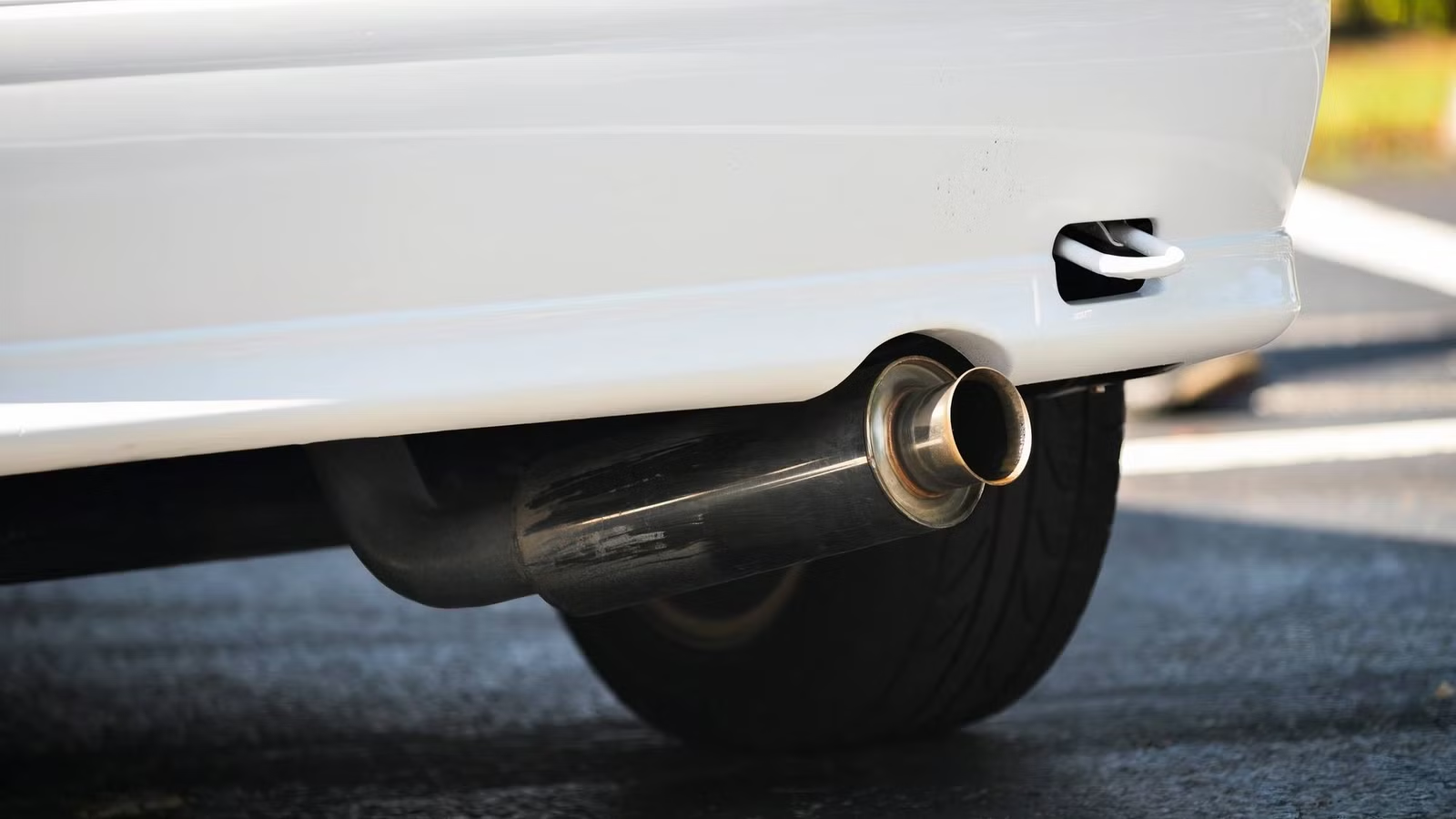
With its distinctive hood scoop, the mechanical whine of its AWD system, and the aggressive growl of its ITB-equipped SR20DET, the Pulsar GTI-R stands as a testament to an era when manufacturers built wild, highly compromised but brilliant cars simply because the rulebook said they had to. For anyone looking to own a genuine piece of Group A history without paying the massive “European premium,” Nissan’s compact weapon is the ultimate bargain.
Sources: Nissan, Classic.com, The Classic Valuer,

Related posts

Latest Post


No Comments